Topic 1.7 Notes – Rational Functions and End Behavior
What Rational Function End Behavior Is
A rational function has the form
where and are polynomials and .
End behavior means what happens as and as . That is different from what happens at specific finite -values like holes or vertical asymptotes. Those matter elsewhere on the graph, but they do not decide the ends.
Here’s the key reason this works. For very large positive or negative , a polynomial is controlled by its leading term.
If
then the end behavior comes from
So you are comparing degrees and leading coefficients, not every term.
If the numerator is the zero polynomial, then on its domain, so both end limits are .
The Three Degree Cases
Everything comes from comparing the degree of the numerator, , to the degree of the denominator, .
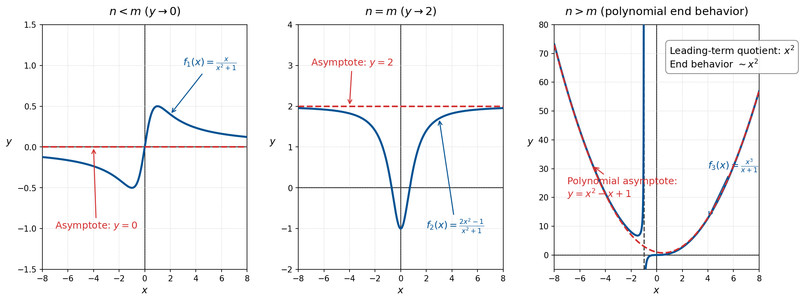
This side-by-side example is a good quick check of what each case looks like at the ends.
If
The denominator grows faster, so the whole fraction goes to .The graph has a horizontal asymptote at .
If
The powers match, so they cancel in the leading-term quotient. The result is the ratio of leading coefficients.Horizontal asymptote:
If
The numerator grows faster. The end behavior matches the polynomialThere is no horizontal asymptote. In the third graph, the curve follows a quadratic end behavior, which is exactly what you expect when .
When the Graph Has Slant or Polynomial End Behavior
The most tested special case is when the numerator degree is exactly one more than the denominator degree.
Slant asymptote
If , then the end behavior is linear, so the graph has a slant asymptote.
The quotient of leading terms gives the slope. If the leading-term quotient is , the slant asymptote is parallel to a line with slope . But that does not usually give the exact -intercept.
To find the exact slant asymptote, use polynomial division:
- Divide numerator by denominator.
- Write the function as quotient remainder term.
- The remainder term goes to , so the quotient line is the asymptote.
Example:
Since , the slant asymptote is .
Higher-degree polynomial end behavior
If , the ends follow a quadratic, cubic, or higher-degree pattern instead of a line.
How to Determine End Behavior from an Equation
Use the same routine every time:
- Identify the numerator and denominator.
- Find each degree and leading coefficient.
- Write the quotient of leading terms.
- Compare degrees.
- State the asymptote or polynomial-like end behavior.
- Give both limits.
For , use the sign and parity of :
- even power, positive coefficient both ends up
- even power, negative coefficient both ends down
- odd power, positive coefficient left down, right up
- odd power, negative coefficient left up, right down
Horizontal Asymptotes and Common Mistakes
A horizontal asymptote means the outputs get arbitrarily close to as goes to , , or both.
One quick reminder before the common mistakes list. A graph can cross a horizontal asymptote, and it can also cross a slant asymptote. The asymptote describes end behavior, not what the graph must do at every finite -value.
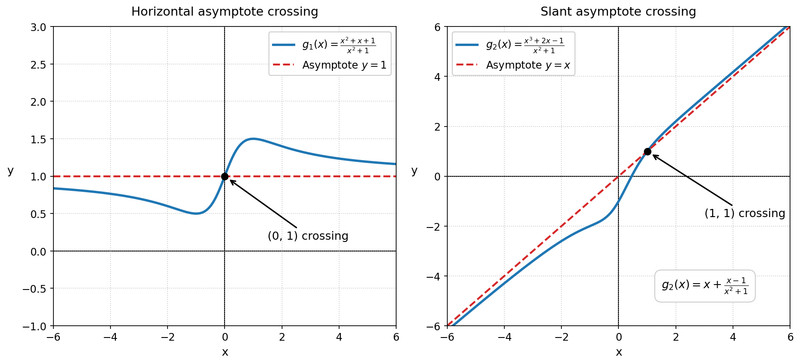
Crossing horizontal and slant asymptotes
Two easy mistakes show up a lot:
- using all terms instead of only the leading terms
- saying equal degrees always gives , when it is actually the ratio of leading coefficients
- forgetting that polynomial-like end behavior can be different on the left and right
- mixing up end behavior with behavior near vertical asymptotes or holes
- calling it a slant asymptote anytime , when it only happens if
