Topic 1.12 Notes – Transformations of Functions
What Function Transformations Do
A transformation makes a new function from an original function . Sometimes is a parent function like or , but the rules work for any original function.
- The preimage is the set of original points on .
- The image is the set of transformed points on .
The rule that organizes everything is this:
- Outside the function changes outputs vertical changes
- Inside the function changes inputs horizontal changes
That is why horizontal changes feel backward. You are changing the input needed to get the same output.
The standard combined form is
Here is what each part does:
- changes outputs
- vertical stretch/compression by
- reflect over the -axis if
- changes inputs
- horizontal scale factor is
- reflect over the -axis if
- shifts right
- shifts up
This graph gives you a quick preview of those ideas using the parent function . You can see an outside change move the graph up or stretch it vertically, and an inside change shift it horizontally.
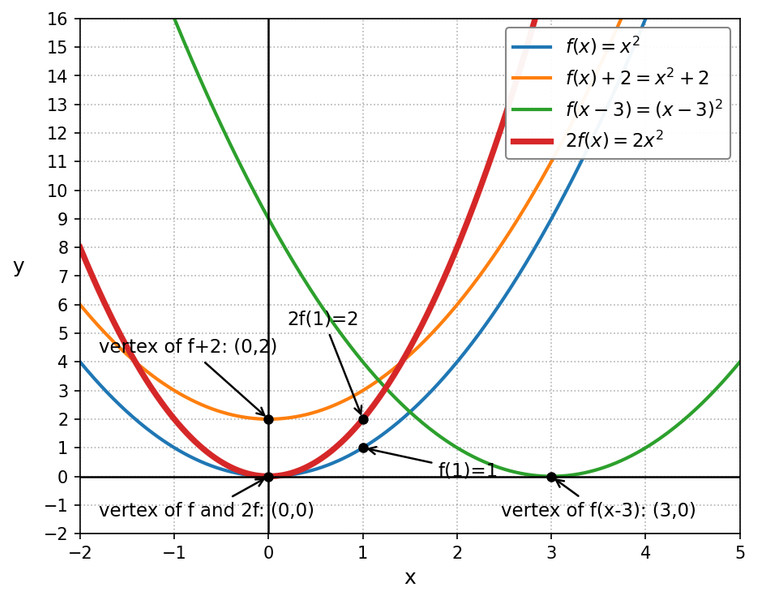
Function transformations of
The Four Basic Transformations
Vertical translation
- moves the graph up
- moves it down
- Point mapping is
The shape stays the same. The range shifts because outputs changed.
Horizontal translation
This is the famous opposite-sign rule:
- moves left
- moves right
Point mapping:
- or
The domain shifts because inputs changed.
Vertical dilation and reflection
- gives a vertical stretch
- gives a vertical compression
- reflects over the -axis
Point mapping is .
Horizontal dilation and reflection
This is where students lose points. The horizontal scale factor is , not .
- gives horizontal compression
- gives horizontal stretch
- reflects over the -axis
Point mapping is .
Building and Reading Combined Transformations
From words to equation, build horizontal changes inside and vertical changes outside:
- Identify the original
- Write the inside as
- Write the outside as
- Combine them
So the finished form is
From equation to description, always factor the entire inside first.
horizontal compression by , left 3
horizontal compression by , reflection over -axis, right 2
For any point on , the full mapping is
This works for graphs, tables, intercepts, extrema, endpoints, and holes.
If a table has , then the transformed row is
You must transform the input too. That is a common test trap.
Domain, Range, and Key Features After a Transformation
For :
- domain values move by
- range values move by
So:
- horizontal changes affect domain
- vertical changes affect range
Features that transform directly:
- points, endpoints, turning points, holes
use the full point mapping - vertical asymptote becomes
- horizontal asymptote becomes
Two important cautions:
- Zeros only stay zeros when
- The -intercept comes from , not from transforming the old -intercept
Common Mistakes and Exam Traps
- means left 4
- means compression by
- Never read term by term. Factor first.
- In tables, do not keep the same input and only change the output.
- Domain, range, and zeros do change under some transformations.
- Symmetry can hide reflections. For even or odd functions, the graph may look unchanged even when a reflection happened.
