Topic 2.2 Notes – Change in Linear and Exponential Functions
Linear and Exponential Change
The whole topic is about how outputs change over equal input intervals.
- Linear change means a constant difference.
- If goes up by 1 each time, the outputs might go .
- You keep adding 3.
- Exponential change means a constant ratio.
- Outputs might go .
- You keep multiplying by 2.
That is the additive vs multiplicative split:
- Linear uses repeated addition
- Exponential uses repeated multiplication
The standard forms show that structure:
- is the initial value because
- is the constant rate of change
- is the initial value because
- is the constant multiplicative factor
A quick sequence connection:
- Arithmetic sequence linear structure
- Geometric sequence exponential structure
These examples show the same starting value, , but different kinds of change as increases by 1.
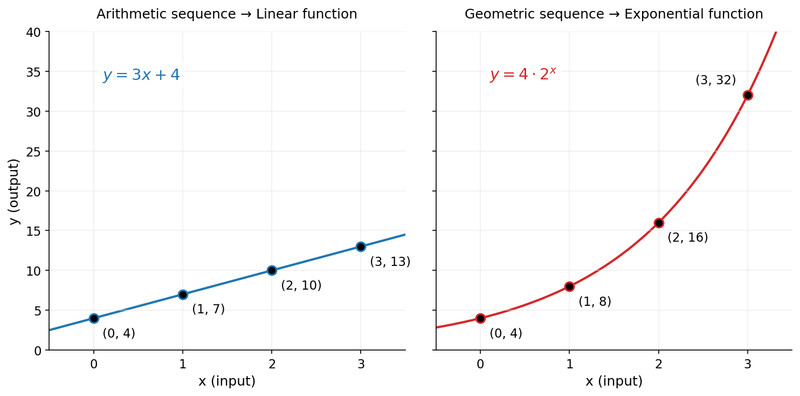
On the left, each output increases by 3, so the sequence matches a linear function. On the right, each output doubles, so the sequence matches an exponential function.
For exponential functions, the base must satisfy:
And for geometric sequences used in this comparison, the ratio cannot be or .
Matching Sequences to Functions
When an arithmetic sequence is really a line
These are parallel forms:
The pieces match:
- because both are outputs at input
- because both tell how much gets added per input unit
Point-based forms also match:
If you know a term and the common difference, or a point and the slope, you can build the model.
When a geometric sequence is really an exponential
These are the matching forms:
The pieces match:
Point-based forms:
Domains and graphs
This is where students often lose points.
- Sequences use whole-number inputs only, so their graphs are discrete points
- Functions use real-number inputs, so their graphs are continuous
A sequence and its corresponding function can agree at integer inputs and still be different because the domains differ. On a quiz or AP-style question, do not connect sequence points unless the problem is clearly extending the sequence to a function.
How to Tell Which Model Fits
Use equal-length input intervals only.
- If outputs change by the same amount, the model is linear.
- If outputs change by the same factor, the model is exponential.
Be careful with interval length.
- If changes by 2, slope is , not just .
- If the ratio over 2 input units is 9, then , so , not 9.
Two values alone do not prove whether a relationship is linear or exponential. They only determine the model once the type is known.
Building the Function from Given Information
One point and a known constant
Linear:
Example with point and slope :
Exponential:
Example with point and factor :
The known output is only the initial value when the input is .
Two values for a linear function
Find slope first:
Using and :
So
Same idea for arithmetic sequences, with
Two values for an exponential function
Use the ratio equation:
Then solve for the base:
Using and :
So
For geometric sequences, the matching formula is
Common Mistakes and Fast Checks
- In , is the intercept. In , is the base.
- A raw output difference is not the slope unless the input change is 1.
- A ratio over 2 or 3 input units is not automatically the exponential base.
- A known point gives the initial value only when .
- To build a real-valued exponential model from two points, the outputs must be nonzero and have the same sign.
- Two points can fit both a line and an exponential curve.
