Topic 2.7 Notes – Composition of Functions
Nesting one function inside another
If you see
read it as “ happens first, then ”.
That means the path is
- Inside function means the one closest to . Here, that is .
- Outside function means the one applied after that. Here, that is .
- is function notation. It does not mean .
Composition is useful when two quantities connect through a middle quantity.
Example: time radius area.
- If and , then
The domain of needs both steps to work:
- must be in the domain of
- must be in the domain of
Also, order matters. Usually,
One special function does nothing to the input. The identity function is
So
Evaluating and Constructing Composites
Evaluating values
For a number input, do the inside first.
If and , then
Compute:
So .
If there are three functions, work from the innermost outward.
Constructing a formula
To build a rule for , replace every in with .
Example: ,
The graph helps you see that the composite uses the output of as the input to .
Parentheses matter a lot, especially with powers and negatives.
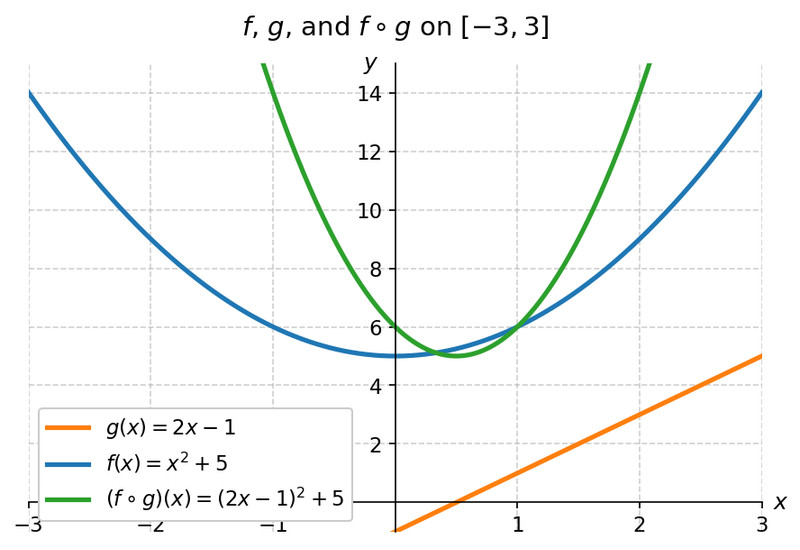
Graphs of , , and
From tables, graphs, and situations
- Tables: find in the first table, then use that output as the input in the table.
- If that input is missing in the second table, the composite may be undefined or cannot be determined.
- Graphs: read , then go to the graph of and evaluate at that value.
- Watch for holes, endpoints, and restricted domains on both graphs.
- Verbal situations: let units guide the order. If miles gallons cost, that tells you which function is inside.
Domain and Order Matter
This is where students lose easy points.
The full rule is
- an input survives only if accepts it and
- the result is allowed in
Common restrictions:
- denominator cannot be zero
- even-root radicand must be nonnegative
- context may restrict values too
A simplified formula can hide excluded values.
Example:
Then but is still excluded.
Reversing order can change formula, domain, range, graph, and even units.
Decomposing a Function into Simpler Functions
Decomposition means reversing composition.
Suppose
A clean decomposition is
Then
Look for the natural inside piece, often a repeated expression or the part “done first.”
Sometimes you can use more than two layers. Decompositions are often not unique. What matters is that recomposing gives the original function back, with the same domain.
Transformations as Compositions
This is the connection to graph transformations.
This changes outputs, so it is a vertical translation.
This changes inputs, so it is a horizontal translation.
This is a vertical dilation. If , it also reflects across the -axis.
This is a horizontal dilation by factor . If , it also reflects across the -axis.
The lock-in idea is simple:
- outside composition changes outputs
- inside composition changes inputs
