Topic 2.8 Notes – Inverse Functions
What an Inverse Function Is
An inverse function undoes another function. If , then the inverse sends back to , so .
That same idea shows up in every representation:
- Ordered pairs swap. If is on , then is on .
- Domain and range switch. The outputs of become the inputs of , so and .
- Known values reverse. If , then .
- Tables reverse. Swap each input-output pair to build the inverse table.
- Context reverses too. If takes time and gives amount, then takes amount and gives time. The units switch with the roles.
One common mistake gets tested a lot. Inverse notation is not reciprocal notation:
When a Function Has an Inverse
A function is invertible on a given domain when each output comes from exactly one input. That is the same as being one-to-one.
If a function repeats an output, the reverse mapping breaks. One input in the inverse would have to point to two outputs, and that is not a function.
Horizontal line test
A graph is one-to-one if every horizontal line hits it at most once.
This is exactly why a full parabola fails the test, but a restricted branch can pass.
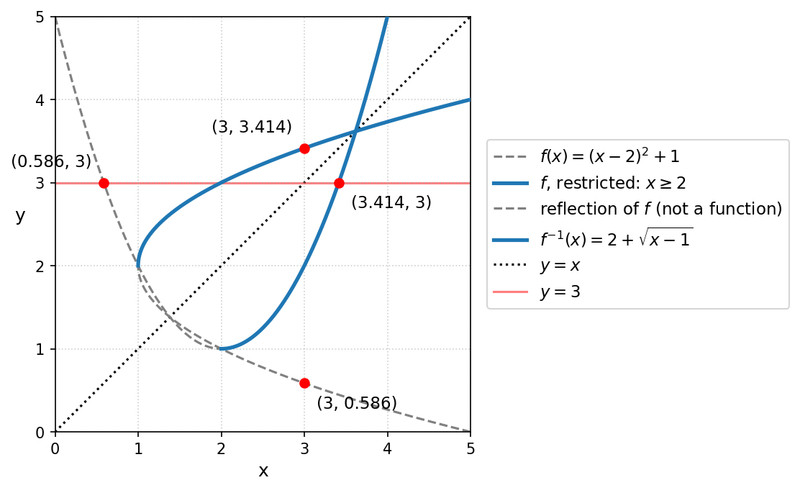
Restricted quadratic and its inverse
Quadratics are the classic example. A parabola over all real numbers is not one-to-one, but you can restrict the domain to one side of the vertex.
- For , use either or .
- Those give different inverses, so the chosen restriction is part of the answer.
- In context, the domain might already be limited, and that can decide which inverse makes sense.
Finding the Inverse
The algebra method is always the same:
- Write
- Switch and
- Solve for
- Rename it
- State the inverse domain from the original range
Example with a restricted quadratic:
Swap and solve:
The branch matches . If the original restriction had been , the inverse would be .
The reverse-operations view helps too. Subtract 2, square, add 1 becomes subtract 1, square root, add 2.
How Inverses Look in Different Representations
- Numerical
Reverse every pair in a table. If original outputs repeat, no inverse function exists. - Graphical
The inverse is the reflection across . , intercepts trade roles when relevant, and points on stay fixed. - Analytical
Swap variables and solve for . - Verbal and context
Say clearly what the inverse input means and what the inverse output means, with units.
Illustrative examples you should recognize:
- table of values where pairs are reversed
- graph reflection over
- contextual models such as time and amount, or amount and time
Checking and Using the Inverse
A function and its inverse undo each other:
Use composition to verify inverses. Domain still matters. With restricted functions, the simplification may only work after using the restriction.
You also use inverses to solve equations. Finding such that is the same as computing .
Common mistakes:
- treating like
- forgetting to restrict a non-one-to-one function
- swapping and but not solving for
- keeping both square-root branches
- using the wrong inverse domain
- ignoring context limits
