5m left·0%
Reading Time: 5 min
Last Updated: August 5, 2026
Main Ideas: 5
Reading Time: 5 min
Last Updated: August 5, 2026
Main Ideas: 5

Topic 3.2 Notes – Sine, Cosine, and Tangent

Verified for 2027 AP® Precalculus Exam
Read aloud
This topic builds the unit-circle meaning of sine, cosine, and tangent. You’re connecting angle rotation in the coordinate plane to a point on a circle, then using that point’s coordinates and slope to get trig values for any angle, including negative angles and angles bigger than one revolution.

Sine, Cosine, and Tangent on the Unit Circle

An angle is in standard position when its vertex is at the origin, its initial ray sits on the positive xx-axis, and its terminal ray comes from rotating that ray. Counterclockwise rotation gives a positive angle. Clockwise rotation gives a negative angle.

The unit circle is the circle centered at the origin with equation

x2+y2=1 x^2+y^2=1

If the terminal ray hits the unit circle at P=(x,y)P=(x,y), then

P=(cos⁡θ,sin⁡θ) P=(\cos\theta,\sin\theta)

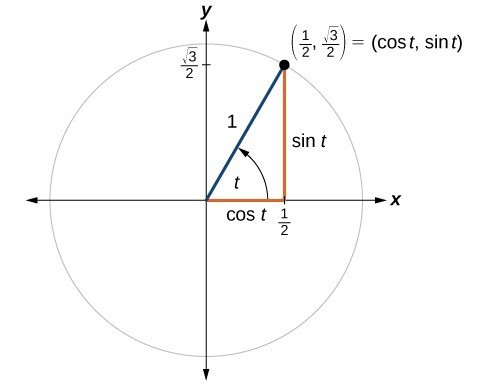
That order matters. Cosine is the xx-coordinate. Sine is the yy-coordinate. In the diagram, the point (12,32)\left(\frac12,\frac{\sqrt3}{2}\right) shows how those coordinates match (cos⁡t,sin⁡t)(\cos t,\sin t).

Study guide illustration

Tangent comes from slope. Since the terminal ray goes through (0,0)(0,0) and (x,y)(x,y),

tan⁡θ=yx=sin⁡θcos⁡θ \tan\theta=\frac{y}{x}=\frac{\sin\theta}{\cos\theta}

when x≠0x\neq 0.

This is the bridge from earlier right-triangle trig. On the unit circle, the triangle ratios turn into coordinate ratios, so trig now works for any angle, not only acute ones.

Standard Position, Radians, and Coterminal Angles

Radians measure angle by arc length. The formula is

θ=sr \theta=\frac{s}{r}

where ss is arc length and rr is radius. On the unit circle, r=1r=1, so θ=s\theta=s. That means radian measure matches directed arc length.

Benchmark angles you should know cold:

  • π2=90∘\frac{\pi}{2}=90^\circ
  • π=180∘\pi=180^\circ
  • 3π2=270∘\frac{3\pi}{2}=270^\circ
  • 2π=360∘2\pi=360^\circ

Conversions:

radians=degrees(π180)degrees=radians(180π) \text{radians}=\text{degrees}\left(\frac{\pi}{180}\right) \qquad \text{degrees}=\text{radians}\left(\frac{180}{\pi}\right)

Coterminal angles share the same terminal ray, so they differ by full revolutions:

  • Radians: θ+2πk\theta+2\pi k
  • Degrees: θ+360k\theta+360k

where kk is any integer.

So π3\frac{\pi}{3} and 7π3\frac{7\pi}{3} are coterminal, and −π2-\frac{\pi}{2} and 3π2\frac{3\pi}{2} are coterminal. Same terminal ray means same sine, cosine, and tangent value whenever tangent exists.

Finding Trig Values from a Point or Ray

When the point is not on the unit circle, use the radius first. If P=(x,y)P=(x,y), then

r=x2+y2 r=\sqrt{x^2+y^2}

and

sin⁡θ=yr,cos⁡θ=xr,tan⁡θ=yx \sin\theta=\frac{y}{r},\qquad \cos\theta=\frac{x}{r},\qquad \tan\theta=\frac{y}{x}

if x≠0x\neq 0.

Dividing by rr normalizes the point to the unit circle:

(xr,yr) \left(\frac{x}{r},\frac{y}{r}\right)

Worked example with P=(−8,15)P=(-8,15):

  1. Find the radius
    r=(−8)2+152=64+225=17 r=\sqrt{(-8)^2+15^2}=\sqrt{64+225}=17
  2. Use the ratios
    cos⁡θ=−817,sin⁡θ=1517,tan⁡θ=−158 \cos\theta=-\frac{8}{17},\qquad \sin\theta=\frac{15}{17},\qquad \tan\theta=-\frac{15}{8}

Since the point is in Quadrant II, the signs make sense. Negative xx, positive yy.

A common test mistake is treating (−8,15)(-8,15) as (cos⁡θ,sin⁡θ)(\cos\theta,\sin\theta). You can only do that on the unit circle.

Signs and Axis Values

The signs come from coordinates.

Quadrantxxyycos⁡θ\cos\thetasin⁡θ\sin\thetatan⁡θ\tan\theta
I+++++
II-+-+-
III----+
IV+-+--

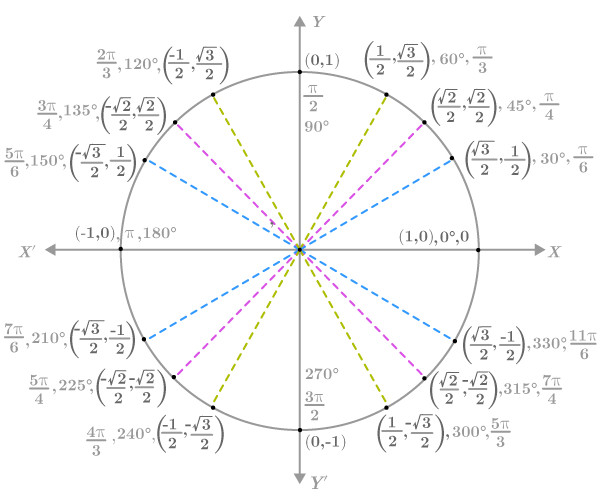
Axis angles are the exact values you should know together. The unit circle below also shows the common benchmark angles, but for this section, focus on the four points on the axes.

  • 0→(1,0)0 \rightarrow (1,0), so cos⁡0=1\cos 0=1, sin⁡0=0\sin 0=0, tan⁡0=0\tan 0=0
  • π2→(0,1)\frac{\pi}{2} \rightarrow (0,1), so cosine =0=0, sine =1=1, tangent undefined
  • π→(−1,0)\pi \rightarrow (-1,0), so cosine =−1=-1, sine =0=0, tangent =0=0
  • 3π2→(0,−1)\frac{3\pi}{2} \rightarrow (0,-1), so cosine =0=0, sine =−1=-1, tangent undefined
Study guide illustration

What Students Miss Under Time Pressure

  • Cosine is xx, sine is yy. The point is (cos⁡θ,sin⁡θ)(\cos\theta,\sin\theta), not the other way around.
  • Tangent is undefined on vertical rays because x=0x=0, so you would divide by zero.
  • Horizontal rays give tangent 00 because the slope is 00.
  • Extra revolutions do not change trig values if the angles are coterminal.
  • Degree and radian measures get mixed all the time, especially with benchmark angles.

Key Takeaways

On the unit circle, the terminal point is (cos⁡θ,sin⁡θ)(\cos\theta,\sin\theta).
On any circle centered at the origin, cos⁡θ=xr\cos\theta=\frac{x}{r} and sin⁡θ=yr\sin\theta=\frac{y}{r}.
Tangent is slope, so tan⁡θ=yx=sin⁡θcos⁡θ\tan\theta=\frac{y}{x}=\frac{\sin\theta}{\cos\theta} only when x≠0x\neq 0.
Coterminal angles have the same trig values because they have the same terminal ray.
The sign of sine comes from yy, the sign of cosine comes from xx, and the sign of tangent comes from yx\frac{y}{x}.
At θ=π2\theta=\frac{\pi}{2} and θ=3π2\theta=\frac{3\pi}{2}, tangent is undefined, not 00.
If a point is not on the unit circle, do not use its raw coordinates as sine and cosine.

AP® is a trademark registered by the College Board, which is not affiliated with, and does not endorse this website.

Notes

1 credit used · 5/5 remaining