5m left·0%
Reading Time: 5 min
Last Updated: July 20, 2026
Main Ideas: 5
Reading Time: 5 min
Last Updated: July 20, 2026
Main Ideas: 5

Topic 2.4 Notes – Exponential Function Manipulation

Verified for 2027 AP® Precalculus Exam
Read aloud
Equivalent exponential forms are different-looking expressions that give the same output for every real xx. In this topic, exponent rules are doing two jobs at once. They simplify expressions, and they show why horizontal changes in an exponential graph can be rewritten as vertical changes or even as a new base.

What Equivalent Exponential Forms Are

Two forms are equivalent when they match for every real input. Example:

3x+2=9⋅3x 3^{x+2}=9\cdot 3^x

Those are the same function, just written to show different features.

For AP Precalculus exponential functions, the base must satisfy

b>0andb≠1 b>0 \quad \text{and} \quad b\ne 1

That keeps bxb^x real for all real xx, and it avoids the constant function 11.

You’ll see the same function written in forms like these:

  • bx+kb^{x+k} shows a horizontal translation
  • abxab^x shows a vertical multiplier
  • bcxb^{cx} shows a horizontal scaling (and maybe reflection)
  • (bc)x(b^c)^x shows a changed base

Quick graph reminder. Changes inside the exponent affect inputs horizontally. A coefficient outside affects outputs vertically. In the graph, y=3x+2y=3^{x+2} and y=9⋅3xy=9\cdot 3^x land on the same curve, which is exactly what equivalent forms mean.
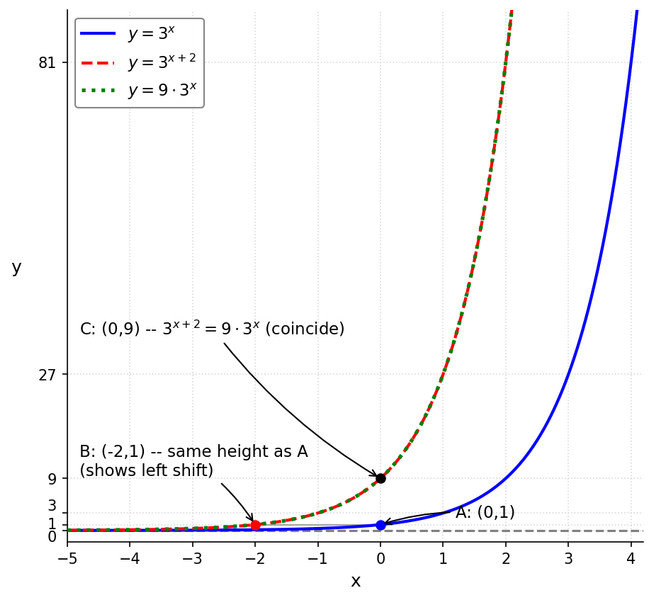
Equivalent exponential forms

The Exponent Rules That Drive the Rewrites

Product property

bm⋅bn=bm+nandbm+n=bmbn b^m\cdot b^n=b^{m+n} \qquad \text{and} \qquad b^{m+n}=b^m b^n

This only works with the same base.

Power property

(bn)m=bnm (b^n)^m=b^{nm}

Reverse use matters a lot here:

bcx=(bc)x b^{cx}=(b^c)^x

Exponents multiply only in a power of a power situation.

Negative exponent property

b−n=1bn b^{-n}=\frac{1}{b^n}

A negative exponent means reciprocal, not a negative number.

Unit-fraction and rational exponents

b1/k=bk b^{1/k}=\sqrt[k]{b}

bm/k=(bk)m=bmk b^{m/k}=\left(\sqrt[k]{b}\right)^m=\sqrt[k]{b^m}

b−m/k=1bm/k b^{-m/k}=\frac{1}{b^{m/k}}

Compact examples

ExpressionEquivalent form/value
3x+23^{x+2}9⋅3x9\cdot 3^x
32x3^{2x}9x9^x
6−x6^{-x}(16)x\left(\frac16\right)^x
642/364^{2/3}1616
32−2/532^{-2/5}14\frac14

Rewriting Exponential Functions to Show Transformations

A horizontal shift in an exponential can be rewritten as a vertical multiplier:

bx+k=bkbx b^{x+k}=b^k b^x

So k>0k>0 shifts left, and that same change becomes multiplying outputs by bkb^k.

  • 5x−3=5x⋅5−3=11255x5^{x-3}=5^x\cdot 5^{-3}=\frac{1}{125}5^x
  • 4x−2=1164x4^{x-2}=\frac{1}{16}4^x

If there’s already a coefficient,

abx+k=(abk)bx ab^{x+k}=(ab^k)b^x

A horizontal scaling can be rewritten as a new base:

bcx=(bc)x,c≠0 b^{cx}=(b^c)^x,\quad c\ne0

  • ∣c∣>1|c|>1 gives a horizontal compression by factor 1∣c∣\frac{1}{|c|}
  • 0<∣c∣<10<|c|<1 gives a horizontal stretch by factor 1∣c∣\frac{1}{|c|}
  • c<0c<0 also reflects across the yy-axis

Examples:

  • 32x=9x3^{2x}=9^x
  • 16x/2=4x16^{x/2}=4^x
  • 5−2x=(125)x5^{-2x}=\left(\frac{1}{25}\right)^x

That reflection idea is worth seeing directly:

b−x=1bx=(1b)x b^{-x}=\frac{1}{b^x}=\left(\frac1b\right)^x

So changing xx to −x-x flips the graph across the yy-axis and swaps the base to its reciprocal.

How to Rewrite Complicated Expressions Efficiently

There’s a clean pattern to these.

  1. Split exponent sums or differences.
  2. Pull constant pieces out to become coefficients.
  3. Rewrite variable multiples as a changed base.
  4. Evaluate rational powers with roots.

Model example:

8(2x−3)/3→82x/3−1→82x/3⋅8−1→(82/3)x⋅18→184x 8^{(2x-3)/3} \to 8^{2x/3-1} \to 8^{2x/3}\cdot 8^{-1} \to (8^{2/3})^x\cdot \frac18 \to \frac18 4^x

That final form makes graph behavior much easier to read.

Common Mistakes and Fast Checks

The usual mistakes are very fixable:

  • bmbnb^m b^n means add exponents, but (bm)n(b^m)^n means multiply
  • 2x⋅3x=6x2^x\cdot 3^x=6^x, but 2x⋅3y2^x\cdot 3^y does not combine that way
  • b−n≠−bnb^{-n}\neq -b^n
  • x+kx+k shifts left
  • In bcxb^{cx}, the horizontal factor is 1∣c∣\frac1{|c|}, not ∣c∣|c|
  • bm+bnb^m+b^n does not simplify to bm+nb^{m+n}

Fast check for equivalence. Plug in an easy value like x=0x=0. If both forms match there and your algebra was legal, you’re probably on track.

Key Takeaways

bx+kb^{x+k} and bkbxb^k b^x are the same function, so a horizontal shift in an exponential can be rewritten as a vertical multiplier.
bcx=(bc)xb^{cx}=(b^c)^x is the rewrite that turns horizontal scaling into a new base.
A negative exponent means reciprocal, so b−x=(1b)xb^{-x}=\left(\frac1b\right)^x.
Rational exponents are roots, so bm/k=(bk)mb^{m/k}=\left(\sqrt[k]{b}\right)^m.
Positive kk in x+kx+k means a shift left, which is one of the easiest test-day sign mistakes.
After any rewrite, checking x=0x=0 is a fast way to catch a wrong coefficient or base.

AP® is a trademark registered by the College Board, which is not affiliated with, and does not endorse this website.

Notes

1 credit used · 5/5 remaining