Topic 3.3 Notes – Sine and Cosine Function Values
Sine and Cosine as Circle Coordinates
An angle is in standard position when its vertex is at the origin and its initial side lies on the positive -axis. The terminal ray lands on a circle of radius .
That intersection point is
On the unit circle, where , this becomes
So the whole idea is simple:
- cosine = -coordinate
- sine = -coordinate
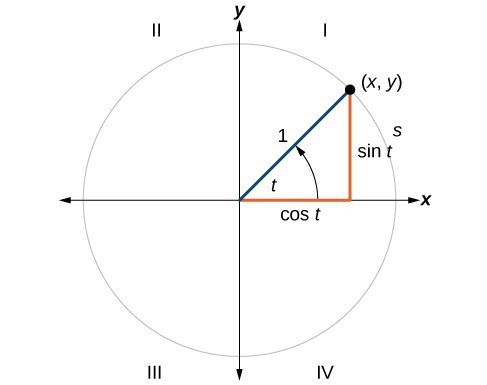
Unit circle coordinates
In the diagram, the point on the unit circle has coordinates , so and .
You also use this backward. If is on a circle of radius , then
The radius is a scale factor. It multiplies both coordinates, not the angle.
Quick checks that catch lots of errors:
- signs must match the quadrant
- each coordinate must stay between and
- the point must satisfy
Exact Values You Need to Know
Some angles come straight from the axes.
Axis angles
On the unit circle:
- and give
- gives
- gives
- gives
On radius , just scale those to , , , .
Special-angle families
These come from special right triangles.
| Family | Triangle | Unit-circle magnitudes |
|---|---|---|
| multiples of | -- | |
| multiples of | -- | |
| multiples of | same triangle, roles reversed |
This unit circle collects the exact coordinates for the axis angles and the most common special angles in both degrees and radians.
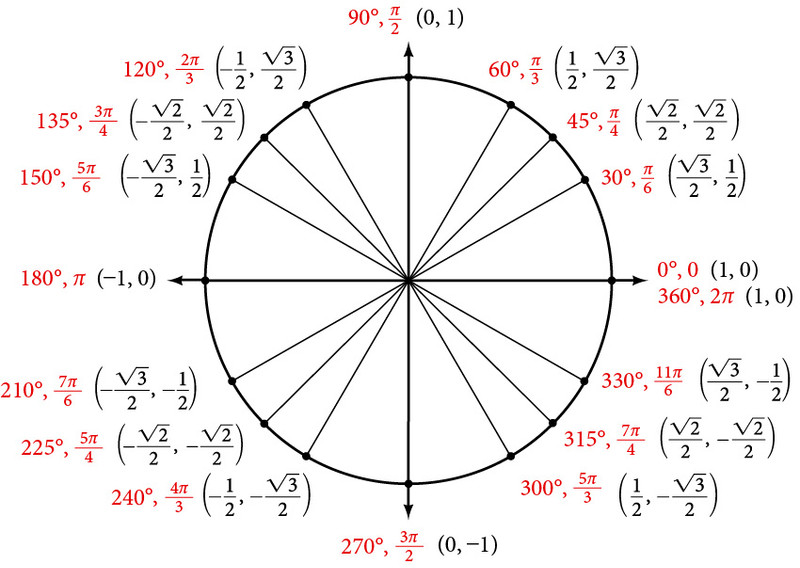
Common exact values on the unit circle
Keep exact values in radical form, not decimals, unless the question asks for an approximation.
Quadrants, Reference Angles, and Coterminal Angles
A reference angle is the acute angle the terminal ray makes with the -axis. It gives the coordinate magnitudes. The quadrant gives the signs.
- Quadrant I:
- Quadrant II:
- Quadrant III:
- Quadrant IV:
Since cosine is and sine is , those sign patterns follow automatically.
Coterminal angles differ by , where is any integer. They land on the same terminal ray, so they have the same sine and cosine.
Negative angles often get easier if you rewrite them in . For example, is coterminal with .
One easy trap: some multiples of are actually axis angles, like . Read those directly from the axes.
Finding a Point or a Trig Value from an Angle
Here’s the full path the test expects you to be able to do cleanly:
- Decide the case: axis angle, family, family, or family.
- If needed, rewrite to a coterminal angle in one revolution.
- Find the quadrant or see if it lies on an axis.
- If it is in a quadrant, find the reference angle.
- Use the right special-angle magnitudes.
- Apply signs from the quadrant.
- If the radius is not 1, multiply both coordinates by .
Example. on radius :
- reference angle
- QII gives signs
- unit-circle point
- radius 8 gives
If you’re given a point, work backward.
Example. :
If and , then , so the angles are and .
Common Mistakes and Fast Self-Checks
| Example | What to watch |
|---|---|
| on a circle | find first, then divide by |
| on radius 8 | QII makes cosine negative, sine positive |
| on radius 6 | rewrite as , then scale to |
| on | two angles, both below the -axis |
