Topic 1.10 Notes – Rational Functions and Holes
What a Hole Is
A rational function has the form
where and are polynomials. Its domain leaves out any input that makes .
A hole is a removable discontinuity. That means one input is excluded, but the graph still heads toward one finite point there.
- If the hole is at , then is undefined.
- But the nearby outputs still approach .
- On the graph, you show that with an open circle at .
The limit language matters here:
This does not mean . It only tells you what happens near .
For a hole, both sides agree:
One easy point to miss is that the hole is the full point , not just the x-value . In this example, the missing point is .
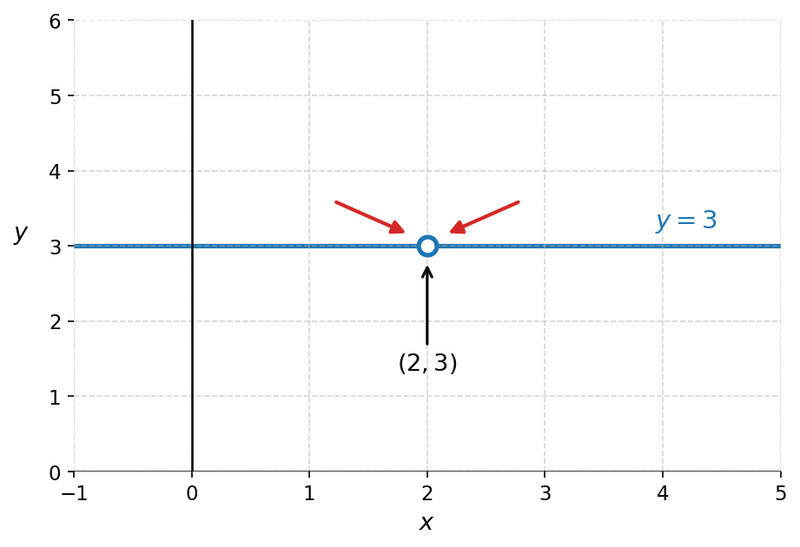
Hole at
How Common Factors Create Holes
Holes happen when the numerator and denominator share a factor, like . The key is comparing multiplicities, which means how many copies of that factor each part has.
Full classification
- Numerator multiplicity denominator multiplicity at
You get a hole. - Denominator multiplicity numerator multiplicity at
You get a vertical asymptote.
This is why your teacher keeps saying to factor completely before deciding anything.
Equal multiplicities
If the same number of copies cancel, the factor disappears completely from the denominator.
Example:
The hole is still at , because the original function was undefined there. Its height comes from the reduced expression:
So the hole is .
Numerator multiplicity greater
If extra copies stay in the numerator after canceling, the reduced expression becomes at . So the hole lands on the x-axis at .
Example:
At , the reduced expression gives , so the hole is .
That point is not an x-intercept because is not in the domain.
Denominator multiplicity greater
If a denominator factor remains after canceling, outputs blow up near . That means vertical asymptote, not hole.
Finding the Coordinates of a Hole
Here’s the full process in the order you’ll use on a quiz.
- Find the original domain restrictions from the denominator.
- Factor numerator and denominator completely.
- Find shared real zeros and compare multiplicities.
- Decide which excluded inputs create holes.
- Cancel common factors to get the reduced expression.
- Plug the excluded x-value into the reduced expression.
- Write the hole as an ordered pair .
Why not substitute into the original function? Because at a shared zero you get , which tells you nothing about the hole’s height.
Also, the reduced expression matches the original only where the original was already defined. Canceling does not put the missing point back into the domain.
Finding Holes from Tables, Graphs, and Limits
Sometimes you don’t get a fully factored expression. You may need to read the hole from other representations.
Numerical evidence
If values close to from both sides approach the same finite number, that signals a hole at .
Example near :
These approach , so the hole is at .
Graphical evidence
Look for an open circle on an otherwise smooth branch. Here, the graph confirms the same hole at .
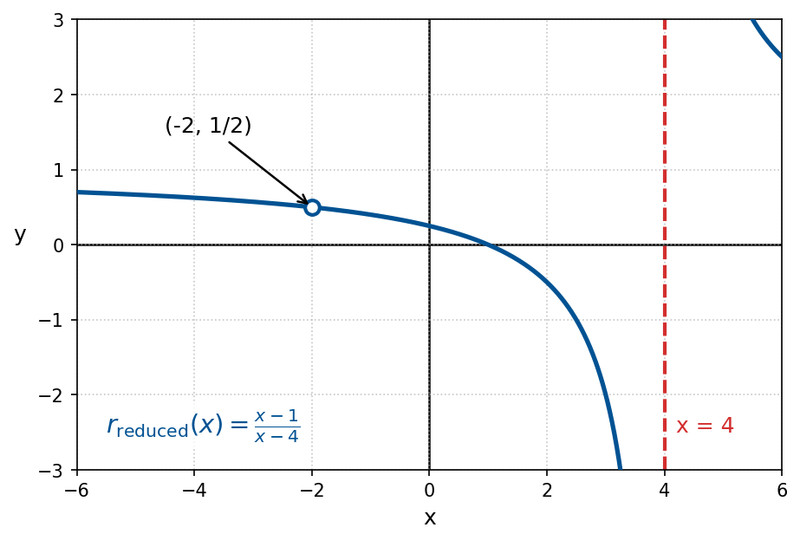
Hole on a rational graph
A calculator graph may hide the hole if it is too small to display clearly, so algebra beats the screen here. This graph also shows why a hole is different from a vertical asymptote at .
Verbal and limit language
If a problem says “nearby outputs approach a single finite value,” that is hole language. A vertical asymptote does not have that finite two-sided trend.
Mistakes That Cost Points
- Canceling a factor and then forgetting that x-value is still excluded from the original domain.
- Assuming every denominator zero gives a vertical asymptote.
- Comparing factors but ignoring multiplicities.
- Calling an x-intercept when it is actually a hole on the x-axis.
- Giving only instead of full coordinates .
- Treating as if it means .
- Trusting a calculator graph when the open circle is not visible.
