Topic 2.9 Notes – Logarithmic Expressions
What a Logarithm Means
The definition is the center of everything:
That means:
- base is the number being raised to a power
- argument is the result you want to get
- value is the exponent
So because .
A few conditions matter for real logarithms:
The result can be any real number:
- positive, like
- zero, like
- negative, like
- fractional, like
If the base is left out, it means common logarithm, base 10:
Evaluating Logarithmic Expressions
Every evaluation problem becomes easier when you rewrite it as an exponential equation.
The basic move
If you see , think:
and solve for .
Anchor values
These show up constantly and are worth knowing cold:
Common cases
- Positive exponent
because - Zero exponent
because - Negative exponent
because
because - Fractional exponent
because - Base between 0 and 1
because - Common log
because
A very common mistake is swapping the exponent and argument. In , the answer is the exponent, not the argument.
Estimating and Checking Logarithm Values
Some logs are exact from exponent facts. Others are not, so you estimate with technology.
Before using a calculator, bound the answer with powers of the base. For example,
so
Then a calculator gives:
That estimate makes sense because is between and , so its common log should be between and .
Sign checks help too:
- If base :
- argument gives a positive log
- argument between and gives a negative log
- If base is between and , those signs reverse.
Also, is the exact value. is only an approximation.
Reading Logarithmic Scales
A logarithmic scale uses equal spacing for equal multiplicative change, not equal difference.
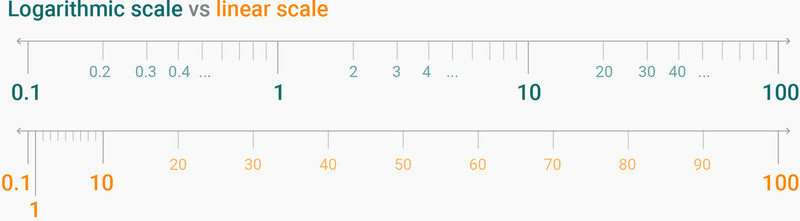
On a base-10 log scale:
- moving right 1 unit means multiply by
- moving left 1 unit means divide by
- moving units means multiply by
More generally, on a base- log scale, a change of 1 unit means multiply by , and a change of units means multiply by .
Examples you should recognize:
- are equally spaced on a base-10 log scale
- from to is 3 log units, so the original values differ by a factor of
- halfway between and is not
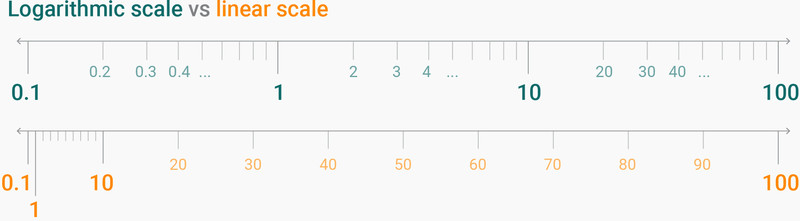
That midpoint is , because halfway on a log scale means halfway in the exponent.
Zero and negative original values do not appear on an ordinary log scale. Also, a log coordinate of means the original value is , since .
Common Mistakes and Quick Fixes
- Converting incorrectly. Keep the base as the base, the answer as the exponent, and the argument as the result.
- Treating like multiplication. It represents one number, the exponent.
- Forgetting . and are undefined in the reals.
- Assuming logs must be positive. They can be negative or fractional.
- Forgetting that means base 10 in this course.
- Reading log-scale spacing as equal differences instead of equal ratios.
- Confusing log value with original value .
