5m left·0%
Reading Time: 5 min
Last Updated: September 1, 2026
Main Ideas: 5
Reading Time: 5 min
Last Updated: September 1, 2026
Main Ideas: 5

Topic 4.4 Notes – Parametrically Defined Circles and Lines

Verified for 2027 AP® Precalculus Exam
Read aloud
Parametric equations describe a path in the plane by making both coordinates depend on the same parameter tt. In this topic, that path is either a circle or a line, and the main idea is that a parametrization tells you more than the shape alone. It also tells you where the motion starts, which way it goes, how much of the path is traced, and over what interval.

What Parametric Circles and Lines Are

A parametric path has the form (x(t),y(t))(x(t),y(t)). As tt changes, the point (x,y)(x,y) moves.

That means a parametrization gives you two things at once:

  • the geometric path itself, like a circle or a segment
  • the motion along the path, including
    • starting point
    • ending point
    • direction
    • how much of the path is covered
    • how the coordinates change as tt changes

This is why the equations and the domain have to be read together. The same formulas with a different interval can give one arc, a full circle, or multiple trips around it.

Also, many different parametrizations can represent the same shape. So on a quiz, don’t stop at “it’s a circle” or “it’s a line.” Check what happens at the beginning, middle, and end of the parameter interval.

Circles written with a parameter

The standard unit circle uses

(x(t),y(t))=(cos⁡t,sin⁡t) (x(t),y(t))=(\cos t,\sin t)

for 0≤t≤2π0\le t\le 2\pi.

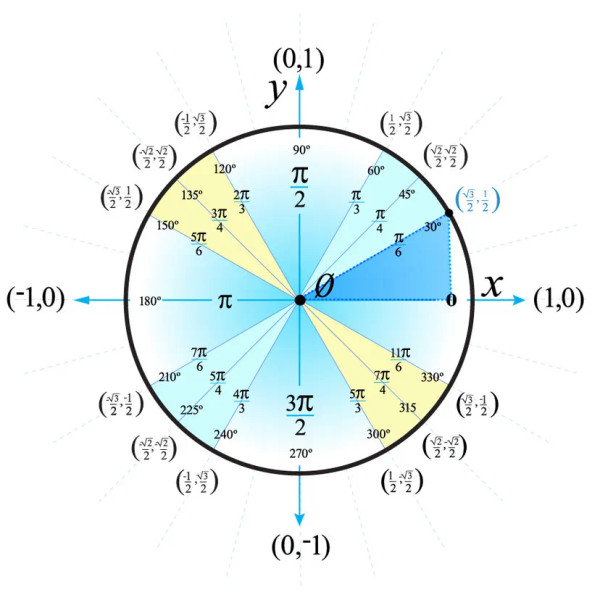
That traces one full counterclockwise revolution starting at (1,0)(1,0), then going through:

  • t=0→(1,0)t=0 \rightarrow (1,0)
  • t=π2→(0,1)t=\frac{\pi}{2} \rightarrow (0,1)
  • t=π→(−1,0)t=\pi \rightarrow (-1,0)
  • t=3π2→(0,−1)t=\frac{3\pi}{2} \rightarrow (0,-1)
  • t=2π→(1,0)t=2\pi \rightarrow (1,0)

The unit circle diagram is a quick way to connect those parameter values to the usual angle positions and key coordinates.
Study guide illustration

A circle centered at (h,k)(h,k) with radius rr is

(x(t),y(t))=(h+rcos⁡t, k+rsin⁡t) (x(t),y(t))=(h+r\cos t,\ k+r\sin t)

For 0≤t≤2π0\le t\le 2\pi, it starts at the rightmost point (h+r,k)(h+r,k).

To change start, direction, or speed, use

(x(t),y(t))=(h+rcos⁡(ωt+ϕ), k+rsin⁡(ωt+ϕ)) (x(t),y(t))=(h+r\cos(\omega t+\phi),\ k+r\sin(\omega t+\phi))

  • ϕ\phi sets the starting angle
  • ω>0\omega>0 means counterclockwise
  • ω<0\omega<0 means clockwise
  • one full revolution takes parameter length 2π∣ω∣\frac{2\pi}{|\omega|}

A common clockwise form is x(t)=h+rcos⁡t, y(t)=k−rsin⁡tx(t)=h+r\cos t,\ y(t)=k-r\sin t.

The domain tells you what part is traced:

  • 0≤t≤π0\le t\le \pi gives the upper semicircle
  • π2≤t≤3π2\frac{\pi}{2}\le t\le \frac{3\pi}{2} gives the left semicircle
  • 0≤t≤4π0\le t\le 4\pi traces the circle twice

Building a Circle Model from a Description

When a word problem describes circular motion, pull out these features:

  1. center
  2. radius
  3. starting point or starting angle
  4. direction
  5. time interval

If motion starts at t=t0t=t_0, angle form is clean:

θ(t)=α+ω(t−t0) \theta(t)=\alpha+\omega(t-t_0)

x(t)=h+rcos⁡(α+ω(t−t0)),y(t)=k+rsin⁡(α+ω(t−t0)) x(t)=h+r\cos(\alpha+\omega(t-t_0)),\qquad y(t)=k+r\sin(\alpha+\omega(t-t_0))

For one full revolution from t0t_0 to t1t_1,

  • counterclockwise uses ω=2πt1−t0\omega=\frac{2\pi}{t_1-t_0}
  • clockwise uses ω=−2πt1−t0\omega=-\frac{2\pi}{t_1-t_0}

Then plug in the start time and one or two other values to make sure the point is where it should be and moving the right way. That check catches a lot of sign mistakes.

Parametrizing Line Segments

From P1=(x1,y1)P_1=(x_1,y_1) to P2=(x2,y2)P_2=(x_2,y_2), the standard form is

(x(t),y(t))=(x1,y1)+t(x2−x1, y2−y1),0≤t≤1 (x(t),y(t))=(x_1,y_1)+t(x_2-x_1,\ y_2-y_1), \quad 0\le t\le 1

Equivalent form:

((1−t)x1+tx2, (1−t)y1+ty2) \big((1-t)x_1+tx_2,\ (1-t)y_1+ty_2\big)

Here:

  • t=0t=0 gives P1P_1
  • t=1t=1 gives P2P_2
  • t=12t=\frac12 gives the midpoint

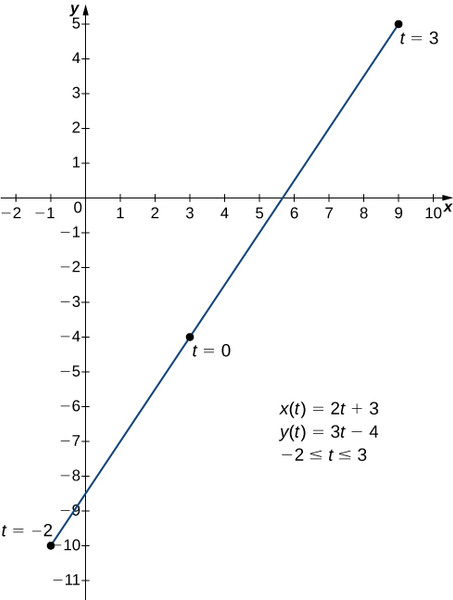
The graph below shows the same idea with a point moving along a straight path as tt changes.

Study guide illustration

If the motion goes from t=at=a to t=bt=b, use

x(t)=x1+t−ab−a(x2−x1),y(t)=y1+t−ab−a(y2−y1) x(t)=x_1+\frac{t-a}{b-a}(x_2-x_1), \qquad y(t)=y_1+\frac{t-a}{b-a}(y_2-y_1)

You can also write a line from an initial point and constant rates:

x(t)=x0+u(t−t0),y(t)=y0+v(t−t0) x(t)=x_0+u(t-t_0), \qquad y(t)=y_0+v(t-t_0)

Here (u,v)(u,v) are the horizontal and vertical rates.

The domain matters here too:

  • 0≤t≤10\le t\le 1 gives the segment
  • t≥0t\ge 0 gives a ray
  • all real tt gives the whole line

What to Check and Common Mistakes

For circles, check:

  • center
  • radius
  • initial point
  • direction
  • total angle traveled

For lines, check:

  • both endpoints
  • one interior point such as the midpoint

Common mistakes:

  • Using different angle expressions in sine and cosine breaks the circle.
  • Center shifts go outside trig functions.
  • Phase shifts go inside trig functions.
  • Radius multiplies sine and cosine values.
  • Different horizontal and vertical scale factors make an ellipse, not a circle.
  • Forgetting the domain can turn a segment into a whole line or a single arc into repeated revolutions.

Key Takeaways

A parametrization describes both the path and the motion along it.
For circles, (cos⁡t,sin⁡t)(\cos t,\sin t) with 0≤t≤2π0\le t\le 2\pi is one full counterclockwise trip starting at (1,0)(1,0).
In x=h+rcos⁡(θ)x=h+r\cos(\theta), y=k+rsin⁡(θ)y=k+r\sin(\theta), the center is (h,k)(h,k) and the radius is rr.
The same angle expression must appear in both cosine and sine for a circle.
The sign of ω\omega controls direction, and one revolution takes 2π∣ω∣\frac{2\pi}{|\omega|}.
For a line segment, (x(t),y(t))=(x1,y1)+t(x2−x1, y2−y1)(x(t),y(t))=(x_1,y_1)+t(x_2-x_1,\ y_2-y_1) with 0≤t≤10\le t\le 1 goes from the first endpoint to the second.
Reversing endpoints reverses direction even though the geometric segment stays the same.
Leaving off the domain is often the mistake that changes the answer.

AP® is a trademark registered by the College Board, which is not affiliated with, and does not endorse this website.

Notes

1 credit used · 5/5 remaining