Topic 2.14 Notes – Logarithmic Function Context and Data Modeling
What a Logarithmic Model Means
A logarithm undoes an exponential. That matters in modeling because the output tells you how many multiplicative steps separate an input from a reference value.
The core model is
Here is what each part means:
- is the reference input.
- is the output when .
- is the factor you multiply the input by.
- is how much the output changes when the input is multiplied by .
So if you replace with , the output increases by .
- In an exponential model, equal input differences give equal output ratios.
- In a logarithmic model, equal input ratios give equal output differences.
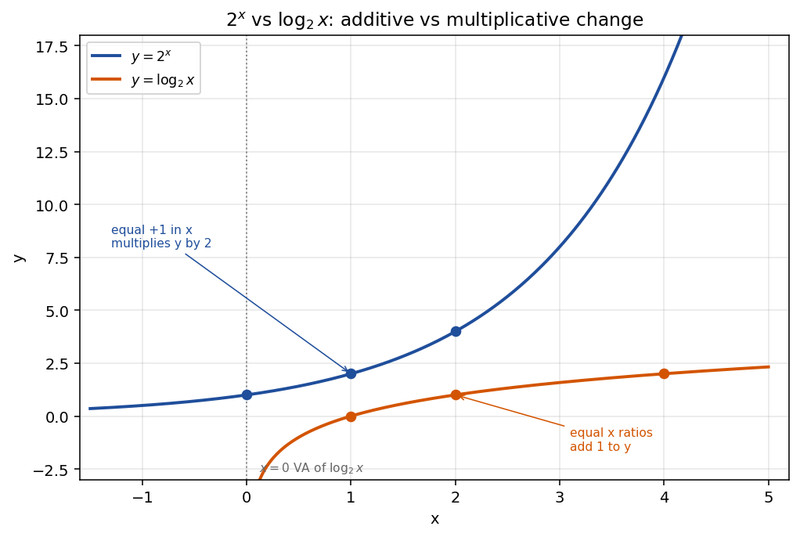
If is a whole number, then the reference input has been multiplied by , times. If is negative, that means repeated division by .
A few graph reminders:
- For , the domain is .
- For , the domain is .
- The line is the vertical asymptote.
- Increasing or decreasing depends on the base and coefficient. In practice, usually uses , and the sign of controls direction.
Ways to Build a Logarithmic Model
You’ll see four common ways.
From a proportion and a real zero
A real zero means . If multiplying the input by changes the output by , then
If , this simplifies to .
Example: zero at , and every factor of raises output by .
Then , so is multiplied by three times.
From two input-output pairs
If the form is , two points let you solve for and .
A form worth knowing is
This shows the meaning clearly. The factor in the input matches the output change .
One limitation matters a lot on tests: two points do not determine a log model if the horizontal shift is also unknown.
From transformations and regression
A transformed model looks like
- moves the asymptote and changes the domain to
- shifts the graph up or down
- stretches output changes and can flip the graph
Regression on a calculator usually gives
All -values must be positive. Also, . Different log bases can describe the same model after vertical rescaling.
Using the Model to Predict and Solve
To find the output, substitute the input. For shifted models, check that first.
To solve for the input, reverse the logarithm:
- Isolate the log
- Rewrite in exponential form
- Solve for
Useful formulas:
When you finish, include units and decide whether the answer is interpolation or extrapolation. Also check whether it makes sense in context, not just algebraically.
What to Look For and What Students Miss
Evidence for a logarithmic model:
- output changes by equal amounts when input is multiplied by a constant factor
- equivalently, multiplying by adds a constant to
Common contexts to recognize:
- sound level
- earthquake magnitude
- acidity
These use logarithmic scales, where multiplicative changes in the original quantity become additive changes on the reported scale.
Common mistakes:
- using equal input differences instead of equal input ratios
- forgetting that “proportional growth” here describes the inputs
- treating the coefficient of as change per 1 unit of
- plugging in or a negative value
- solving for and never checking if it fits the context
- assuming a strong regression statistic alone proves the model is right
