6m left·0%
Reading Time: 6 min
Last Updated: August 20, 2026
Main Ideas: 4
Reading Time: 6 min
Last Updated: August 20, 2026
Main Ideas: 4

Topic 3.10 Notes – Trigonometric Equations and Inequalities

Verified for 2027 AP® Precalculus Exam
Read aloud
Trigonometric equations and inequalities ask for the angles or inputs that make a trig statement true. This topic is about combining inverse trig, unit-circle facts, periodicity, algebra, and intervals so you can find all solutions, not just the first one your calculator gives.

Solving Trigonometric Equations

A trig equation asks for inputs that make something with sin⁡\sin, cos⁡\cos, or tan⁡\tan true. The main thing to remember is that inverse trig gives a principal value, which is only one angle in a restricted output range.

  • arcsin⁡x∈[−π/2,π/2]\arcsin x \in [-\pi/2,\pi/2]
  • arccos⁡x∈[0,π]\arccos x \in [0,\pi]
  • arctan⁡x∈(−π/2,π/2)\arctan x \in (-\pi/2,\pi/2)

So if arcsin⁡(1/2)=π/6\arcsin(1/2)=\pi/6, that does not mean π/6\pi/6 is the only solution to sin⁡x=1/2\sin x=1/2.

Range checks

Before solving, check whether a real solution is even possible.

  • sin⁡u=c\sin u=c or cos⁡u=c\cos u=c has no real solution if c∉[−1,1]c\notin[-1,1]
  • tan⁡u=c\tan u=c has a real solution for every real cc

General solution formulas

Because trig functions repeat, solutions repeat.

If α=arcsin⁡c,sin⁡u=c⇒u=α+2πk or u=π−α+2πk \text{If } \alpha=\arcsin c,\quad \sin u=c \Rightarrow u=\alpha+2\pi k \text{ or } u=\pi-\alpha+2\pi k

If α=arccos⁡c,cos⁡u=c⇒u=α+2πk or u=−α+2πk \text{If } \alpha=\arccos c,\quad \cos u=c \Rightarrow u=\alpha+2\pi k \text{ or } u=-\alpha+2\pi k

If α=arctan⁡c,tan⁡u=c⇒u=α+πk \text{If } \alpha=\arctan c,\quad \tan u=c \Rightarrow u=\alpha+\pi k

Here k∈Zk\in\mathbb Z. Sine and cosine repeat every 2π2\pi. Tangent repeats every π\pi.

Keep the unit circle in mind when you want the other angles with the same trig value.
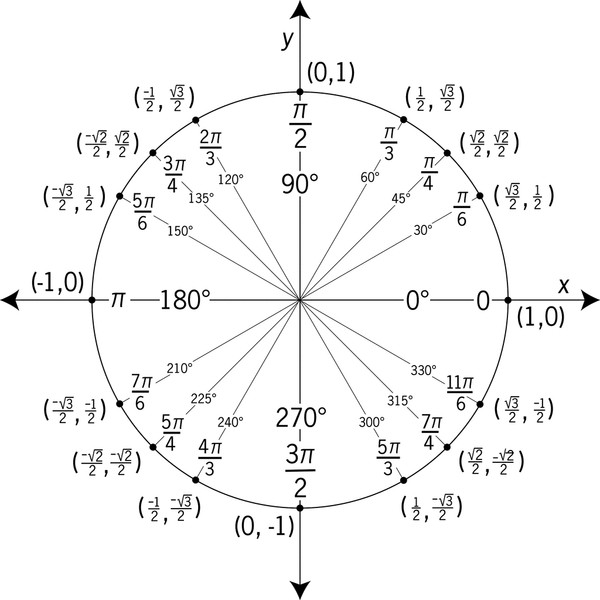
Study guide illustration

Unit circle with common angles

Exact and approximate answers

  • Use exact unit-circle values when you can. Example: sin⁡x=3/2\sin x=\sqrt{3}/2 gives exact angles.
  • arccos⁡(0.3)\arccos(0.3) is already an exact answer.
  • Round only at the end.

Solving on an Interval and with Transformed Angles

When the angle is something like 3x−π/23x-\pi/2, solve for the whole angle first, then solve for xx.

For example, solve cos⁡(2x)=1/2\cos(2x)=1/2 on 0≤x<2π0\le x<2\pi.

  1. Let u=2xu=2x
  2. Solve cos⁡u=1/2\cos u=1/2, so u=π/3+2πku=\pi/3+2\pi k or u=5π/3+2πku=5\pi/3+2\pi k
  3. Since 0≤x<2π0\le x<2\pi, you have 0≤u<4π0\le u<4\pi
  4. List all uu-values in that interval

    u=π/3, 5π/3, 7π/3, 11π/3 u=\pi/3,\ 5\pi/3,\ 7\pi/3,\ 11\pi/3

  5. Divide by 2

    x=π/6, 5π/6, 7π/6, 11π/6 x=\pi/6,\ 5\pi/6,\ 7\pi/6,\ 11\pi/6

The spacing changes because the period changes. For cos⁡(2x)\cos(2x), the period in xx is π\pi, not 2π2\pi.

When algebra comes first

Sometimes you need algebra before inverse trig.

Example:

2sin⁡2x−sin⁡x−1=0 2\sin^2x-\sin x-1=0

Factor:

(2sin⁡x+1)(sin⁡x−1)=0 (2\sin x+1)(\sin x-1)=0

So sin⁡x=−1/2\sin x=-1/2 or sin⁡x=1\sin x=1.

One common trap is dividing by a trig expression like sin⁡x\sin x. If sin⁡x=0\sin x=0 could be a solution, dividing would erase it.

Trigonometric Inequalities

Trig inequalities usually give intervals, not single numbers.

Basic method

  1. Isolate the trig expression
  2. Solve the related equation for boundary angles
  3. Include undefined points as boundaries when needed
  4. Use the unit circle, graph, or test values to see where the inequality is true
  5. Write the answer with correct interval notation

Sine and cosine inequalities

Example:

cos⁡x≤−22 \cos x\le -\frac{\sqrt2}{2}

Boundary angles on [0,2π][0,2\pi] are 3π/43\pi/4 and 5π/45\pi/4. Cosine is that small on the left side of the unit circle, so

x∈[3π4,5π4] x\in\left[ \frac{3\pi}{4},\frac{5\pi}{4}\right]

Wraparound sometimes creates two pieces, like values near both 00 and 2π2\pi.

Tangent inequalities

For tangent, think branch by branch between asymptotes.

Example:

tan⁡x>1 \tan x>1

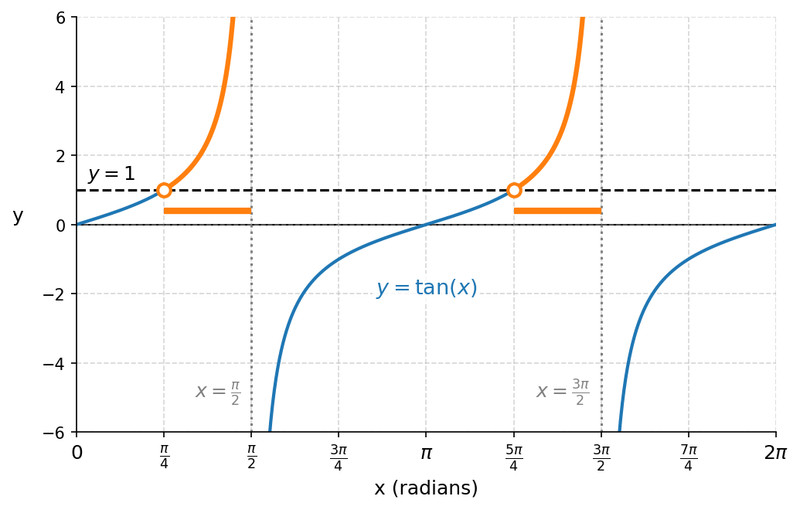
On [0,2π)[0,2\pi), equality happens at π/4\pi/4 and 5π/45\pi/4. Tangent is undefined at π/2\pi/2 and 3π/23\pi/2. The graph makes it clear that you only keep the parts of each branch above y=1y=1. So

x∈(π4,π2)∪(5π4,3π2) x\in\left(\frac{\pi}{4},\frac{\pi}{2}\right)\cup\left(\frac{5\pi}{4},\frac{3\pi}{2}\right)

Do not apply inverse trig to both sides of an inequality as if trig functions were one-to-one on all real numbers.

Graphs, Context, and Common Mistakes

Some equations are easier with technology. If f(x)=g(x)f(x)=g(x), solutions are the intersection points. You can also solve f(x)−g(x)=0f(x)-g(x)=0 numerically. Make sure the graphing window shows the full domain asked for.

In context, the domain often limits answers. A trig model may repeat forever mathematically, but a problem about time might only allow 0≤t≤120\le t\le 12 seconds. Keep units and only report values that make sense there.

Common mistakes

  • stopping after one inverse-trig output
  • forgetting tangent’s period is π\pi
  • adding 2π2\pi directly to xx in transformed angles
  • missing extra solutions over multiple cycles
  • including asymptotes in tangent inequalities
  • mixing radians and degrees

Key Takeaways

Inverse trig gives a principal value, and periodicity gives the rest of the solutions.
For sin⁡u=c\sin u=c and cos⁡u=c\cos u=c, check that c∈[−1,1]c\in[-1,1] before doing any work.
In transformed equations like sin⁡(3x−π/4)=1/2\sin(3x-\pi/4)=1/2, solve for the whole angle first, then back-solve for xx.
The period of tangent is π\pi, so its general solution uses +πk+\pi k, not +2πk+2\pi k.
On a restricted interval, convert the xx-interval into the angle interval so you do not miss solutions.
In inequalities, boundary points come from the related equation, and undefined points also split the intervals.
Never include tangent asymptotes in the answer because tangent does not exist there.
An answer like arccos⁡(0.3)\arccos(0.3) is exact, and rounding should wait until the final step.

AP® is a trademark registered by the College Board, which is not affiliated with, and does not endorse this website.

Notes

1 credit used · 5/5 remaining