Topic 4.6 Notes – Conic Sections
What Conic Sections Are
A conic is usually a relation, not a single function of . That matters because circles, ellipses, and many hyperbolas fail the vertical line test, even though they still have equations and graphs.
Here’s the recognition pattern after you simplify into standard form:
- One squared variable only parabola
- Both squared, same sign ellipse
- Circle is the special ellipse where the horizontal and vertical radii match
- Both squared, opposite signs hyperbola
Translations work the same way as in other graphing topics:
- and point to
- Read inside signs oppositely, so
For ellipses, circles, and hyperbolas, is the center. For a parabola, it is the vertex.
A common test mistake is classifying from a scrambled equation too early. Rewrite first.
Standard Forms and Key Features
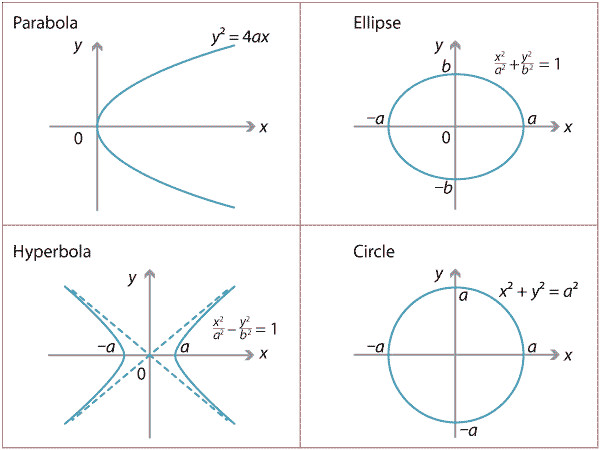
Keep this reference image in mind as you review the standard forms. It shows the basic axis-aligned conics centered at the origin, which matches the parent forms before any shifts.
Parabolas
- vertex
- axis of symmetry
- opens up, opens down
- vertex
- axis of symmetry
- opens right, opens left
Only the variable perpendicular to the opening direction is squared. Also, larger means narrower.
Ellipses and circles
- center
- horizontal radius , vertical radius
- endpoints and
- symmetry lines and
- center , radius
- special case of ellipse with
Hyperbolas
- center , opens left and right
- vertices
- center , opens up and down
- vertices
For both forms,
Those are the asymptotes. In the reference image, that matches the hyperbola panel with the dashed diagonal lines. The opening direction comes from the positive squared term, not from the bigger denominator.
Rewriting to Standard Form
The algebra pattern is the same each time:
- Group -terms and -terms, move constants.
- Factor first if a leading coefficient is in the way.
- Complete the square using
- Simplify.
- For ellipses and hyperbolas, divide so the right side is .
Example parabola:
So
It’s a parabola with vertex , opening up.
Building an Equation from a Graph or Description
Write the correct standard form first, then fill in features.
- Parabola with given vertex and point
Vertex , point
Equation is - Ellipse with center and radii
Center , horizontal radius , vertical radius - Circle with center and radius
Center , radius - Hyperbola with center, vertices, asymptotes
Center , vertical vertices and , slopes
Here , and so
Graph Clues, Symmetry, and Common Mistakes
- Ellipse sketch comes from center plus four endpoints.
- Hyperbola sketch comes from the guiding rectangle , , then the diagonals as asymptotes.
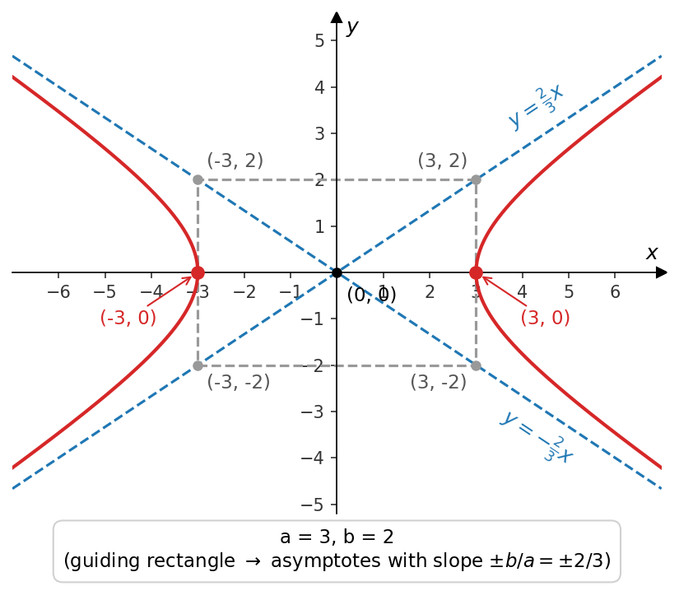
Hyperbola sketch from a guiding rectangle
- Intercepts come from setting or . Some conics have none.
- Symmetry
- parabola has one symmetry line
- ellipse and hyperbola have symmetry across and
- circle is symmetric across every line through its center
Common mistakes you want to avoid:
- reading and with the wrong sign
- assuming the larger denominator controls hyperbola opening
- mixing up what means in a parabola versus an ellipse/hyperbola
- calling every equation a function
- classifying before rewriting to standard form
