Topic 4.11 Notes – The Inverse and Determinant of a Matrix
Identity Matrices, Inverses, and Determinants
For matrices, the identity matrix is
It acts like the number 1 in regular multiplication. If is any matrix, then
An inverse of a matrix is written . It is the matrix that undoes , which means
That does not mean “take reciprocals of each entry.” Matrix inverse is a whole-matrix operation.
For , the determinant is
You may also see determinant written with vertical bars:
The one connection you want locked in is this:
- exists exactly when
Finding the Inverse of a Matrix
When , the inverse formula is
Here is the hand process in order:
- Find the determinant .
- If it equals 0, stop. No inverse exists.
- Swap the main diagonal entries and .
- Negate both off-diagonal entries and .
- Multiply by .
Example with
- So
Parameters
If a matrix has a variable in it, use the determinant to find when the inverse breaks.
Example
So is not invertible when or . For all other ,
Verifying an inverse
Check by matrix multiplication, not by multiplying matching entries.
- Compute or
- You should get
Determinants as Geometry and Invertibility
A matrix can be seen as two row vectors or two column vectors in . Those two vectors form a parallelogram. Here, the columns of make a parallelogram with area .
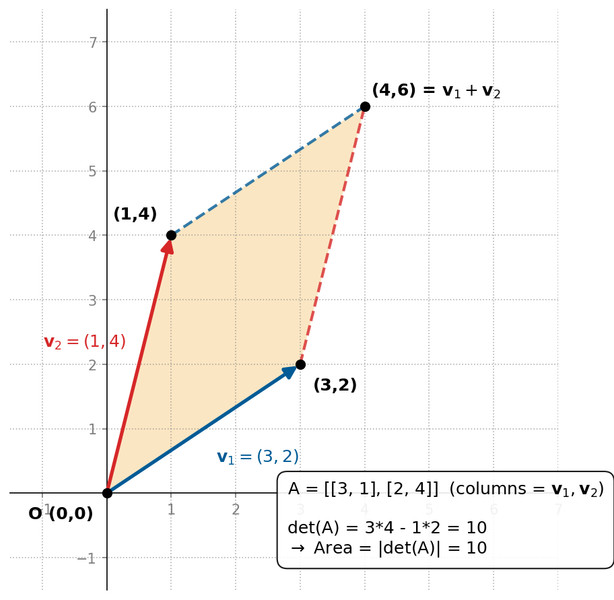
Parallelogram from the columns of a matrix
The geometric fact is:
- = area of the parallelogram
- If , the vectors are parallel and the shape collapses to area 0
Illustrative examples that all point to the same idea:
- column vectors form the parallelogram
- row vectors can also form it
- parallelogram area is
- parallel vectors when the determinant is 0 means no area
A negative determinant is still fine. The sign can change if you switch vector order, but the area stays the same because area uses absolute value.
Equivalent ways to spot invertibility:
- inverse exists
- row vectors are not parallel
- column vectors are not parallel
- parallelogram area is positive
Equivalent ways to spot noninvertibility:
- inverse does not exist
- row or column vectors are parallel
- parallelogram has area 0
When to Use Each Idea
- Use the determinant first if asked whether a matrix is invertible.
- Use the determinant first before using the inverse formula, because division by 0 would make the formula invalid.
- Use the inverse formula when asked for exact .
- Use determinant reasoning in vector questions about area or parallelism.
- With parameters, solve to find the values where invertibility changes.
- Technology can find or , but you still need to interpret the result and state restrictions.
Common Mistakes and Fast Checks
- Mixing up with
- Forgetting that determinant 0 means no inverse
- Swapping the wrong entries or forgetting to negate both off-diagonal entries
- Treating like entry-by-entry reciprocals
- Using instead of for area
- Missing parameter values that make the denominator 0
- After finding an inverse, multiply and make sure you get exactly
