5m left·0%
Reading Time: 5 min
Last Updated: August 20, 2026
Main Ideas: 5
Reading Time: 5 min
Last Updated: August 20, 2026
Main Ideas: 5

Topic 3.9 Notes – Inverse Trigonometric Functions

Verified for 2027 AP® Precalculus Exam
Read aloud
Inverse trigonometric functions undo sine, cosine, and tangent, but only after those trig functions are restricted to intervals where they pass the horizontal line test. This topic is about what the inverse trig functions mean, why their ranges are fixed, how to graph them, and how to evaluate and compose them without falling into the usual traps.

Restricted domains that make trig invertible

Trig functions take an angle and return a ratio value. Inverse trig functions reverse that. They take a ratio value and return an angle.

  • arcsin⁡x\arcsin x or sin⁡−1x\sin^{-1}x
  • arccos⁡x\arccos x or cos⁡−1x\cos^{-1}x
  • arctan⁡x\arctan x or tan⁡−1x\tan^{-1}x

That −1-1 means inverse function, not reciprocal.

  • sin⁡−1x≠1sin⁡x\sin^{-1}x \neq \frac{1}{\sin x}
  • The reciprocal of sine is cosecant, csc⁡x\csc x
  • Likewise, reciprocals are secant and cotangent, not arccos or arctan

One more idea matters right away. An inverse function only exists if the original function is one-to-one, which means it passes the horizontal line test. Full sine, cosine, and tangent fail that because they repeat.

The Three Inverse Trig Functions and Their Restricted Domains

The standard restrictions are

sin⁡x on [−π2,π2],cos⁡x on [0,π],tan⁡x on (−π2,π2) \sin x \text{ on } \left[-\frac{\pi}{2},\frac{\pi}{2}\right], \quad \cos x \text{ on } [0,\pi], \quad \tan x \text{ on } \left(-\frac{\pi}{2},\frac{\pi}{2}\right)

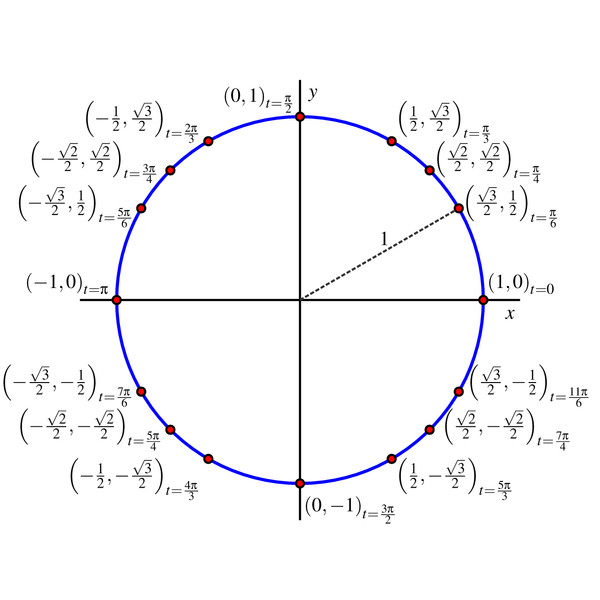
These are chosen because each restricted trig function becomes one-to-one and still gives all outputs it needs. On the unit circle, these intervals pick out the angle values the inverse functions are allowed to return.
Study guide illustration

Unit circle reference angles

Arcsine

y=arcsin⁡xy=\arcsin x means sin⁡y=x\sin y=x and −π2≤y≤π2-\frac{\pi}{2}\le y\le \frac{\pi}{2}.

  • domain [−1,1][-1,1]
  • range [−π2,π2]\left[-\frac{\pi}{2},\frac{\pi}{2}\right]
  • increasing
  • arcsin⁡(−1)=−π2\arcsin(-1)=-\frac{\pi}{2}, arcsin⁡(0)=0\arcsin(0)=0, arcsin⁡(1)=π2\arcsin(1)=\frac{\pi}{2}

Its outputs are only in Quadrant I, Quadrant IV, or on the axes.

Arccosine

y=arccos⁡xy=\arccos x means cos⁡y=x\cos y=x and 0≤y≤π0\le y\le \pi.

  • domain [−1,1][-1,1]
  • range [0,π][0,\pi]
  • decreasing
  • arccos⁡(1)=0\arccos(1)=0, arccos⁡(0)=π2\arccos(0)=\frac{\pi}{2}, arccos⁡(−1)=π\arccos(-1)=\pi

Its outputs are never negative.

Arctangent

y=arctan⁡xy=\arctan x means tan⁡y=x\tan y=x and −π2<y<π2-\frac{\pi}{2}< y< \frac{\pi}{2}.

  • domain all real numbers
  • range (−π2,π2)\left(-\frac{\pi}{2},\frac{\pi}{2}\right)
  • increasing
  • arctan⁡(0)=0\arctan(0)=0

It never outputs ±π2\pm \frac{\pi}{2}.

Constructing the Inverse Analytically and Graphically

Analytically, the pattern is always the same:

  1. Write the restricted trig function, like y=sin⁡xy=\sin x on [−π2,π2]\left[-\frac{\pi}{2},\frac{\pi}{2}\right].
  2. Switch xx and yy, so x=sin⁡yx=\sin y.
  3. Rename with inverse notation, so y=arcsin⁡xy=\arcsin x.

Domain and range swap.

Graphically, inverse graphs are reflections across y=xy=x.

Know these point swaps:

  • sine
    • (−π2,−1),(0,0),(π2,1)(-\frac{\pi}{2},-1),(0,0),(\frac{\pi}{2},1) ↔ (−1,−π2),(0,0),(1,π2)(-1,-\frac{\pi}{2}),(0,0),(1,\frac{\pi}{2})
  • cosine
    • (0,1),(π2,0),(π,−1)(0,1),(\frac{\pi}{2},0),(\pi,-1) ↔ (1,0),(0,π2),(−1,π)(1,0),(0,\frac{\pi}{2}),(-1,\pi)
  • tangent has vertical asymptotes x=±π2x=\pm \frac{\pi}{2}, so arctan has horizontal asymptotes y=±π2y=\pm \frac{\pi}{2}

Evaluating and Composing Inverse Trig Functions

For exact values, treat the input as a trig value, find angles with that value, then choose the one in the inverse range.

  • arcsin⁡(−22)=−π4\arcsin\left(-\frac{\sqrt2}{2}\right)=-\frac{\pi}{4}
  • arccos⁡(−32)=5π6\arccos\left(-\frac{\sqrt3}{2}\right)=\frac{5\pi}{6}
  • arccos⁡(−12)=2π3\arccos\left(-\frac{1}{2}\right)=\frac{2\pi}{3}
  • arctan⁡(−3)=−π3\arctan(-\sqrt3)=-\frac{\pi}{3}

Compositions you should know cold:

  • sin⁡(arcsin⁡x)=x\sin(\arcsin x)=x for −1≤x≤1-1\le x\le 1
  • cos⁡(arccos⁡x)=x\cos(\arccos x)=x for −1≤x≤1-1\le x\le 1
  • tan⁡(arctan⁡x)=x\tan(\arctan x)=x for all real xx

The reverse direction is trickier because the answer must land in the inverse’s range.

  • arcsin⁡(sin⁡3π4)=arcsin⁡(22)=π4\arcsin(\sin \frac{3\pi}{4})=\arcsin(\frac{\sqrt2}{2})=\frac{\pi}{4}
  • arccos⁡(cos⁡(−π3))=arccos⁡(12)=π3\arccos(\cos(-\frac{\pi}{3}))=\arccos(\frac{1}{2})=\frac{\pi}{3}
  • arctan⁡(tan⁡2π3)=arctan⁡(−3)=−π3\arctan(\tan \frac{2\pi}{3})=\arctan(-\sqrt3)=-\frac{\pi}{3}

Common Mistakes and Calculator Checks

Most errors come from forgetting the principal value.

  • arcsin⁡\arcsin, arccos⁡\arccos, and arctan⁡\arctan return one standard angle, not every angle
  • arcsin⁡x\arcsin x and arccos⁡x\arccos x only accept inputs in [−1,1][-1,1]
  • arctan⁡x\arctan x accepts any real input
  • arctan approaches ±π2\pm \frac{\pi}{2} but never equals them
  • calculator mode matters. In radians mode, answers look different than in degree mode

On a quiz or FRQ, always check two things before boxing your answer. Is the input allowed and is the output in the correct interval?

Key Takeaways

sin⁡−1x\sin^{-1}x, cos⁡−1x\cos^{-1}x, and tan⁡−1x\tan^{-1}x mean inverse functions, not reciprocals.
The output of an inverse trig function must be a principal angle in its fixed range.
arcsin⁡x\arcsin x has range [−π2,π2]\left[-\frac{\pi}{2},\frac{\pi}{2}\right], arccos⁡x\arccos x has range [0,π][0,\pi], and arctan⁡x\arctan x has range (−π2,π2)\left(-\frac{\pi}{2},\frac{\pi}{2}\right).
sin⁡(arcsin⁡x)=x\sin(\arcsin x)=x, cos⁡(arccos⁡x)=x\cos(\arccos x)=x, and tan⁡(arctan⁡x)=x\tan(\arctan x)=x work on the stated domains, but the reverse compositions only return the original angle when it is already in the inverse range.
If you get an exact angle that has the right trig value but lies outside the inverse range, it is not the final answer.

AP® is a trademark registered by the College Board, which is not affiliated with, and does not endorse this website.

Notes

1 credit used · 5/5 remaining