Topic 1.9 Notes – Rational Functions and Vertical Asymptotes
What Vertical Asymptotes Are
A rational function has the form
where and are polynomials. Its domain excludes any real -value that makes .
A vertical asymptote happens at when the outputs blow up near that input. In symbols, that means one or both one-sided limits are infinite:
- or
- or
That is about behavior near . It does not mean . In fact, is undefined there.
Here is a typical example. The graph shows vertical asymptotes at and , with the function values growing without bound as approaches those inputs from one or both sides.
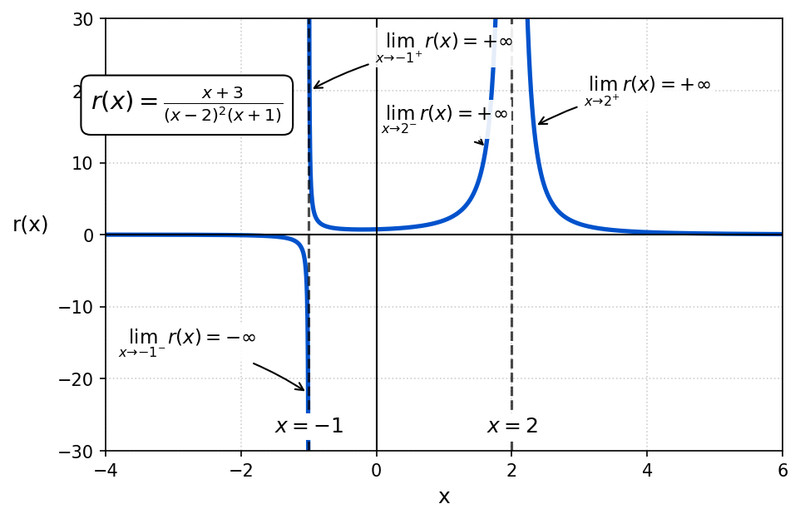
Rational function with vertical asymptotes
Vertical asymptotes come from real zeros of the denominator after shared factors are accounted for. Only real zeros matter here, because only real -values can give vertical lines on the real graph.
Which Denominator Zeros Become Vertical Asymptotes
A denominator zero is only the starting point. You have to compare it with the numerator.
For a real zero , there are four cases:
- Denominator zero only vertical asymptote
- Common zero, larger multiplicity in denominator vertical asymptote
- Common zero, equal multiplicities hole, no vertical asymptote
- Common zero, larger multiplicity in numerator no vertical asymptote, but is still excluded from the original function
The key idea is the factor . If, after cancellation, some is still left in the denominator, then is a vertical asymptote.
One common trap is seeing after substitution and deciding too fast. only tells you there is a shared zero. It does not tell you whether the result is an asymptote or a hole.
How to Find Vertical Asymptotes from an Equation
This is the full process you’ll use on quizzes and FRQs.
- Factor the numerator and denominator.
- List the real zeros of the denominator.
- Compare multiplicities at any shared zero.
- Cancel common factors to analyze the graph.
- Whatever real denominator factors remain give vertical asymptotes.
Example:
Denominator zeros are , , and .
- At , one cancels, but remains downstairs asymptote
- At , only the denominator is zero asymptote
- At , cancels completely hole, not an asymptote
So the vertical asymptotes are
The simplified form is
but remember is still excluded from the original domain.
Determining the Direction on Each Side
Once you know is a vertical asymptote, you still need the direction on each side.
Use the reduced factored form and check signs near .
- If the remaining power of in the denominator is odd, the sign changes across . The one-sided limits have opposite signs.
- If the remaining power is even, the sign stays the same across . The one-sided limits have the same sign.
For
- At , the factor has odd power, so signs switch:
- At , the factor has even power, so both sides match:
Reading Vertical Asymptotes from Graphs, Tables, and Wording
From a graph, look for branches approaching a vertical line and shooting up or down without bound.
From a table, look for inputs getting closer to the same number from left and right while outputs become very large positive or negative.
From words:
- “increase without bound as inputs approach from the right” means
- “decrease without bound as inputs approach from the left” means
Common mistakes:
- Calling every denominator zero an asymptote
- Forgetting multiplicities
- Treating a hole like an asymptote
- Writing
- Trusting a graphing window more than the algebra
