Topic 1.11 Notes – Equivalent Representations of Polynomial and Rational Expressions
What Equivalent Forms Show
The same polynomial or rational expression can be written in different equivalent forms. They match in value wherever the algebra is valid.
For polynomials, the two main forms are:
- Factored form like
- shows real zeros
- shows x-intercepts
- shows multiplicity of each zero
- Standard form like
- shows degree
- shows leading term and leading coefficient
- shows constant term and therefore the y-intercept
- helps with end behavior
For rational expressions, each form answers a different kind of question:
- Factored form
- shows excluded inputs from the original denominator
- shows holes from canceled factors
- shows vertical asymptotes from denominator factors left after canceling
- Standard form
- lets you compare numerator and denominator degrees
- gives horizontal asymptotes
- Division form
- writes the expression as a polynomial plus a remainder fraction
- can reveal a slant asymptote
A huge idea here is the difference between algebraic equivalence and same function. If you cancel a factor in a rational expression, that excluded -value stays excluded. It does not come back into the domain.
The graph below is a good example. After canceling, the simplified rule looks like , but the original expression still has a hole where the canceled factor made invalid. You can also see the vertical asymptote at , the horizontal asymptote , and the x-intercept at .
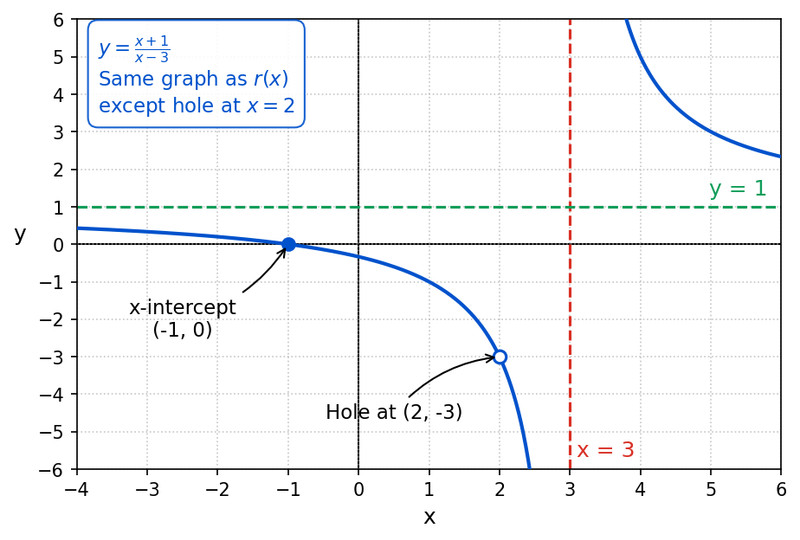
Rational function with a hole and asymptotes
Reading Polynomials and Rational Expressions from the Right Form
Polynomials
In factored form, zeros come from setting each factor equal to 0.
- gives zeros and
- multiplicity matters:
- odd multiplicity usually crosses the x-axis
- even multiplicity usually touches and bounces
In standard form, you read features directly:
- highest power = degree
- leading term controls end behavior
- constant term = y-intercept
Rational expressions
Factor completely first. Then classify features from the original denominator and what cancels.
| Feature | How to find it |
|---|---|
| x-intercepts | zeros of the simplified numerator that are still in the domain |
| vertical asymptotes | denominator factors left after canceling |
| holes | canceled denominator factors |
| domain | all real except zeros of the original denominator |
| horizontal asymptotes | compare degrees in standard form |
| range | when needed, solve for in terms of |
For horizontal asymptotes:
- numerator degree smaller
- equal degrees
- numerator degree larger no horizontal asymptote
A common trap is this one. If an extra numerator copy remains after canceling, the original excluded -value is still a hole, not an intercept.
Polynomial Long Division and Asymptotes
Long division rewrites
So
The process:
- Write both polynomials in descending powers.
- Insert missing powers with zero coefficients.
- Divide leading term by leading term.
- Put that result in the quotient.
- Multiply back and subtract.
- Repeat until the remainder degree is smaller than the divisor degree.
Example idea: if the quotient is , then the graph approaches for large because the remainder fraction goes to 0.
That is why long division helps with slant asymptotes. If the numerator degree is exactly 1 more than the denominator degree, the asymptote is a line. If the degree difference is bigger than 1, the end-behavior asymptote is a higher-degree polynomial.
Expanding Binomials with the Binomial Theorem
The Binomial Theorem expands repeated products like :
What to notice:
- coefficients come from Pascal’s Triangle or
- powers of the first term go down
- powers of the second term go up
- the exponents in each term add to
This Pascal’s Triangle diagram shows the coefficient patterns for the first few powers.
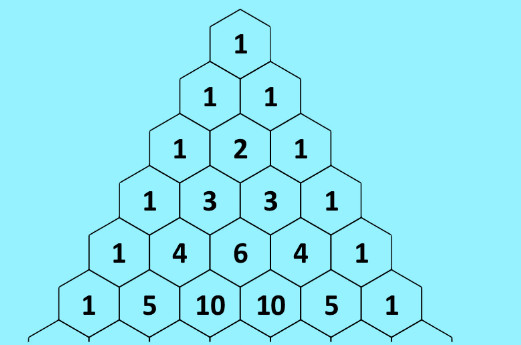
Pascal’s Triangle
Example:
For subtraction, use . The signs alternate because powers of the negative term alternate.
What to Do on the Test
Ask what feature the question wants. Zeros and holes usually mean factor. End behavior usually means standard form. Slant asymptote usually means division.
Keep these habits tight:
- factor first before naming rational-function features
- keep original domain restrictions after canceling
- a canceled factor is never an x-intercept
- include missing powers in long division
- in binomial expansions, Pascal numbers are coefficients, not exponents
