Topic 4.8 Notes – Vectors
Magnitude, direction, and components
A vector is a directed line segment. It has a tail where it starts, a head where it ends, a magnitude (its length), and a direction.
One common way to draw a vector is in standard position, with its tail at the origin.
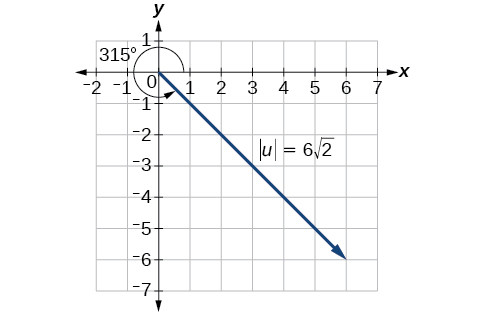
Vector in standard position
If and , then the vector from to is
So if and , then
That means “3 right and 4 up.”
A vector in standard position has its tail at the origin. So in standard position goes from to . You can slide a vector anywhere in the plane and it stays the same vector as long as magnitude and direction stay unchanged.
The zero vector is . It happens when . Its magnitude is , and it has no defined direction.
One trap here is context. might mean a point in the plane or the components of a vector. A point is a location. A vector is a change in location.
Magnitude, Direction, and Components
For a vector , the magnitude is
Example for :
The direction angle of a nonzero vector is measured from the positive -axis. You often use
but you must fix the quadrant using the signs of and . Inverse tangent alone often gives the wrong angle on tests.
If you know magnitude and direction , then the vector is
Example. Magnitude , direction :
If an angle is measured from some other axis, use cosine for the adjacent component and sine for the opposite one, then assign signs from the actual direction.
Quick habits that save points:
- Negative components change direction, not magnitude.
- Reversing endpoints changes both signs.
- .
Vector Operations
Scalar multiplication
If , then .
- keeps direction
- reverses direction
- gives the zero vector
Also,
Vector addition and subtraction
Adding vectors means combining total horizontal and vertical change. Geometrically, you can add by placing one vector tip-to-tail with the other, or by completing a parallelogram. Both give the same resultant vector.
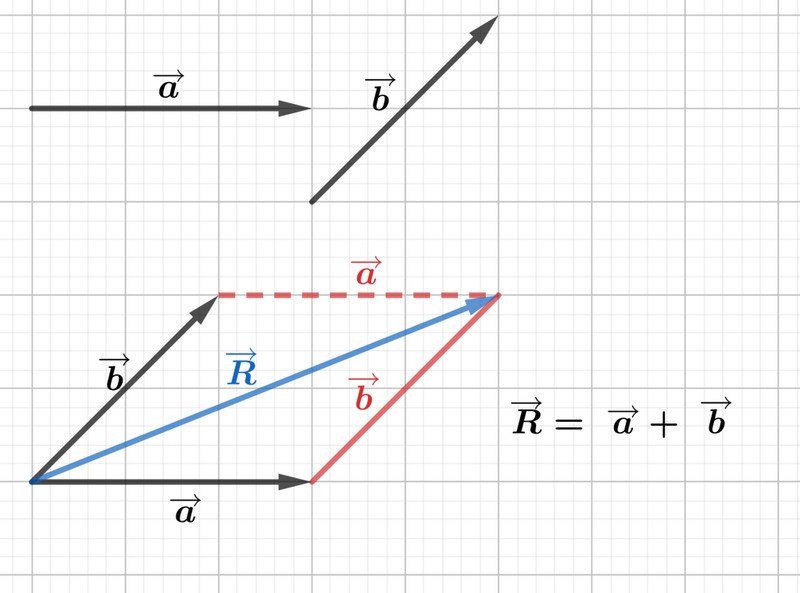
Vector addition
Example. .
Dot product
The dot product is a scalar, not a vector.
Example. .
For nonzero vectors:
- positive dot product means an acute angle
- zero dot product means a right angle
- negative dot product means an obtuse angle
Unit Vectors and Angle Between Vectors
A unit vector has magnitude . To normalize a nonzero vector,
For , the unit vector is . The zero vector cannot be normalized.
The standard unit vectors are
So .
The geometric dot product is
so for two nonzero vectors,
If and both vectors are nonzero, then they are perpendicular.
Triangles from Vector Addition and Common Traps
When two vectors are added head to tail, the two addends and the resultant form a triangle. The diagram compares that triangle with the same two vectors drawn from a common tail, which is where the angle students are usually given appears.
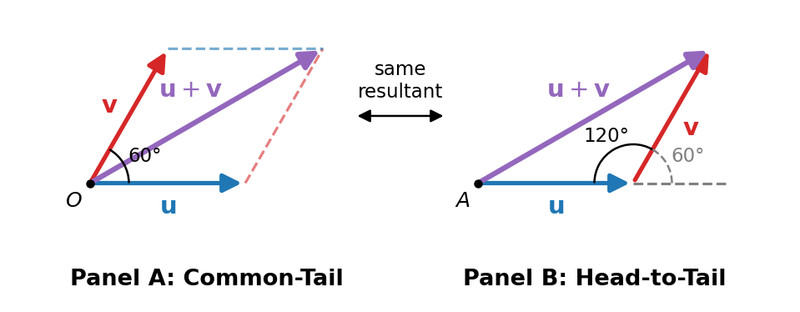
Common-tail angle and head-to-tail triangle
If the magnitudes are and and the common-tail angle is , then
That matches the Law of Cosines because the triangle’s interior angle is , not . In the picture, a common-tail angle becomes a angle in the triangle.
You may also use
to find unknown angles in the triangle.
Three equivalent ways to find :
- add components, then find magnitude
- use triangle trig
- use
