Topic 3.4 Notes – Sine and Cosine Function Graphs
What Sine and Cosine Are
On the unit circle, an angle in standard position lands at a point
That single fact drives the whole topic.
In the unit-circle diagram, the point in Quadrant I shows the basic idea. The horizontal coordinate is cosine, and the vertical coordinate is sine.
- is the signed -coordinate of
- is the signed -coordinate of
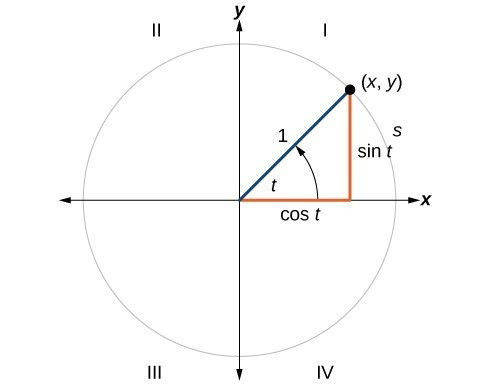
Sine and cosine on the unit circle
“Signed” matters.
- Below the -axis, sine is negative.
- Left of the -axis, cosine is negative.
The graph connection is the part students mix up most:
- Unit-circle point
- Sine graph point
- Cosine graph point
So the graph’s horizontal axis is the angle input , not the unit-circle -coordinate.
A few facts you need right away:
- Domain of both sine and cosine is all real numbers
- Range of both is
- Positive angles go counterclockwise, negative angles go clockwise
- Angles bigger than mean extra revolutions
Building the Parent Graphs from the Unit Circle
The quarter-turn angles give the landmarks for one full revolution:
Sine graph landmarks
At those angles, the unit-circle points are
.
Reading the -values gives the sine graph points:
Sine goes up to , down through to , then back up to .
Cosine graph landmarks
Reading the -values instead gives:
Cosine goes down from to , then back up to .
The graphs below show those five landmark points for one full cycle of each function.
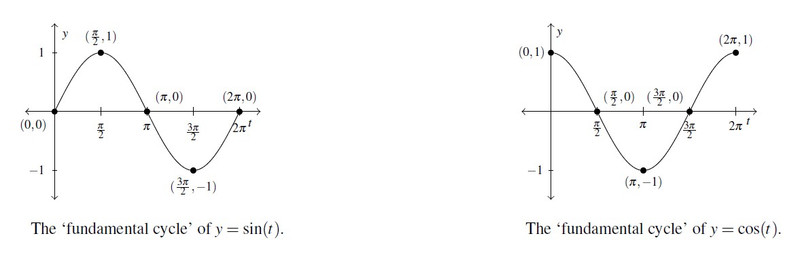
Parent graphs of sine and cosine on to
These are smooth curves, not broken line segments. And the fastest way to tell them apart is at :
Reading Key Features from the Circle and the Graph
The landmarks repeat every full revolution, so
where is any integer.
For sine:
- zeros when
- maximum when
- minimum when
For cosine:
- zeros when
- maximum when
- minimum when
One common wording trap: is the maximum output value. is an input where sine reaches that maximum.
Moving Between Representations
You should be able to move back and forth between circle, graph, and function values.
- From a unit-circle point, read off sine from and cosine from .
- From a graph point like , the first coordinate is the angle and the second is the output.
- “Vertical position” means sine. “Horizontal position” means cosine.
Examples:
- If and the terminal point is , then
and the sine graph has point
and the cosine graph has point - If , the terminal point is , so
and
A single sine or cosine value usually matches more than one angle, so the output alone usually does not give one unique input.
Common Mix-Ups
- The graph’s horizontal axis is , not the unit-circle -coordinate.
- Sine and cosine are signed coordinates, not plain distances.
- Sine = vertical, cosine = horizontal.
- Both parent graphs stay between and .
- The curve should look wavelike and smooth.
- Cosine “increasing” means the -coordinate is increasing. The distance from the origin never changes on the unit circle.
