5m left·0%
Reading Time: 5 min
Last Updated: September 10, 2026
Main Ideas: 5
Reading Time: 5 min
Last Updated: September 10, 2026
Main Ideas: 5

Topic 4.12 Notes – Linear Transformations and Matrices

Verified for 2027 AP® Precalculus Exam
Read aloud
This topic is about using a 2×22\times2 matrix to carry out a linear transformation in R2\mathbb R^2. You’re taking input vectors, writing them as columns, multiplying, and reading the output vectors that come out of the transformation.

How a linear map acts on the plane

A linear transformation L:R2→R2L:\mathbb R^2\to\mathbb R^2 takes a vector like (x,y)(x,y) and sends it to another vector by a linear rule. In this topic, that rule has the form

L(x,y)=(ax+by,  cx+dy) L(x,y)=(ax+by,\;cx+dy)

That means each output piece is built from constant multiples of xx and yy, then added together.

A vector has to be written as a column for matrix multiplication:

[xy] \begin{bmatrix}x\\y\end{bmatrix}

What counts as linear:

  • L(x,y)=(3x−2y,  x+4y)L(x,y)=(3x-2y,\;x+4y)
  • L(x,y)=(−y,  2x)L(x,y)=(-y,\;2x)

What does not count:

  • added constants, like (3x−2y+5,  x+4y)(3x-2y+5,\;x+4y)
  • products, like (xy,  x+y)(xy,\;x+y)
  • powers, like (x2,  y)(x^2,\;y)

One fast check is the zero-vector test. Every linear transformation sends

0=[00]to0 \mathbf 0=\begin{bmatrix}0\\0\end{bmatrix} \quad\text{to}\quad \mathbf 0

So if L(0)≠0L(\mathbf 0)\ne \mathbf 0, the rule is definitely not linear.
Be careful, though. If L(0)=0L(\mathbf 0)=\mathbf 0, that does not prove linearity by itself.

A common trap is a translation:

T(x,y)=(x+h,  y+k) T(x,y)=(x+h,\;y+k)

This is not linear unless h=k=0h=k=0, because the origin moves.

The Matrix Form of a Linear Transformation

Every linear transformation here matches exactly one 2×22\times2 matrix AA so that

L(v)=Av L(\mathbf v)=A\mathbf v

If

L(x,y)=(ax+by,  cx+dy) L(x,y)=(ax+by,\;cx+dy)

then the matrix is

A=[abcd] A=\begin{bmatrix}a&b\\c&d\end{bmatrix}

So you can read the matrix directly from the coefficients of xx and yy in each output component.

  • first output ax+byax+by gives the first row [a    b][a\;\;b]
  • second output cx+dycx+dy gives the second row [c    d][c\;\;d]

Example:

L(x,y)=(2x−3y,  5x+y)⇒A=[2−351] L(x,y)=(2x-3y,\;5x+y) \quad\Rightarrow\quad A=\begin{bmatrix}2&-3\\5&1\end{bmatrix}

This matrix form explains why linear transformations preserve structure:

  • L(u+v)=L(u)+L(v)L(\mathbf u+\mathbf v)=L(\mathbf u)+L(\mathbf v)
  • L(ku)=kL(u)L(k\mathbf u)=kL(\mathbf u)
  • L(ru+sv)=rL(u)+sL(v)L(r\mathbf u+s\mathbf v)=rL(\mathbf u)+sL(\mathbf v)

“Unique matrix” means one whole transformation rule gives one matrix. It does not mean one input-output pair is enough to find the matrix.

Transforming One Vector

Here’s the full move.

  1. Write the vector as a 2×12\times1 column.
  2. Put the matrix on the left.
  3. Multiply using row-by-column dot products.

Example:

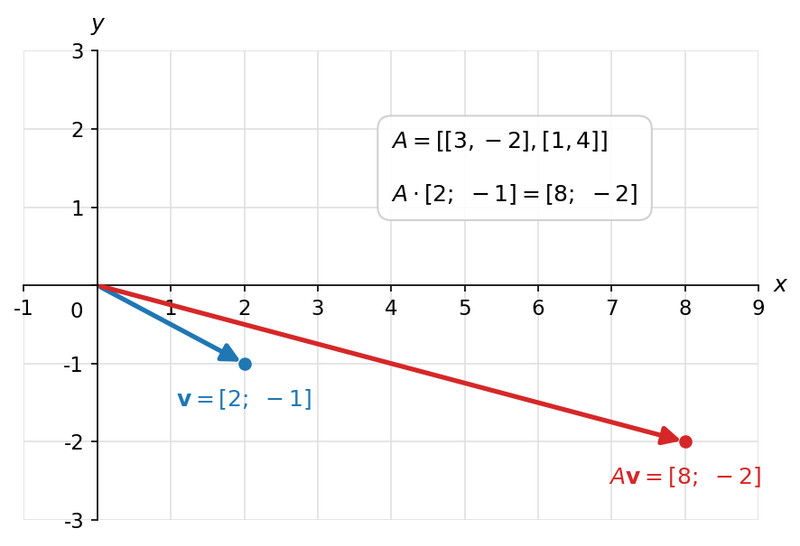
A=[3−214],v=[2−1] A=\begin{bmatrix}3&-2\\1&4\end{bmatrix}, \qquad \mathbf v=\begin{bmatrix}2\\-1\end{bmatrix}

Then

Av=[3−214][2−1]=[3(2)+(−2)(−1)1(2)+4(−1)]=[8−2] A\mathbf v= \begin{bmatrix}3&-2\\1&4\end{bmatrix} \begin{bmatrix}2\\-1\end{bmatrix} = \begin{bmatrix}3(2)+(-2)(-1)\\1(2)+4(-1)\end{bmatrix} = \begin{bmatrix}8\\-2\end{bmatrix}

So the output vector is [8−2]\begin{bmatrix}8\\-2\end{bmatrix}. On a graph, the transformation sends v\mathbf v from (2,−1)(2,-1) to (8,−2)(8,-2).

Quick checks:

  • dimensions work because (2×2)(2×1)=2×1(2\times2)(2\times1)=2\times1
  • the order is AvA\mathbf v, never vA\mathbf vA

Common mistakes:

  • writing the vector as a row
  • reversing the order
  • multiplying entries straight across instead of using row-by-column
  • giving a scalar instead of a vector

Transforming Several Vectors at Once

If you have nn vectors, put them into a 2×n2\times n matrix by columns:

V=[v1v2⋯vn] V=\begin{bmatrix}\mathbf v_1&\mathbf v_2&\cdots&\mathbf v_n\end{bmatrix}

Then multiplying AVAV transforms all of them at once:

AV=[Av1Av2⋯Avn] AV=\begin{bmatrix}A\mathbf v_1&A\mathbf v_2&\cdots&A\mathbf v_n\end{bmatrix}

So each output column matches the same input column.

Example setup:

V=[20−1−132] V=\begin{bmatrix}2&0&-1\\-1&3&2\end{bmatrix}

This means the input vectors are [2−1]\begin{bmatrix}2\\-1\end{bmatrix}, [03]\begin{bmatrix}0\\3\end{bmatrix}, and [−12]\begin{bmatrix}-1\\2\end{bmatrix}.

Dimension check:

(2×2)(2×n)=2×n (2\times2)(2\times n)=2\times n

This is useful for transforming the vertices of a figure all at once.

Common mistakes:

  • putting vectors in rows
  • mixing entries from different columns
  • matching an output with the wrong input column

What to Watch for on Problems

This topic is about finding output vectors from a given 2×22\times2 matrix and either one vector or a matrix of vectors.

It does not yet include finding a matrix from partial information, composing transformations, inverses, or classifying geometry in detail.

Key Takeaways

A linear transformation in this topic must look like L(x,y)=(ax+by,  cx+dy)L(x,y)=(ax+by,\;cx+dy).
If a rule adds a constant, includes xyxy, or includes powers like x2x^2, it is not linear.
Every linear transformation sends 0\mathbf 0 to 0\mathbf 0, but passing that test alone does not prove linearity.
The matrix for L(x,y)=(ax+by,  cx+dy)L(x,y)=(ax+by,\;cx+dy) is [abcd]\begin{bmatrix}a&b\\c&d\end{bmatrix}.
The fastest way to build the matrix is to read the coefficients of xx and yy from each output component.
Vectors must be written as columns, and the multiplication order is AvA\mathbf v.
For several vectors, each input vector is one column of a 2×n2\times n matrix, and each output stays in the matching column.
A translation like T(x,y)=(x+h,  y+k)T(x,y)=(x+h,\;y+k) is not linear unless h=0h=0 and k=0k=0.

AP® is a trademark registered by the College Board, which is not affiliated with, and does not endorse this website.

Notes

1 credit used · 5/5 remaining