Topic 4.9 Notes – Vector-Valued Functions
What a Vector-Valued Position Function Is
A vector-valued position function gives the particle’s location in the plane at time .
Those are the same thing written two ways. It is also the same motion as the parametric equations , . Vector form just packages both coordinates into one vector.
- tells you where the particle is
- the point is
- the position vector is drawn from the origin to that point
- a restricted interval like gives the time of the motion, so it also determines the start and end points
The graph here is the path in the coordinate plane. It is not a graph with on an axis. Arrows on the path show which way the particle moves as increases.
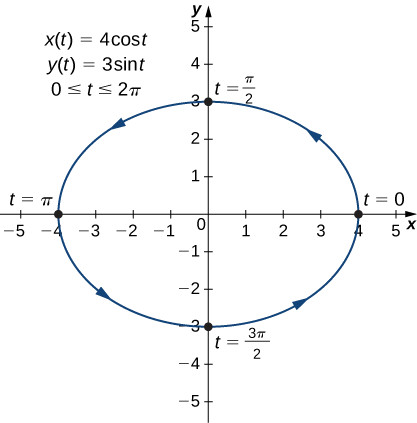
Parametric path of a particle in the plane
Position, Distance from the Origin, Velocity, and Speed
These four ideas get mixed up a lot, so keep them separate.
- Position
tells the particle’s location. - Distance from the origin
This is the straight-line distance from to the particle. - Velocity
Differentiate component by component. - Speed
Speed is the magnitude of velocity.
Example with
- position at
- distance from origin at
- velocity
- speed at
Two common traps:
- is not total distance traveled along the path
- speed can never be negative, even if one or both velocity components are negative
How to Read Direction of Motion
Direction comes from the velocity components, not from where the particle is located.
Horizontal motion
Use .
- means moving right
- means moving left
- means no horizontal motion at that instant
Vertical motion
Use .
- means moving up
- means moving down
- means no vertical motion at that instant
Combined direction
- right and up
- right and down
- left and up
- left and down
If one component is zero, the motion is purely horizontal or vertical. If both are zero, the particle is instantaneously at rest.
A point like only tells location. It does not tell left, right, up, or down.
Working from Different Representations
From a formula for :
- evaluate for location
- compute for distance from the origin
- differentiate for
- use the signs of and for direction
- compute for speed
From a formula or table for :
- use component signs for direction
- use magnitude for speed
- support your answer with the actual values or signs
From a graph of the path:
- you can identify the shape of the path
- you need arrows, time labels, or extra information to know direction or speed
- the same path can come from different motions
Common Mix-Ups
- confusing position with velocity
- using signs of and instead of signs of and
- saying means distance traveled
- forgetting speed is , so it is never negative
- treating the path as if were one of the graph axes
- giving a vague answer when the question asks for a specific quantity like location, velocity, direction, or speed
