Topic 4.2 Notes – Parametric Functions Modeling Planar Motion
What a Parametric Planar Motion Function Represents
A parametric planar motion function has the form
That ordered pair is the particle’s position at time .
- tells you the horizontal position
- tells you the vertical position
- At one specific time , the position is
The biggest thing to keep straight is that both coordinates come from the same time. If and , that does not mean the particle was at .
The graph of a parametric motion function is drawn in the -plane. It shows the path or trajectory of the particle, meaning where it travels. It is not a graph with on an axis.
A few details matter a lot on quizzes:
- The domain of is the time interval where the motion is defined.
- If endpoints are included, those give the initial and terminal positions.
- The same location can happen at more than one time, because different -values can produce the same ordered pair.
Reading Position from Equations, Tables, and Graphs
From an equation, plug in the time you want.
Example: if , then
From a table, each row is one full position at one common time. Keep the row together.
- Good reading: at , the particle is at
- Common mistake: taking from one row and from another
If a table repeats a point, that means the particle returned to the same place at different times.
From a path graph, you can tell which locations are on the path, but unless time labels are shown, you usually cannot tell when the particle is there.
Also, if you’re using a graph or sampled table, your answer may be approximate. And one table entry alone does not prove an absolute max or min unless the full behavior is known.
Horizontal and Vertical Extrema
For planar motion, left-right information comes from , and up-down information comes from .
- Leftmost point comes from the minimum of
- Rightmost point comes from the maximum of
- Lowest point comes from the minimum of
- Highest point comes from the maximum of
How to find them
- Work over the given domain of .
- Analyze for horizontal extrema.
- Analyze for vertical extrema.
- Check included endpoints.
- Report exactly what the question asks for.
That last part is where people lose points. A problem might ask for:
- the extreme coordinate value
- the time when it happens
- the full position of the particle
Those are different answers.
Useful tools here include:
- quadratic vertex
- sinusoidal amplitude and midline
- graph or table estimates
If an endpoint is open, the particle may approach an extreme location without ever actually reaching it.
Also, the rightmost or highest point is not the point farthest from the origin. Different idea.
Finding Intercepts of the Parametric Path
Intercepts are about where the path meets an axis.
-intercepts
A point is on the -axis when , so solve
Then plug each allowed time into , and write the point as .
-intercepts
A point is on the -axis when , so solve
Then plug each allowed time into , and write the point as .
In the graph below, the path hits the same -intercept at two different times and also has an -intercept.
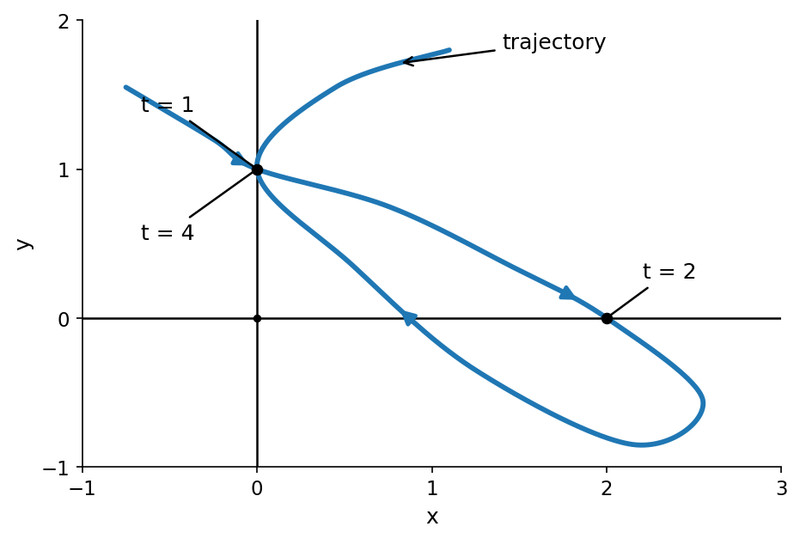
Intercepts on a parametric path
Two important cases show up a lot:
- Same intercept, different times. Two values of can give the same intercept point.
- Origin. If and at the same allowed time, the path goes through , which is both an - and -intercept.
If one component stays zero for an interval, part of the path lies along an axis. And an intercept does not have to be a crossing. The path might just touch the axis and turn around.
What to Say and What Students Mix Up
Be precise with the kind of answer you give.
- Time is a -value.
- A coordinate value is just an -value or a -value.
- A position is the full ordered pair .
If units are given, keep them attached. Time might be in seconds, while position might be in meters.
A phrase like “maximum horizontal position” means the answer is an -value. A phrase like “where is the particle” means the answer is a point.
Also keep these traps in mind:
- Always respect the domain.
- Don’t treat the path graph as being a function of .
- Don’t combine with when .
- Don’t assume a single table row proves an absolute extremum.
