Topic 1.6 Notes – Polynomial Functions and End Behavior
What End Behavior Is
For a polynomial , end behavior asks two separate questions:
- What happens as → the right end
- What happens as → the left end
The output can only do one of two things at each end:
A graph rises if outputs go to . It falls if outputs go to .
That’s all long-run behavior. The middle of the graph can wiggle, cross the axis, and turn around a lot. None of that changes the ends.
These four sketches show the standard end-behavior patterns you’ll use over and over.
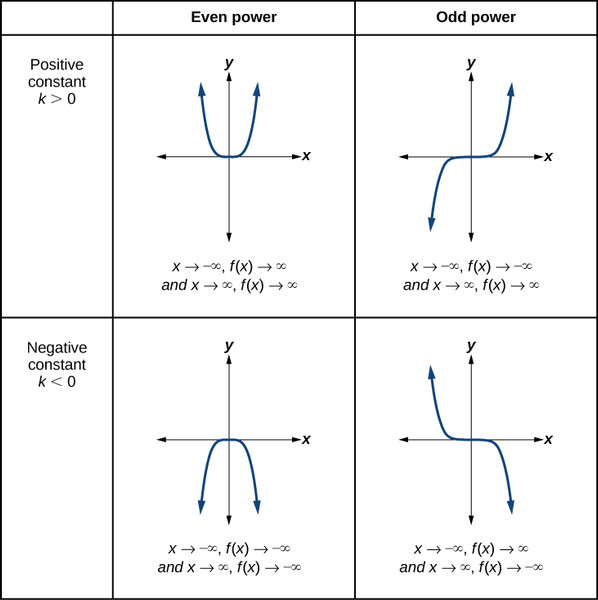
Common polynomial end-behavior patterns
A quick reminder from earlier polynomial work: when gets very large, the highest-power term matters most.
The Leading Term Controls the Ends
A polynomial in standard form looks like
Here:
- leading term is
- leading coefficient is
- degree is
Lower-degree terms matter in the middle, but not at the ends, because grows much faster than , and constants when is large.
The only two features you need are:
- parity of degree
- even degree → both ends go the same way
- odd degree → ends go opposite ways
- sign of leading coefficient
- positive → right end rises
- negative → right end falls
The four cases
| Degree and sign | Example | Left end | Right end |
|---|---|---|---|
| even, positive | rises | rises | |
| even, negative | falls | falls | |
| odd, positive | falls | rises | |
| odd, negative | rises | falls |
Fast shortcut to memorize:
- even = same on both ends
- odd = opposite ends
- the sign tells the right end
Finding End Behavior from an Equation
When the polynomial is already in standard form, the process is quick:
- Find the term with the greatest exponent.
- Decide whether that exponent is even or odd.
- Check whether its coefficient is positive or negative.
- Use the four-case chart.
For , the leading term is .
- degree → odd
- coefficient → negative
So the graph rises left and falls right:
If the polynomial is factored, build the leading term from the factors. For
the leading parts are and , so the overall leading term is
That gives odd degree, negative coefficient, so again:
- rises to the left
- falls to the right
On a quiz, write the conclusion either in limit notation or in graph words.
Reading End Behavior from a Graph or Table
From a graph, look only at the far left and far right. Ignore turning points in the middle.
- both ends up → even degree, positive leading coefficient
- both ends down → even degree, negative leading coefficient
- left down, right up → odd degree, positive leading coefficient
- left up, right down → odd degree, negative leading coefficient
You can infer parity and sign, but not exact degree. A quadratic and a quartic can both rise on both ends.
From a table, very large positive and negative inputs can suggest end behavior, but a finite table is only evidence unless you know the actual polynomial rule.
Also be careful with graphing windows. A calculator can hide the true far-end behavior.
Common Mistakes and Edge Cases
- Using a lower-degree term instead of the leading term.
- Mixing up left end with right end.
- Confusing with the graph going down. Those are different. tells input direction; the limit tells output direction.
- Letting middle behavior decide the ends.
- Claiming the exact degree from end behavior alone.
- Forgetting constants:
- if , then both limits equal
- if , the output is always
