Topic 1.5 Notes – Polynomial Functions and Complex Zeros
What Polynomial Zeros Tell You
A zero is an input value that makes the polynomial equal 0, so . That same number is also a root of the equation .
These ideas travel together:
- If , then is a zero.
- If is real, then is a factor.
- If is real, then is an x-intercept of the graph.
Be careful with the language:
- A zero is a number like
- An x-intercept is a point like
The sign in the factor is always opposite the zero.
- zero ↔ factor
- zero ↔ factor
A degree- polynomial has exactly complex zeros counting multiplicity. That does not mean x-intercepts, because:
- some zeros can repeat
- some zeros can be non-real
- only real zeros show up on the real graph
Zeros, Multiplicity, and Complex Conjugates
Multiplicity and the graph
If a factor repeats, then has multiplicity equal to that exponent.
- means zero has multiplicity
What the graph does at depends most on whether is even or odd:
- even multiplicity
The graph touches the x-axis and turns around. The sign stays the same on both sides. - odd multiplicity
The graph crosses the x-axis. The sign changes across the zero.
This picture compares multiplicities 1, 2, and 3 at the same zero so you can see that behavior side by side.
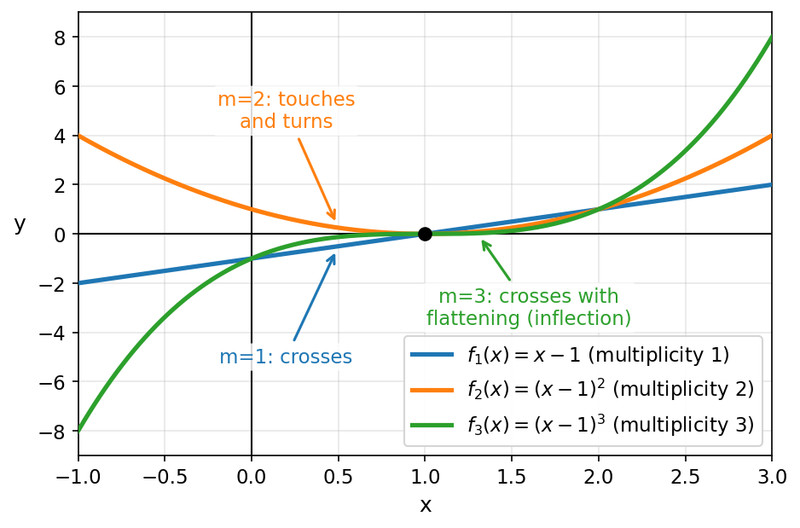
You usually can tell even vs odd from the graph. You usually cannot tell the exact multiplicity for sure just from the picture.
Real zeros also matter in inequalities, because they split the number line into intervals.
Complex zeros and conjugate pairs
For polynomials with real coefficients, non-real zeros come in conjugate pairs:
- if is a zero, then is also a zero
Examples you should recognize:
- and
- and
- and
Those paired factors multiply into a quadratic with real coefficients. For example,
One big consequence is that an odd-degree polynomial with real coefficients must have at least one real zero.
Finding and Using Zeros
When a polynomial is factored, use the zero-product property.
- Set each factor equal to 0.
- Solve each one.
- List repeated zeros as many times as their multiplicity.
- Solve quadratic factors too, even if they give non-real answers.
- Check that the total number of zeros matches the degree.
Example:
Zeros:
- twice
That’s 5 zeros counting multiplicity, matching degree 5.
If the polynomial does not factor nicely, graphing technology can approximate real zeros. The graphing window matters. A zero outside the window can disappear. A standard graph only shows real zeros unless your calculator has a complex root feature.
For polynomial inequalities:
- Find the distinct real zeros
- Put them on a number line
- Break the line into intervals
- test signs, or use multiplicity to track sign changes
- Include zeros for or , exclude for or
Non-real zeros are never interval endpoints.
Degree from Successive Differences
This works only when the input values are equally spaced.
You keep subtracting consecutive outputs:
- constant first differences → linear
- constant second differences → quadratic
- constant third differences → cubic
The first row of differences that becomes constant gives the degree. If inputs are not equally spaced, this test does not work.
Even and Odd Polynomial Functions
A polynomial can be even, odd, or neither.
- even means
Graph symmetry is across the y-axis. - odd means
Graph symmetry is about the origin.
For monomials :
- even exponent → even function
- odd exponent → odd function
For full polynomials:
- only even powers, plus maybe a constant → even
- only odd powers → odd
- nonzero constant term blocks odd symmetry
- mixed even and odd powers usually means neither
Important consequences:
- If an even polynomial has zero , then is also a zero.
- Every odd polynomial has , so it passes through the origin.
The common trap is mixing up odd degree with odd function. Degree uses the highest power only. Even/odd symmetry depends on all terms.
