5m left·0%
Reading Time: 5 min
Last Updated: August 24, 2026
Main Ideas: 4
Reading Time: 5 min
Last Updated: August 24, 2026
Main Ideas: 4

Topic 2.13 Notes – Exponential and Logarithmic Equations and Inequalities

Verified for 2027 AP® Precalculus Exam
Read aloud
This topic is about solving equations and inequalities where the variable is inside an exponent or inside a logarithm, and about building inverse functions for transformed exponential and logarithmic forms. The whole unit hangs on one fact: exponentials and logs undo each other, but only when you respect their domain and range restrictions.

Solving Exponential and Logarithmic Equations

The central inverse relationship is

log⁡b(x)=c  ⟺  bc=x \log_b(x)=c \iff b^c=x

with b>0b>0, b≠1b\ne1, and x>0x>0.

That gives you the two matching rules you use all the time:

  • If bu=bvb^u=b^v, then u=vu=v, but only after the bases match.
  • If log⁡b(M)=log⁡b(N)\log_b(M)=\log_b(N), then M=NM=N, but only when M>0M>0 and N>0N>0.

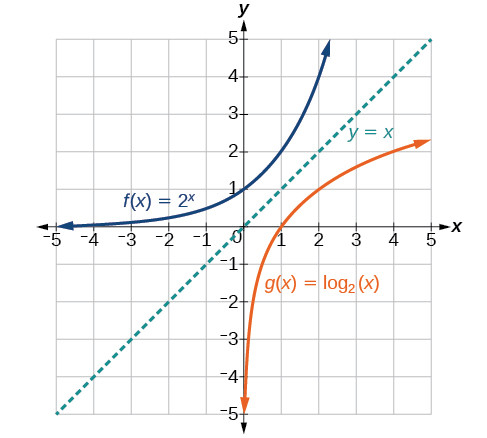
It also helps to keep the inverse relationship in mind visually. The exponential and logarithmic graphs are reflections across y=xy=x.

Study guide illustration

Exponential equations

A few common forms show up over and over:

  1. Same base

    8x−1=42x+1 8^{x-1}=4^{2x+1}

    Rewrite with base 2:

    23x−3=24x+2 2^{3x-3}=2^{4x+2}

    so 3x−3=4x+23x-3=4x+2, giving x=−5x=-5.

  2. Isolate and convert

    32x+1=5 3^{2x+1}=5

    Convert:

    2x+1=log⁡35 2x+1=\log_3 5

    so

    x=log⁡35−12 x=\frac{\log_3 5-1}{2}

    Keep this exact unless a decimal is requested.

  3. Take ln⁡\ln of both sides

    2x+1=53−x 2^{x+1}=5^{3-x}

    Then

    (x+1)ln⁡2=(3−x)ln⁡5 (x+1)\ln2=(3-x)\ln5

    and solve normally.

  4. Substitute for repeated structure

    4x−5(2x)+4=0 4^x-5(2^x)+4=0

    Let u=2xu=2^x. Then 4x=(2x)2=u24^x=(2^x)^2=u^2, so

    u2−5u+4=0 u^2-5u+4=0

    giving u=1u=1 or u=4u=4, so x=0x=0 or x=2x=2.

Also remember bx=exln⁡bb^x=e^{x\ln b}. That can make awkward bases easier to handle.

Logarithmic equations

  • A single log often converts straight to exponential form:

    log⁡3(2x−1)=2⇒2x−1=9⇒x=5 \log_3(2x-1)=2 \Rightarrow 2x-1=9 \Rightarrow x=5

  • If you can combine logs, do it before solving:

    ln⁡(x−2)+ln⁡(x+1)=ln⁡10 \ln(x-2)+\ln(x+1)=\ln10

    becomes

    ln⁡((x−2)(x+1))=ln⁡10 \ln((x-2)(x+1))=\ln10

    so (x−2)(x+1)=10(x-2)(x+1)=10, then solve. The product rule ln⁡A+ln⁡B=ln⁡(AB)\ln A+\ln B=\ln(AB) needs A>0A>0 and B>0B>0, so here that means x>2x>2.

If symbolic isolation gets ugly, graphs or numerical methods are fair game. For example, 2x=x+22^x=x+2 is usually solved by graphing intersections.

Restrictions and Extraneous Solutions

This is where a lot of quiz points disappear.

  • Exponential restriction
    bu>0b^u>0 for every real uu. So bu=0b^u=0 or bu=cb^u=c with c≤0c\le0 has no real solution.

  • Logarithmic restriction
    Every log argument must be strictly positive.

So in

log⁡2(x−3)+log⁡2(x+1)=4 \log_2(x-3)+\log_2(x+1)=4

you need x−3>0x-3>0 and x+1>0x+1>0, so x>3x>3, before solving.

Extraneous solutions often come from:

  • combining logs and then solving a polynomial,
  • substitution that gives an impossible value like u≤0u\le0 when u=2xu=2^x,
  • context limits such as time needing x≥0x\ge0.

Always check candidates in the original equation, or at least check every original log argument.

Solving Exponential and Logarithmic Inequalities

Monotonicity controls the direction.

  • If b>1b>1, bxb^x and log⁡bx\log_b x are increasing, so the inequality direction stays the same.
  • If 0<b<10<b<1, they are decreasing, so the direction reverses.

Exponential inequalities

(13)2x−1≥9 \left(\frac13\right)^{2x-1}\ge9

Rewrite 99 as (13)−2\left(\frac13\right)^{-2}. Since the base is between 0 and 1, reverse the inequality:

2x−1≤−2 2x-1\le-2

so x≤−12x\le-\frac12.

Logarithmic inequalities

Domain first. Always.

log⁡1/2(x−1)<−2 \log_{1/2}(x-1)<-2

You need x>1x>1. Rewrite −2-2 as log⁡1/24\log_{1/2}4. Since base 1/21/2 is decreasing:

x−1>4 x-1>4

so x>5x>5.

Graphically, solving F(x)>G(x)F(x)>G(x) means finding where the graph of FF lies above GG. Endpoints come from intersections and excluded domain values.

Undoing a transformed exponential or logarithm

The two forms are

f(x)=abx−h+kandf(x)=alog⁡b(x−h)+k f(x)=ab^{x-h}+k \qquad\text{and}\qquad f(x)=a\log_b(x-h)+k

Inverse of a transformed exponential

From y=abx−h+ky=ab^{x-h}+k, undo in reverse order: subtract kk, divide by aa, apply log⁡b\log_b, add hh.

f−1(x)=h+log⁡b(x−ka) f^{-1}(x)=h+\log_b\left(\frac{x-k}{a}\right)

Inverse of a transformed logarithm

From y=alog⁡b(x−h)+ky=a\log_b(x-h)+k, undo by: subtract kk, divide by aa, convert to exponential form, add hh.

f−1(x)=h+b(x−k)/a f^{-1}(x)=h+b^{(x-k)/a}

These two graphs show the full pattern in action for one transformed exponential and one transformed logarithm.
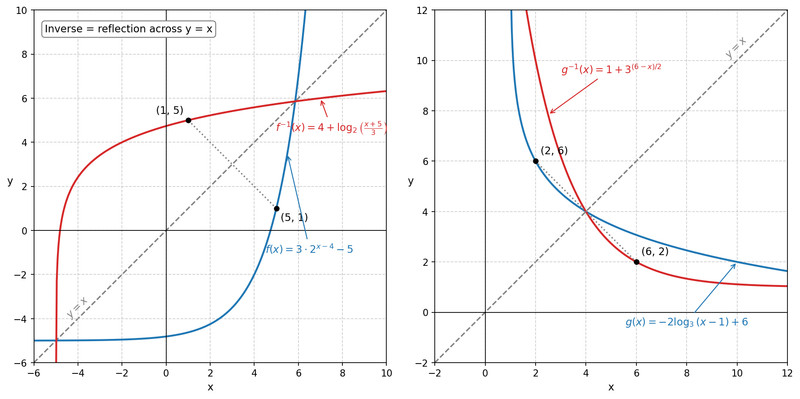
Inverses of transformed exponential and logarithmic functions

Domain and range swap between a function and its inverse, and the graphs reflect across y=xy=x. The labeled points make that swap easy to see. A quick check is composition: f(f−1(x))=xf(f^{-1}(x))=x on the inverse’s domain.

Key Takeaways

You can only set exponents equal after rewriting both sides with the same base.
Every original log argument must stay greater than 0, even after you combine logs.
Exponential expressions are always positive, so equations forcing them to be 0 or negative have no real solution.
For bases 0<b<10<b<1, both exponential and logarithmic inequalities reverse direction.
Substitution like u=2xu=2^x carries the hidden restriction u>0u>0.
Exact answers like ln⁡5ln⁡3\frac{\ln 5}{\ln 3} should stay exact unless the problem asks for a decimal.
The inverse of abx−h+kab^{x-h}+k is h+log⁡b(x−ka)h+\log_b\left(\frac{x-k}{a}\right).
The inverse of alog⁡b(x−h)+ka\log_b(x-h)+k is h+b(x−k)/ah+b^{(x-k)/a}.

AP® is a trademark registered by the College Board, which is not affiliated with, and does not endorse this website.

Notes

1 credit used · 5/5 remaining