5m left·0%
Reading Time: 5 min
Last Updated: August 25, 2026
Main Ideas: 5
Reading Time: 5 min
Last Updated: August 25, 2026
Main Ideas: 5

Topic 3.13 Notes – Trigonometry and Polar Coordinates

Verified for 2027 AP® Precalculus Exam
Read aloud
Polar coordinates locate points with an angle and a signed distance from the origin instead of horizontal and vertical movement. In this topic, you convert between polar and rectangular coordinates, recognize when different polar pairs name the same point, and connect all of that to complex numbers in the plane.

What Polar Coordinates Are

A polar point is written as (r,θ)(r,\theta), not (x,y)(x,y).

  • The pole is the origin.
  • The polar axis is the positive xx-axis.
  • θ\theta is the angle in standard position.
  • rr is the signed radial displacement.

That word signed matters.

  • If r>0r>0, move ∣r∣|r| units along the terminal ray of θ\theta.
  • If r<0r<0, move ∣r∣|r| units in the opposite direction along the same line.
  • The actual distance from the origin is ∣r∣|r|.

So (−4,π6)\left(-4,\frac{\pi}{6}\right) does not sit in Quadrant I. The angle points there, but the negative radius flips the point across the origin, as the diagram shows.
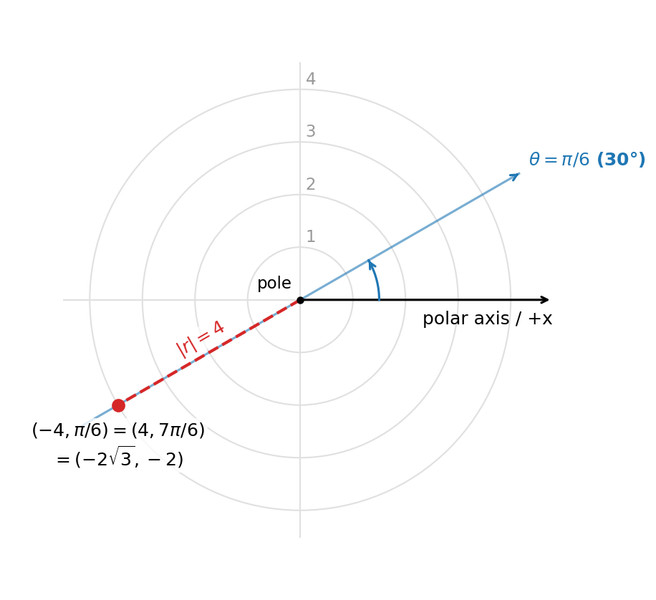
One more special case. (0,θ)(0,\theta) is always the pole, no matter what angle you use. That leads right into the biggest difference from rectangular coordinates.

Equivalent Polar Representations

A rectangular point has one name. A polar point has infinitely many.

You get equivalent names in two ways:

(r,θ)=(r,θ+2πk) (r,\theta)=(r,\theta+2\pi k)

Same radius, coterminal angles.

(r,θ)=(−r,θ+(2k+1)π) (r,\theta)=(-r,\theta+(2k+1)\pi)

Changing the sign of rr means the angle must shift by an odd multiple of π\pi.

In degrees, those become adding 360∘k360^\circ k or an odd multiple of 180∘180^\circ.

For one point, all of these are equivalent:

Polar form
(−4,π6)\left(-4,\frac{\pi}{6}\right)
(4,7π6)\left(4,\frac{7\pi}{6}\right)
(−4,13π6)\left(-4,\frac{13\pi}{6}\right)
(4,−5π6)\left(4,-\frac{5\pi}{6}\right)

A lot of quiz mistakes happen because students forget that negative rr flips the point across the origin.

If a problem asks for a specific form, check the instructions carefully.

  • positive rr
  • angle in an interval like 0≤θ<2π0\le \theta<2\pi
  • negative angles allowed or not

Converting Between Polar and Rectangular Coordinates

Polar to rectangular

Use

x=rcos⁡θy=rsin⁡θ x=r\cos\theta \qquad y=r\sin\theta

Example:

(−4,π6) \left(-4,\frac{\pi}{6}\right)

x=−4cos⁡π6=−4⋅32=−23 x=-4\cos\frac{\pi}{6}=-4\cdot\frac{\sqrt3}{2}=-2\sqrt3

y=−4sin⁡π6=−4⋅12=−2 y=-4\sin\frac{\pi}{6}=-4\cdot\frac12=-2

So the rectangular coordinates are (−23,−2)\boxed{(-2\sqrt3,-2)}.

Use unit-circle values when you can, and keep exact values unless told to round.

Rectangular to polar

Here’s the full move.

  1. Find the radius

r=x2+y2 r=\sqrt{x^2+y^2}

  1. Find the angle from

tan⁡θ=yx \tan\theta=\frac{y}{x}

  1. Fix the quadrant
  • if x>0x>0, use θ=arctan⁡(y/x)\theta=\arctan(y/x)
  • if x<0x<0, use θ=arctan⁡(y/x)+π\theta=\arctan(y/x)+\pi
  • if x=0x=0, use π2\frac{\pi}{2} or 3π2\frac{3\pi}{2}
  • if (x,y)=(0,0)(x,y)=(0,0), then r=0r=0 and any angle works

Example with (−3,1)( -\sqrt3,1):

r=(−3)2+12=3+1=2 r=\sqrt{(-\sqrt3)^2+1^2}=\sqrt{3+1}=2

arctan⁡(1−3)=−π6 \arctan\left(\frac{1}{-\sqrt3}\right)=-\frac{\pi}{6}

Since x<0x<0, add π\pi:

θ=−π6+π=5π6 \theta=-\frac{\pi}{6}+\pi=\frac{5\pi}{6}

So one answer is (2,5π6)\boxed{\left(2,\frac{5\pi}{6}\right)}.

Another equivalent answer is (−2,−π6)\boxed{\left(-2,-\frac{\pi}{6}\right)}.

These formulas fit together because x=rcos⁡θx=r\cos\theta and y=rsin⁡θy=r\sin\theta give x2+y2=r2x^2+y^2=r^2, and dividing gives tan⁡θ=yx\tan\theta=\frac{y}{x}.

Complex Numbers in Rectangular and Polar Form

A complex number a+bia+bi matches the point (a,b)(a,b) in the complex plane.

  • horizontal axis = real axis
  • vertical axis = imaginary axis

So rectangular and polar forms describe the same number in two ways:

  • Rectangular form: z=a+biz=a+bi
  • Polar form: z=r(cos⁡θ+isin⁡θ)z=r(\cos\theta+i\sin\theta)

The connections are

a=rcos⁡θ,b=rsin⁡θ a=r\cos\theta,\qquad b=r\sin\theta

The modulus is

r=∣z∣=a2+b2 r=|z|=\sqrt{a^2+b^2}

The argument is the angle θ\theta. It is not unique, since θ+2πk\theta+2\pi k gives the same direction. The complex number 00 has no defined argument.

Examples:

  • −3+i=2(cos⁡5π6+isin⁡5π6)-\sqrt3+i=2\left(\cos\frac{5\pi}{6}+i\sin\frac{5\pi}{6}\right)
  • 3(cos⁡4π3+isin⁡4π3)=−32−332i3\left(\cos\frac{4\pi}{3}+i\sin\frac{4\pi}{3}\right)=-\frac32-\frac{3\sqrt3}{2}i

What Students Miss Under Time Pressure

  • arctan⁡(y/x)\arctan(y/x) alone does not tell you the correct quadrant.
  • If x=0x=0, don’t use tan⁡θ=yx\tan\theta=\frac{y}{x}. Go straight to axis angles.
  • A negative rr changes the point’s direction by π\pi.
  • Many prompts want a different equivalent polar form, not just any one answer.
  • Degree mode and radian mode can wreck an otherwise correct setup.
  • Early rounding can turn a clean exact answer into a messy wrong one.

Key Takeaways

In polar coordinates, ∣r∣|r| is the distance from the origin, not rr.
The same polar point can be written with coterminal angles or by flipping the sign of rr and adding π\pi.
Use x=rcos⁡θx=r\cos\theta and y=rsin⁡θy=r\sin\theta directly even when rr is negative.
When converting from rectangular to polar, the quadrant check is as important as the arctan⁡\arctan step.
If a calculator gives a negative angle and the interval is 0≤θ<2π0\le \theta<2\pi, add 2π2\pi.
For complex numbers, a+bia+bi and r(cos⁡θ+isin⁡θ)r(\cos\theta+i\sin\theta) are two forms of the same point in the plane.

AP® is a trademark registered by the College Board, which is not affiliated with, and does not endorse this website.

Notes

1 credit used · 5/5 remaining