5m left·0%
Reading Time: 5 min
Last Updated: July 23, 2026
Main Ideas: 5
Reading Time: 5 min
Last Updated: July 23, 2026
Main Ideas: 5

Topic 2.10 Notes – Inverses of Exponential Functions

Verified for 2027 AP® Precalculus Exam
Read aloud
Logarithmic functions show up here as the inverses of exponential functions. You’re connecting equations, tables, and graphs of y=bxy=b^x to y=log⁡bxy=\log_b x, and the whole topic is about seeing that they describe the same relationship with inputs and outputs reversed.

What Logarithmic Functions Are

A logarithm is an exponent. If

y=log⁡bx y=\log_b x

that means

by=x. b^y=x.

So log⁡bx\log_b x asks, “What exponent on base bb gives me xx?”

The core inverse pair in this topic is

g(x)=bxandf(x)=log⁡bx g(x)=b^x \qquad \text{and} \qquad f(x)=\log_b x

with b>0b>0 and b≠1b\neq 1.

Why those base rules matter:

  • b>0b>0 keeps bxb^x a real exponential function for all real xx
  • b≠1b\neq 1 matters because 1x=11^x=1, which is constant, so it cannot have an inverse

You may also see the general logarithmic form

f(x)=alog⁡bx, f(x)=a\log_b x,

but the main inverse relationship here is the basic pair bxb^x and log⁡bx\log_b x, where the exponential has initial value 11.

Their domain and range swap:

  • y=bxy=b^x has domain all real numbers, range (0,∞)(0,\infty)
  • y=log⁡bxy=\log_b x has domain (0,∞)(0,\infty), range all real numbers

Anchor points you should know cold:

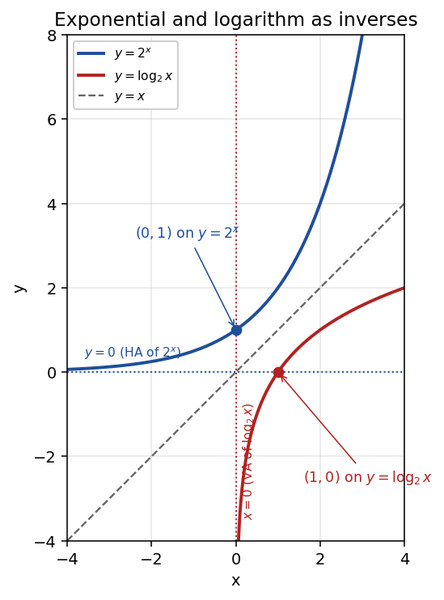
  • (0,1)(0,1) is always on y=bxy=b^x
  • (1,0)(1,0) is always on y=log⁡bxy=\log_b x

It helps to see those facts all at once, especially the swapped domain and range, the asymptotes, and the reflection across y=xy=x.

Exponential and logarithmic inverse graphs

How to Construct the Inverse

From the equation

Take the exponential and reverse input/output:

  1. Write y=bxy=b^x
  2. Switch xx and yy, giving x=byx=b^y
  3. Rewrite in logarithmic form as y=log⁡bxy=\log_b x

So

g−1(x)=log⁡bx. g^{-1}(x)=\log_b x.

Equivalent forms are the same relationship written two ways:

y=bx⟺x=log⁡by y=b^x \Longleftrightarrow x=\log_b y

Example:

7u=v⟺log⁡7v=u 7^u=v \Longleftrightarrow \log_7 v=u

From points or a table

If (s,t)(s,t) is on y=bxy=b^x, then (t,s)(t,s) is on y=log⁡bxy=\log_b x. You swap every ordered pair completely.

For y=3xy=3^x:

  • Exponential points
    (−2,19),(−1,13),(0,1),(1,3),(2,9)\left(-2,\tfrac19\right),\left(-1,\tfrac13\right),(0,1),(1,3),(2,9)
  • Logarithmic points
    (19,−2),(13,−1),(1,0),(3,1),(9,2)\left(\tfrac19,-2\right),\left(\tfrac13,-1\right),(1,0),(3,1),(9,2)

From the graph

Inverse graphs are reflections across the line y=xy=x. Every point (s,t)(s,t) becomes (t,s)(t,s).

What the Inverse Relationship Looks Like

The strongest way to show two functions are inverses is composition:

blog⁡bx=xfor x>0 b^{\log_b x}=x \qquad \text{for } x>0

log⁡b(bx)=xfor all real x \log_b(b^x)=x \qquad \text{for all real } x

These are not random log rules. They say the functions undo each other.

Graph features also reflect:

  • exponential asymptote y=0y=0 becomes logarithmic asymptote x=0x=0
  • if b>1b>1, both functions are increasing
  • if 0<b<10<b<1, both are decreasing

Example with a base between 0 and 1:

(12)−3=8⟺log⁡1/28=−3 \left(\tfrac12\right)^{-3}=8 \Longleftrightarrow \log_{1/2} 8=-3

That one gets missed a lot because students expect logs to increase. They do only when b>1b>1.

How Exponential and Logarithmic Change Compare

For the exponential g(x)=bxg(x)=b^x, adding to the input multiplies the output:

g(x+k)=bkg(x) g(x+k)=b^k g(x)

especially

g(x+1)=bg(x). g(x+1)=bg(x).

For the logarithm f(x)=log⁡bxf(x)=\log_b x, multiplying the input adds to the output:

f(bkx)=f(x)+k f(b^k x)=f(x)+k

especially

f(bx)=f(x)+1. f(bx)=f(x)+1.

That’s the inverse pattern:

  • Exponential growth: additive input changes give multiplicative output changes
  • Logarithmic growth: multiplicative input changes give additive output changes

Example with base 4:

  • log⁡44=1\log_4 4=1
  • log⁡416=2\log_4 16=2
  • log⁡464=3\log_4 64=3

Each time the input is multiplied by 44, the output goes up by 11.

Common Mistakes and Fast Checks

  • Inverse vs reciprocal. If g(x)=bxg(x)=b^x, then g−1(x)=log⁡bxg^{-1}(x)=\log_b x, not 1g(x)=b−x\frac1{g(x)}=b^{-x}.
  • Log domain. You can only plug positive inputs into log⁡bx\log_b x.
  • Wrong reflection line. Inverses reflect across y=xy=x.
  • Incomplete swapping. (s,t)(s,t) must become (t,s)(t,s), not just “move the numbers around.”
  • Base between 0 and 1. The functions are still inverses even though both decrease.

Key Takeaways

y=log⁡bxy=\log_b x means exactly the same thing as by=xb^y=x.
The inverse of bxb^x is log⁡bx\log_b x, and g−1(x)g^{-1}(x) does not mean 1g(x)\frac{1}{g(x)}.
The domain of log⁡bx\log_b x is only positive numbers because bxb^x is always positive.
If (s,t)(s,t) is on y=bxy=b^x, then (t,s)(t,s) is on y=log⁡bxy=\log_b x.
blog⁡bx=xb^{\log_b x}=x requires x>0x>0, but log⁡b(bx)=x\log_b(b^x)=x works for every real xx.
The asymptote flips from y=0y=0 for the exponential to x=0x=0 for the logarithm.
For 0<b<10<b<1, the exponential and logarithm are both decreasing and still inverse functions.
Multiplying the input of log⁡bx\log_b x by bb increases the output by 11.

AP® is a trademark registered by the College Board, which is not affiliated with, and does not endorse this website.

Notes

1 credit used · 5/5 remaining