Topic 2.11 Notes – Logarithmic Functions
What Logarithmic Functions Are
A logarithmic function in general form is
with , , and .
The core meaning is
So a logarithm asks, “What exponent on base gives ?”
Because logs and exponentials are inverses, their graphs reflect across , as in the graph of and below.
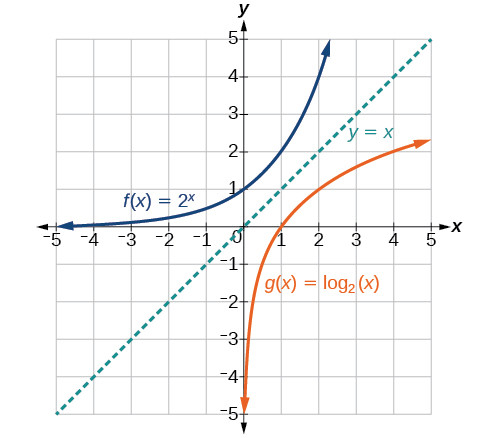
Useful anchor points for :
- because
For , those become:
A couple names you should recognize:
- Common log means
- Natural log means
In general form, the domain is and the range is .
Intercepts:
- -intercept is always
- No -intercept, because is not in the domain
If the argument is changed, like , the domain comes from the full argument being positive:
How the Graph Behaves
Logs are monotonic on their whole domain. They never switch from increasing to decreasing.
Increasing and decreasing
For :
- if , it is increasing
- if , it is decreasing
If , multiplying by reflects across the -axis, so the direction reverses.
Compact test for :
- increasing when
- decreasing when
Concavity
For the parent graph:
- if , it is concave down
- if , it is concave up
If , concavity reverses too.
That gives an important general-form pairing:
- increasing logs are concave down
- decreasing logs are concave up
Extrema and inflection points
On the full domain, logarithmic functions have:
- no local or absolute extrema
- no inflection points
On a closed interval, any max or min happens at an endpoint.
Asymptotes, End Behavior, and Transformed Arguments
In general form, the vertical asymptote is
You only approach it from the right, so use , not a two-sided limit.
For an increasing log:
For a decreasing log:
There is no horizontal asymptote because outputs stay unbounded.
For
here is what changes:
- domain comes from
- vertical asymptote is where , so
- the graph exists only on the side where
- shifts up or down, but does not change range, monotonicity, or concavity
- if , increasing/decreasing reverses, but concavity does not
So transformed logs can be any of these:
- increasing, concave down
- decreasing, concave down
- increasing, concave up
- decreasing, concave up
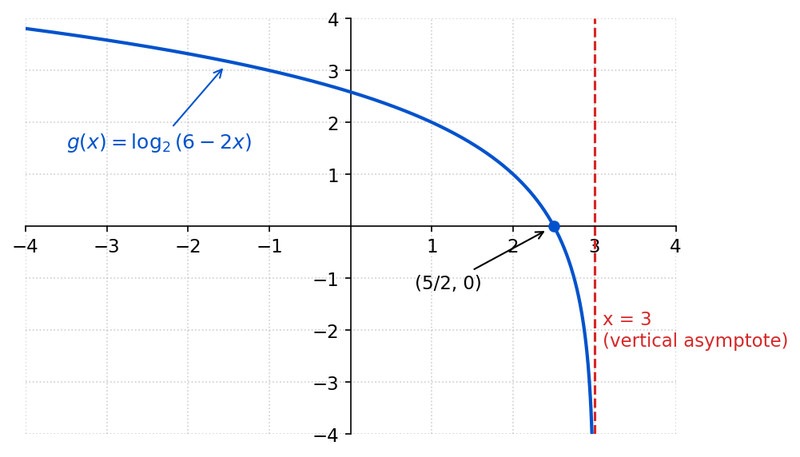
Example:
Domain:
So the asymptote is , and the graph is on the left of it. Since decreases as increases, the graph is decreasing. It stays concave down. The graph below also shows the x-intercept at .
Recognizing Logarithmic Structure from Tables, Equations, and Graphs
In an equation, the variable is inside a logarithm, and the full argument must stay positive.
In a graph, look for these clues:
- one side of a vertical asymptote only
- monotonic on the whole domain
- one concavity only
- unbounded near the asymptote and also at the far end
- no extrema and no inflection points
In a table, the hallmark is this: equal output changes match proportional inputs.
Example for :
- outputs
- inputs
Each output goes up by 2, and each input gets multiplied by 3.
With shifted logs, raw -values often are not proportional. The proportional pattern may appear only after adjusting for the asymptote, like distances from it.
Common Mistakes on the Test
- Saying the domain is all real numbers for general form
- Giving a -intercept at
- Mixing up “undefined at ” with the one-sided limit as
- Using a two-sided limit at
- Assuming every log is increasing
- Keeping the general-form increase/concavity pairing after a horizontal reflection inside the argument
- Checking raw -values for proportionality in shifted logs instead of distances from the vertical asymptote
