Topic 2.3 Notes – Exponential Functions
What an Exponential Function Is
The general form is
with , , and .
A few pieces matter right away:
- The variable is in the exponent, so this is different from a power function like .
- is the initial value because so the -intercept is .
- is the multiplicative factor for a 1-unit increase in :
More generally, equal input intervals give equal output ratios:
That constant-ratio idea is the whole topic. Linear functions have constant differences. Exponential functions have constant ratios.
For natural-number inputs, the exponent tells you how many factors of get applied to .
Example:
The domain is all real numbers, so the graph is a smooth continuous curve, not separate dots like a geometric sequence.
Why the restrictions matter:
- gives the zero function
- gives a constant function
- or fails to give real outputs for all real
Key Characteristics from and
When you analyze one, check this full set: growth or decay, intercepts, domain/range, increasing or decreasing, concavity, asymptote, end behavior, extrema.
This set of graphs puts all four sign-and-base cases on the same axes, so you can compare how and change the shape.
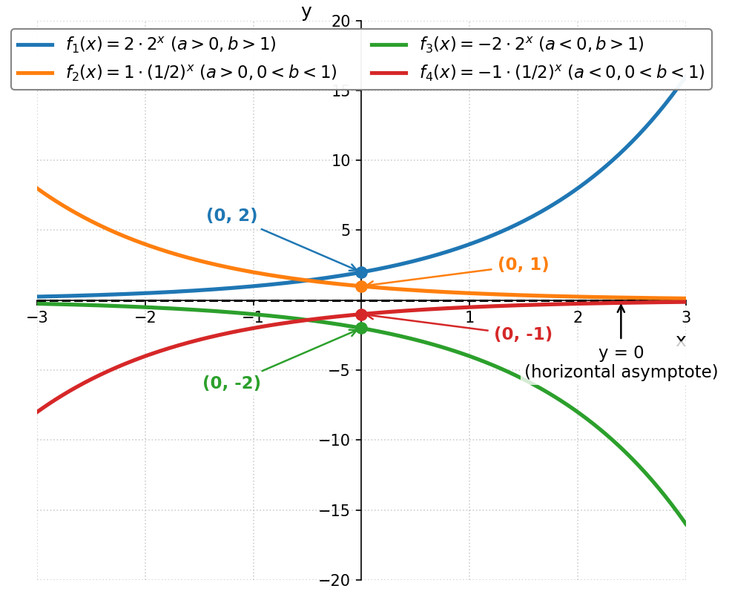
- If and , it shows exponential growth.
- If and , it shows exponential decay.
Intercepts domain and range
- Domain is
- -intercept is
- No -intercept since
- Range is if , and if
Increasing decreasing concavity extrema
The base alone is not enough. The sign of matters too.
| Case | Behavior |
|---|---|
| increasing | |
| decreasing | |
| decreasing | |
| increasing |
Concavity:
- means concave up
- means concave down
- No inflection points
- No local or absolute extrema on all real numbers
- On a closed interval, extrema can happen at endpoints
Asymptote and end behavior
The horizontal asymptote is always .
- If , the graph approaches on the left
- If , the graph approaches on the right
- It approaches from above when , from below when
Recognizing Exponential Behavior in Equations Tables and Graphs
From an equation, look for a constant times a positive constant base raised to a variable exponent.
From a table, check ratios over equal input steps, not differences.
- Linear example idea:
- Exponential example idea:
If inputs go , the equal step is 2, so the constant ratio is , not .
From a graph, look for:
- a smooth curve
- entirely above or entirely below the -axis
- passing through
- always increasing or always decreasing
- only one concavity
- approaching in one direction
Additive Transformations of Exponential Functions
A vertical shift gives
Now the outputs usually do not have a constant ratio. But if you remove the shift, exponential behavior appears:
Example with outputs :
- Raw ratios are not constant.
- Subtract 5 from each output.
- You get .
- Those have constant ratio 2.
So
That shift changes:
- asymptote to
- range to if , or if
- -intercept to
It does not change:
- domain
- increasing/decreasing pattern
- concavity
- absence of inflection points
Common Mistakes to Catch Fast
- Constant differences do not mean exponential.
- Equal ratios only count when the input intervals are equal.
- does not automatically mean decreasing. Check the sign of .
- Exponential functions in general form do not cross the -axis.
- Only one end approaches the horizontal asymptote.
- In , the asymptote is , not .
- In , the -intercept is , not just .
