Topic 1.8 Notes – Rational Functions and Zeros
What Zeros of a Rational Function Are
A rational function has the form
where and are polynomials and .
A zero means . For any fraction to equal 0, the top must be 0 and the bottom must not be 0. So for rational functions:
- is a zero when and
- real zeros come from real zeros of the numerator
- any value that also makes the denominator 0 is excluded and is not a zero
That domain piece matters a lot. If the denominator is 0, the function is undefined, even if that factor cancels later.
- Graph connection
A real zero gives an -intercept only if the function is defined at . - An undefined input is never a zero and never an -intercept.
This graph shows both ideas at once. The function has an -intercept at , but the factor cancels and leaves a hole at , so is excluded instead of being a zero.
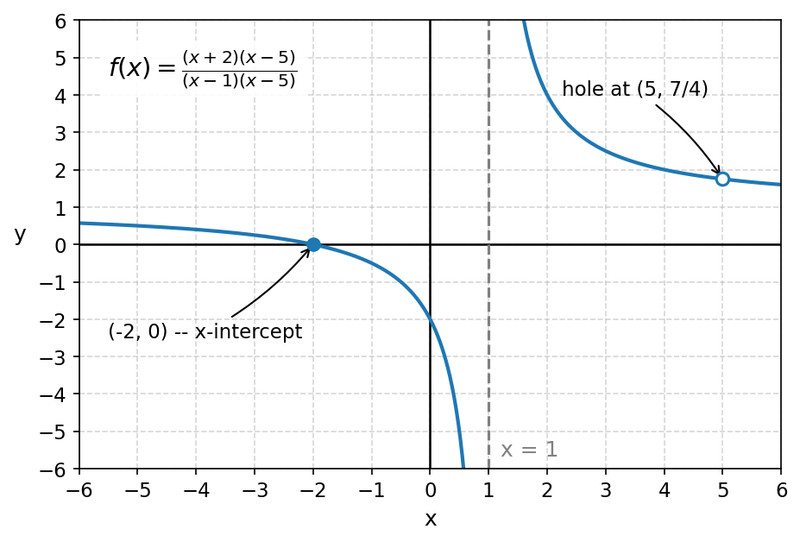
Rational function with an x-intercept, a hole, and a vertical asymptote
Finding Zeros Analytically
This is the standard process you’ll use on quizzes and no-calculator work.
- Factor the numerator and denominator completely.
- Find denominator zeros first. These are excluded values.
- Find numerator zeros. These are candidate zeros.
- Remove any candidate that is excluded.
- Report the remaining real zeros, or the -intercepts if asked.
Example:
- denominator zeros are , so both are excluded
- numerator zeros are
- is excluded, so it is not a zero
- the only zero is , so the -intercept is
Cancellation rule
You can simplify by canceling common factors, but the restriction stays.
The simplified expression has a zero at 4, but the original function is undefined there. So the original rational function has no zero.
Equations rewritten to find zeros
If you see
rewrite it as
Then solve , while keeping . Multiplying by the denominator is fine only if you track excluded values first.
Zeros from Graphs, Tables, and Technology
Zeros can show up in different forms, but the domain still decides.
- From a graph
A zero is where the graph actually touches or crosses the -axis.
An open circle on the -axis is not a zero. - From a table
A zero happens when the function value is defined and equals 0.
Blank, error, or undefined does not count. - From technology
A calculator can approximate numerator zeros, but you still must check the denominator. A graph can hide a missing point.
Solving Rational Inequalities with Zeros
For inequalities like or , both numerator and denominator zeros matter because they split the number line.
Boundary values include:
- numerator zeros that are in the domain
- denominator zeros, always excluded
- common zeros of numerator and denominator, still excluded
Sign-chart procedure
For
solve .
- numerator zeros:
- denominator zeros:
These split the number line into intervals: , , , ,
Test one point in each interval to get the sign. The sign chart below shows that the negative intervals are:
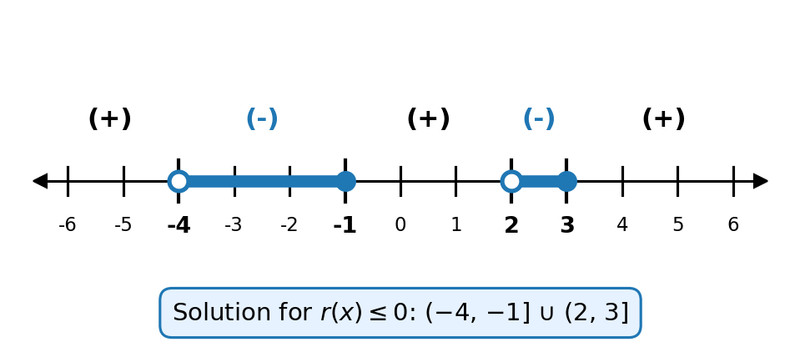
The brackets happen because includes valid numerator zeros.
Endpoint rules
- Include numerator zeros only for or , and only if they’re in the domain.
- Exclude numerator zeros for or .
- Exclude denominator zeros every time.
- In interval notation, use brackets only at valid included numerator zeros.
Common Traps and Sign Shortcuts
The most common mistakes are:
- forgetting the original domain after canceling
- calling a denominator zero a zero of the function
- losing a “puncture” in an inequality after canceling a common factor
- leaving a canceled factor off the number line - the hole is still excluded, even though the sign does not change there
Multiplicity helps with signs:
- odd multiplicity means the sign changes
- even multiplicity means the sign stays the same
That works for numerator and denominator factors. Still, if you’re unsure, a full sign chart is safer than doing sign changes in your head.
