AP®︎ Physics 1: Unit 2 Practice Test
Prepare for your quiz, test, or the AP exam with focused practice questions on Unit 2 of AP Physics 1 – Force and Translational Dynamics.
Questions List
Unit 2 (All Topics)
Question 1 Topic 2.1Easy
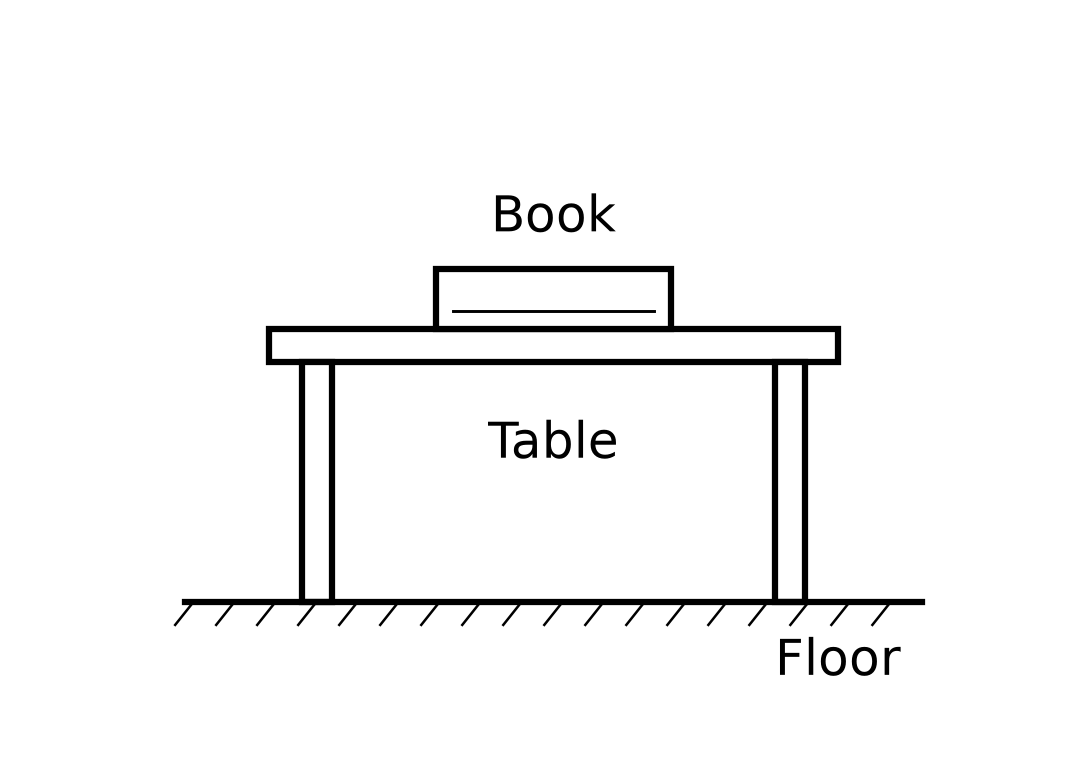
Which of the following lists all the interactions that are external to the system?
What You’re Being Tested On:
Explore the learning objectives taken directly from the College Board’s AP® Physics 1 Curriculum. Ensure you’re prepared for the exact topics covered on the AP® exam, in-class tests, and quizzes, and gain confidence in your mastery of the material.
Unit 2: Force and Translational Dynamics
What causes objects to speed up, slow down, or change direction, built around Newton's three laws and free-body diagrams.

Topic 2.1: Systems and Center of Mass
Boundary Statements official exam scope notes
- AP Physics 1 only expects students to calculate the center of mass for systems of five or fewer particles arranged in a two-dimensional configuration or for systems that are highly symmetrical.
Learning Objective: 2.1.A
Describe the properties and interactions of a system.
Essential Knowledge: 2.1.A.1
System properties are determined by the interactions between objects within the system.
Essential Knowledge: 2.1.A.2
If the properties or interactions of the constituent objects within a system are not important in modeling the behavior of the macroscopic system, the system can itself be treated as a single object.
Essential Knowledge: 2.1.A.3
Systems may allow interactions between constituent parts of the system and the environment, which may result in the transfer of energy or mass.
Essential Knowledge: 2.1.A.4
Individual objects within a chosen system may behave differently from each other as well as from the system as a whole.
Essential Knowledge: 2.1.A.5
The internal structure of a system affects the analysis of that system.
Essential Knowledge: 2.1.A.6
As variables external to a system are changed, the system’s substructure may change.
Learning Objective: 2.1.B
Describe the location of a system’s center of mass with respect to the system’s constituent parts.
Essential Knowledge: 2.1.B.1
For systems with symmetrical mass distributions, the center of mass is located on lines of symmetry.
Essential Knowledge: 2.1.B.2
The location of a system’s center of mass along a given axis can be calculated using the equation
Essential Knowledge: 2.1.B.3
A system can be modeled as a singular object that is located at the system’s center of mass.
Topic 2.2: Forces and Free-Body Diagrams
Boundary Statements official exam scope notes
- AP Physics 1 only expects students to depict the forces exerted on objects, not the force components on free-body diagrams. On the AP Physics exams, individual forces represented on a free-body diagram must be drawn as individual straight arrows, originating on the dot and pointing in the direction of the force. Individual forces that are in the same direction must be drawn side by side, not overlapping.
Learning Objective: 2.2.A
Describe a force as an interaction between two objects or systems.
Essential Knowledge: 2.2.A.1
Forces are vector quantities that describe the interactions between objects or systems.
Essential Knowledge: 2.2.A.1.i
A force exerted on an object or system is always due to the interaction of that object with another object or system.
Essential Knowledge: 2.2.A.1.ii
An object or system cannot exert a net force on itself.
Essential Knowledge: 2.2.A.2
Contact forces describe the interaction of an object or system touching another object or system and are macroscopic effects of interatomic electric forces.
Learning Objective: 2.2.B
Describe the forces exerted on an object or system using a free-body diagram.
Essential Knowledge: 2.2.B.1
Free-body diagrams are useful tools for visualizing forces being exerted on a single object or system and for determining the equations that represent a physical situation.
Essential Knowledge: 2.2.B.2
The free-body diagram of an object or system shows each of the forces exerted on the object by the environment.
Essential Knowledge: 2.2.B.3
Forces exerted on an object or system are represented as vectors originating from the representation of the center of mass, such as a dot. A system is treated as though all of its mass is located at the center of mass.
Essential Knowledge: 2.2.B.4
A coordinate system with one axis parallel to the direction of acceleration of the object or system simplifies the translation from free-body diagram to algebraic representation. For example, in a free-body diagram of an object on an inclined plane, it is useful to set one axis parallel to the surface of the incline.
Topic 2.3: Newton’s Third Law
Boundary Statements official exam scope notes
- AP Physics 1 only expects students to describe tension qualitatively in a string, cable, chain, or similar system with mass. For example, students might note that the tension in a hanging chain is greater toward the top of the chain.
- The interaction between objects or systems at a distance is limited to gravitational forces in AP Physics 1. In AP Physics 2, gravitational, electric, and magnetic forces may be considered.
Learning Objective: 2.3.A
Describe the interaction of two objects using Newton’s third law and a representation of paired forces exerted on each object.
Essential Knowledge: 2.3.A.1
Newton’s third law describes the interaction of two objects in terms of the paired forces that each exerts on the other.
Essential Knowledge: 2.3.A.2
Interactions between objects within a system (internal forces) do not influence the motion of a system’s center of mass.
Essential Knowledge: 2.3.A.3
Tension is the macroscopic net result of forces that segments of a string, cable, chain, or similar system exert on each other in response to an external force.
Essential Knowledge: 2.3.A.3.i
An ideal string has negligible mass and does not stretch when under tension.
Essential Knowledge: 2.3.A.3.ii
The tension in an ideal string is the same at all points within the string.
Essential Knowledge: 2.3.A.3.iii
In a string with nonnegligible mass, tension may not be the same at all points within the string.
Essential Knowledge: 2.3.A.3.iv
An ideal pulley is a pulley that has negligible mass and rotates about an axle through its center of mass with negligible friction.
Topic 2.4: Newton’s First Law
Learning Objective: 2.4.A
Describe the conditions under which a system’s velocity remains constant.
Essential Knowledge: 2.4.A.1
The net force on a system is the vector sum of all forces exerted on the system.
Essential Knowledge: 2.4.A.2
Translational equilibrium is a configuration of forces such that the net force exerted on a system is zero. Derived equation:
Essential Knowledge: 2.4.A.3
Newton’s first law states that if the net force exerted on a system is zero, the velocity of that system will remain constant.
Essential Knowledge: 2.4.A.4
Forces may be balanced in one dimension but unbalanced in another. The system’s velocity will change only in the direction of the unbalanced force.
Essential Knowledge: 2.4.A.5
An inertial reference frame is one from which an observer would verify Newton’s first law of motion.
Topic 2.5: Newton’s Second Law
Learning Objective: 2.5.A
Describe the conditions under which a system’s velocity changes.
Essential Knowledge: 2.5.A.1
Unbalanced forces are a configuration of forces such that the net force exerted on a system is not equal to zero.
Essential Knowledge: 2.5.A.2
Newton’s second law of motion states that the acceleration of a system’s center of mass has a magnitude proportional to the magnitude of the net force exerted on the system and is in the same direction as that net force. Relevant equation:
Essential Knowledge: 2.5.A.3
The velocity of a system’s center of mass will only change if a nonzero net external force is exerted on that system.
Topic 2.6: Gravitational Force
Learning Objective: 2.6.A
Describe the gravitational interaction between two objects or systems with mass.
Essential Knowledge: 2.6.A.1
Newton’s law of universal gravitation describes the gravitational force between two objects or systems as directly proportional to each of their masses and inversely proportional to the square of the distance between the systems’ centers of mass. Relevant equation:
Essential Knowledge: 2.6.A.1.i
The gravitational force is attractive.
Essential Knowledge: 2.6.A.1.ii
The gravitational force is always exerted along the line connecting the centers of mass of the two interacting systems.
Essential Knowledge: 2.6.A.1.iii
The gravitational force on a system can be considered to be exerted on the system’s center of mass.
Essential Knowledge: 2.6.A.2
A field models the effects of a noncontact force exerted on an object at various positions in space.
Essential Knowledge: 2.6.A.2.i
The magnitude of the gravitational field created by a system of mass at a point in space is equal to the ratio of the gravitational force exerted by the system on a test object of mass to the mass of the test object. Derived equation:
Essential Knowledge: 2.6.A.2.ii
If the gravitational force is the only force exerted on an object, the observed acceleration of the object (in ) is numerically equal to the magnitude of the gravitational field strength (in ) at that location.
Essential Knowledge: 2.6.A.3
The gravitational force exerted by an astronomical body on a relatively small nearby object is called weight. Derived Equation:
Learning Objective: 2.6.B
Describe situations in which the gravitational force can be considered constant.
Essential Knowledge: 2.6.B.1
If the gravitational force between two systems’ centers of mass has a negligible change as the relative position of the two systems changes, the gravitational force can be considered constant at all points between the initial and final positions of the systems.
Essential Knowledge: 2.6.B.2
Near the surface of Earth, the strength of the gravitational field is
Learning Objective: 2.6.C
Describe the conditions under which the magnitude of a system’s apparent weight is different from the magnitude of the gravitational force exerted on that system.
Essential Knowledge: 2.6.C.1
The magnitude of the apparent weight of a system is the magnitude of the normal force exerted on the system.
Essential Knowledge: 2.6.C.2
If the system is accelerating, the apparent weight of the system is not equal to the magnitude of the gravitational force exerted on the system.
Essential Knowledge: 2.6.C.3
A system appears weightless when there are no forces exerted on the system or when the force of gravity is the only force exerted on the system.
Essential Knowledge: 2.6.C.4
The equivalence principle states that an observer in a noninertial reference frame is unable to distinguish between an object’s apparent weight and the gravitational force exerted on the object by a gravitational field.
Learning Objective: 2.6.D
Describe inertial and gravitational mass.
Essential Knowledge: 2.6.D.1
Objects have inertial mass, or inertia, a property that determines how much an object’s motion resists changes when interacting with another object.
Essential Knowledge: 2.6.D.2
Gravitational mass is related to the force of attraction between two systems with mass.
Essential Knowledge: 2.6.D.3
Inertial mass and gravitational mass have been experimentally verified to be equivalent.
Topic 2.7: Kinetic and Static Friction
Learning Objective: 2.7.A
Describe kinetic friction between two surfaces
Essential Knowledge: 2.7.A.1
Kinetic friction occurs when two surfaces in contact move relative to each other.
Essential Knowledge: 2.7.A.1.i
The kinetic friction force is exerted in a direction opposite to the motion of each surface relative to the other surface.
Essential Knowledge: 2.7.A.1.ii
The force of friction between two surfaces does not depend on the size of the surface area of contact.
Essential Knowledge: 2.7.A.2
The magnitude of the kinetic friction force exerted on an object is the product of the normal force the surface exerts on the object and the coefficient of kinetic friction. Relevant equation:
Essential Knowledge: 2.7.A.2.i
The coefficient of kinetic friction depends on the material properties of the surfaces that are in contact.
Essential Knowledge: 2.7.A.2.ii
Normal force is the perpendicular component of the force exerted on an object by the surface with which it is in contact; it is directed away from the surface.
Learning Objective: 2.7.B
Describe static friction between two surfaces.
Essential Knowledge: 2.7.B.1
Static friction may occur between the contacting surfaces of two objects that are not moving relative to each other.
Essential Knowledge: 2.7.B.2
Static friction adopts the value and direction required to prevent an object from slipping or sliding on a surface. Relevant equation:
Essential Knowledge: 2.7.B.2.i
Slipping and sliding refer to situations in which two surfaces are moving relative to each other.
Essential Knowledge: 2.7.B.2.ii
There exists a maximum value for which static friction will prevent an object from slipping on a given surface. Derived equation:
Essential Knowledge: 2.7.B.3
The coefficient of static friction is typically greater than the coefficient of kinetic friction for a given pair of surfaces.
Topic 2.8: Spring Forces
Learning Objective: 2.8.A
Describe the force exerted on an object by an ideal spring
Essential Knowledge: 2.8.A.1
An ideal spring has negligible mass and exerts a force that is proportional to the change in its length as measured from its relaxed length.
Essential Knowledge: 2.8.A.2
The magnitude of the force exerted by an ideal spring on an object is given by Hooke’s law:
Essential Knowledge: 2.8.A.3
The force exerted on an object by a spring is always directed toward the equilibrium position of the object–spring system.
Topic 2.9: Circular Motion
Boundary Statements official exam scope notes
- AP Physics 1 only expects students to quantitatively analyze banked curves in which no friction is required to maintain uniform circular motion. Analysis of situations in which friction is required on a banked curve is limited to qualitative descriptions.
- AP Physics 1 does not expect students to know Kepler’s first or second laws of planetary motion.
Learning Objective: 2.9.A
Describe the motion of an object traveling in a circular path.
Essential Knowledge: 2.9.A.1
Centripetal acceleration is the component of an object’s acceleration directed toward the center of the object’s circular path.
Essential Knowledge: 2.9.A.1.i
The magnitude of centripetal acceleration for an object moving in a circular path is the ratio of the object’s tangential speed squared to the radius of the circular path. Relevant equation:
Essential Knowledge: 2.9.A.1.ii
Centripetal acceleration is directed toward the center of an object’s circular path.
Essential Knowledge: 2.9.A.2
Centripetal acceleration can result from a single force, more than one force, or components of forces exerted on an object in circular motion.
Essential Knowledge: 2.9.A.2.i
At the top of a vertical, circular loop, an object requires a minimum speed to maintain circular motion. At this point, and with this minimum speed, the gravitational force is the only force that causes the centripetal acceleration. Derived equation:
Essential Knowledge: 2.9.A.2.ii
Components of the static friction force and the normal force can contribute to the net force producing centripetal acceleration of an object traveling in a circle on a banked surface.
Essential Knowledge: 2.9.A.2.iii
A component of tension contributes to the net force producing centripetal acceleration experienced by a conical pendulum.
Essential Knowledge: 2.9.A.3
Tangential acceleration is the rate at which an object’s speed changes and is directed tangent to the object’s circular path.
Essential Knowledge: 2.9.A.4
The net acceleration of an object moving in a circle is the vector sum of the centripetal acceleration and tangential acceleration.
Essential Knowledge: 2.9.A.5
The revolution of an object traveling in a circular path at a constant speed (uniform circular motion) can be described using period and frequency.
Essential Knowledge: 2.9.A.5.i
The time to complete one full circular path, one full rotation, or a full cycle of oscillatory motion is defined as period, .
Essential Knowledge: 2.9.A.5.ii
The rate at which an object is completing revolutions is defined as frequency, . Relevant equation:
Essential Knowledge: 2.9.A.5.iii
For an object traveling at a constant speed in a circular path, the period is given by the derived equation .
Learning Objective: 2.9.B
Describe circular orbits using Kepler’s third law.
Essential Knowledge: 2.9.B.1
For a satellite in circular orbit around a central body, the satellite’s centripetal acceleration is caused only by gravitational attraction. The period and radius of the circular orbit are related to the mass of the central body. Derived equation:
