AP®︎ Physics 1: Topic 5.6 Practice Test
Prepare for your quiz, test, or the AP exam with focused practice questions on Topic 5.6 of AP Physics 1 – Newton’s Second Law in Rotational Form.
Questions List
Topic 5.6
Question 1 Easy
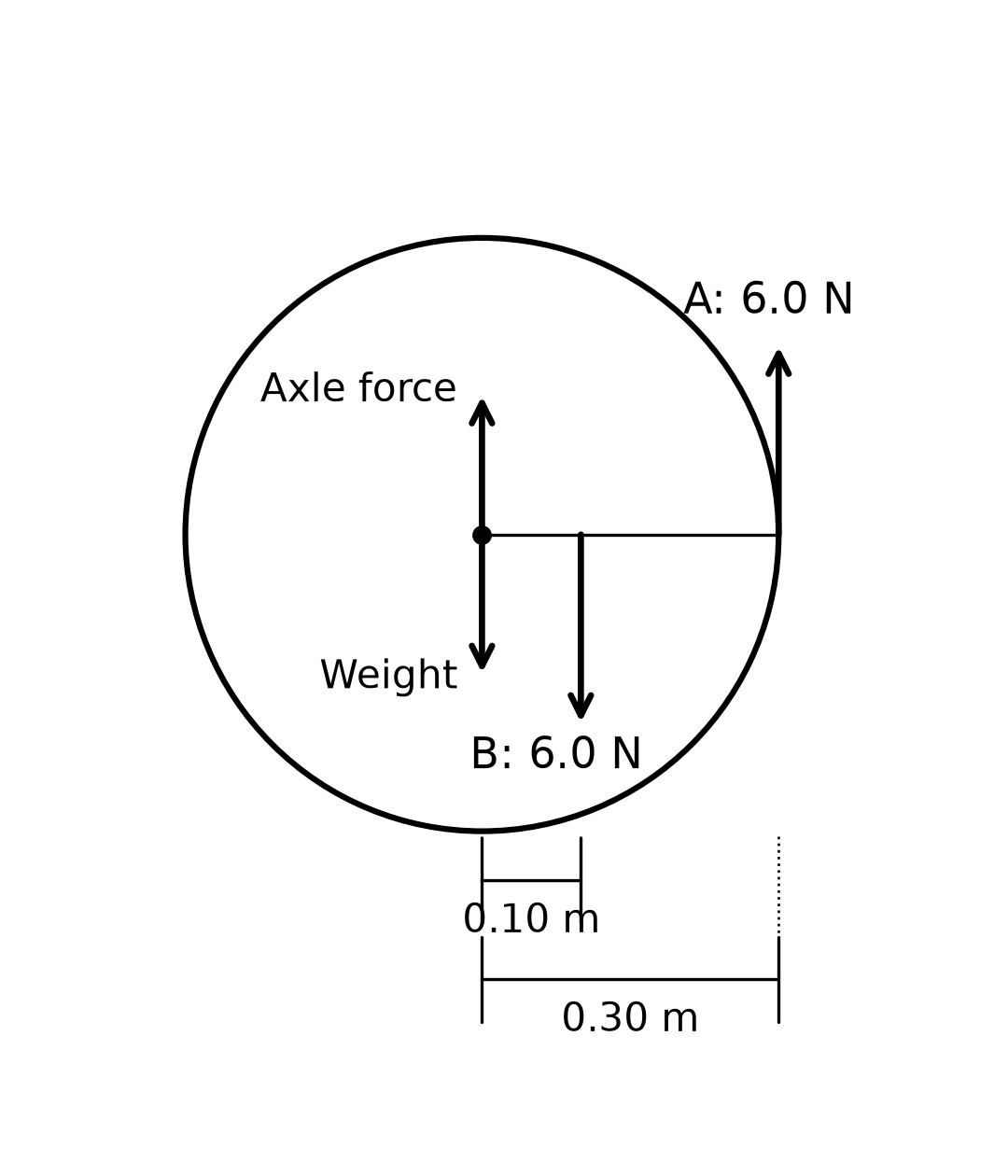
Which statement about the wheel's angular velocity is correct?
What You’re Being Tested On:
Explore the learning objectives taken directly from the College Board’s AP® Physics 1 Curriculum. Ensure you’re prepared for the exact topics covered on the AP® exam, in-class tests, and quizzes, and gain confidence in your mastery of the material.

Topic 5.6: Newton’s Second Law in Rotational Form
Learning Objective: 5.6.A
Describe the conditions under which a system’s angular velocity changes.
Essential Knowledge: 5.6.A.1
Angular velocity changes when the net torque exerted on the object or system is not equal to zero.
Essential Knowledge: 5.6.A.2
The rate at which the angular velocity of a rigid system changes is directly proportional to the net torque exerted on the rigid system and is in the same direction. The angular acceleration of the rigid system is inversely proportional to the rotational inertia of the rigid system. Relevant equation:
Essential Knowledge: 5.6.A.3
To fully describe a rotating rigid system, linear and rotational analyses may need to be performed independently.
