Topic 5.6 Notes – Newton’s Second Law in Rotational Form
Newton’s Second Law for Rotation
For rotation, the core relationship is:
- = net torque about a chosen axis (N·m)
- = rotational inertia about that axis (kg·m²)
- = angular acceleration (rad/s²)
This is the rotational version of .
What it tells you
- If , then .
The angular velocity is constant (could be zero or nonzero). - If , then .
The angular velocity changes. - The direction of is the same as the direction of the net torque (use your CCW positive convention unless told otherwise).
The proportional relationships matter a lot on tests:
- Larger net torque → larger angular acceleration.
- Larger rotational inertia → smaller angular acceleration for the same torque.
So if two objects experience the same torque and one speeds up faster, it must have the smaller .
The Three Quantities in
Net Torque
For a single force:
- = distance from axis to where the force is applied
- = angle between and
- Only the perpendicular component of the force creates torque.
If multiple torques act:
- Add them algebraically using signs (CCW +, CW −).
- Zero net torque does not mean zero forces. It means torques cancel.
Choosing the axis cleverly can eliminate unknown torques. On FRQs, picking the pivot at a hinge or contact point often makes one torque drop out.
Rotational Inertia
Rotational inertia is the rotational version of mass. It measures how hard it is to change angular velocity.
It depends on:
- Total mass
- How far the mass is from the axis
- The axis location itself
Mass farther from the axis → larger .
That’s why:
- A hoop has larger than a solid disk of the same mass and radius.
- A rod rotated about its end has larger than the same rod about its center.
Same torque applied to two objects:
- Smaller → larger
- Larger → smaller
This comparison shows up constantly in multiple-choice reasoning questions.
Angular Acceleration
Angular acceleration is the rate of change of angular velocity.
If torque is constant, is constant.
For a point at radius , the tangential (linear) acceleration is:
That equation is the bridge between rotation and translation.
When Angular Velocity Changes
Angular velocity changes only when:
- The net torque is not zero, and
- The object is free to rotate about that axis.
If torque stops acting, the object keeps rotating at constant angular velocity. Rotational inertia plays the same role mass does in linear motion.
A common AP trap is assuming something slows down because a force exists. What matters is whether that force produces a net torque about the chosen axis.
Combining Linear and Rotational Analysis
Many systems both translate and rotate. In those cases, you often need two separate equations:
- Linear motion of the center of mass
- Rotation about an axis
They are independent equations, but they’re linked by constraints like:
That shows up in rolling objects, pulleys, and yo-yos.
A classic example is a massive pulley with two hanging masses, like the system below.
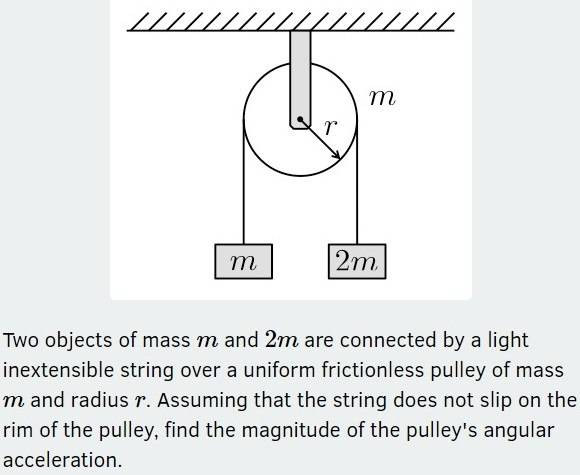
Atwood machine with a massive pulley
Important pulley idea: if the pulley has rotational inertia, the tensions on the two sides are not equal. The difference in tension creates the net torque.
When you see a problem with both forces and rotation, expect to write both and , then connect them with .
