Topic 6.5 Notes – Rolling
1. Total Kinetic Energy of a Rolling Object
When something rolls, it is doing two things at once:
- Moving forward (translating)
- Spinning (rotating)
So its total kinetic energy is the sum of both parts:
Translational Kinetic Energy
This is the same expression you already know:
- is total mass
- is the speed of the center of mass
If the center of mass is moving, this energy exists, even if the object isn’t spinning.
Rotational Kinetic Energy
Now add the spinning part:
- depends on mass distribution
- is angular speed
Two objects with the same and can have different total kinetic energies because their moments of inertia differ. A hoop has more of its mass far from the axis than a solid disk, so more energy goes into rotation.
That’s why different shapes roll down ramps at different speeds. The gravitational potential energy splits differently between translation and rotation.
2. Rolling Without Slipping
Rolling without slipping means the rotation and translation are perfectly linked.
The Key Relationships
If you know one quantity, you instantly know the other.
Here’s what that physically looks like for a wheel rolling to the right:
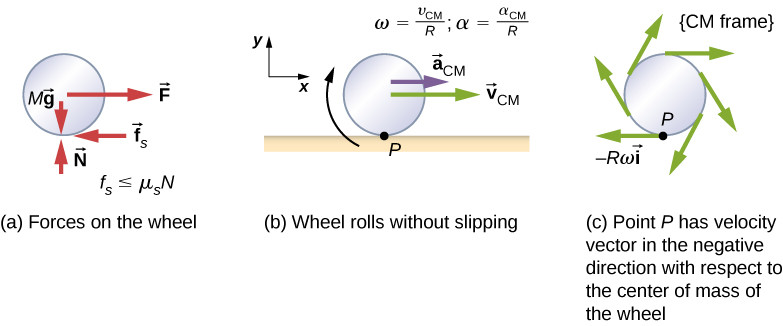
Wheel rolling without slipping
The center of mass moves to the right, and the wheel rotates so that the bottom point in contact with the ground has zero velocity relative to the surface.
The point touching the ground is instantaneously at rest. That’s the defining feature.
Why This Matters for Energy
Since , you can substitute:
So energy becomes:
Now everything is in terms of . One variable. Much cleaner.
Friction in Ideal Rolling
Static friction:
- Provides the torque needed to rotate.
- Does no work in ideal rolling.
- Does not remove mechanical energy.
Because the contact point isn’t moving relative to the surface, there’s no displacement at the point of force application.
So if a problem says:
- “Rolls without slipping”
- No energy losses mentioned
You can use conservation of mechanical energy safely.
3. Static Friction in Rolling Without Slipping
Static friction is what enforces .
It can point:
- Up the incline
- Down the incline
Direction depends on whether friction needs to increase or decrease rotation.
Students often think friction always slows things down. In rolling problems, friction often helps the object rotate correctly.
Important energy idea: static friction changes how energy is distributed between translation and rotation, but it does not decrease total mechanical energy in ideal cases.
4. Rolling While Slipping
Now the link breaks:
The bottom point is sliding relative to the surface.
That means:
- Friction is kinetic friction
- The contact point moves
- Friction does negative work
- Mechanical energy decreases
What Happens Physically
If the object is spinning too fast compared to its forward motion:
- Friction increases
- Friction decreases
If it’s sliding forward too fast with little spin:
- Friction decreases
- Friction increases
Either way, the system evolves toward rolling without slipping.
You won’t be asked to derive the full equations for slipping motion. That math is beyond AP scope. But you must clearly explain:
- How friction changes linear motion
- How friction changes rotational motion
- Why energy decreases during slipping
This shows up often in conceptual multiple-choice and paragraph-style FRQs.
