Topic 1.1 Notes – Scalars and Vectors in One Dimension
1. What Scalars and Vectors Are
Scalar quantities
A scalar has magnitude only. Just a number and units.
Examples you’ll see constantly:
- Distance (how much ground you covered)
- Speed (how fast, no direction)
- Mass
- Time
If I say “5 meters” or “20 seconds,” that’s complete information. No direction needed.
Scalars combine with normal arithmetic:
- 3 m + 2 m = 5 m
No signs for direction because direction doesn’t exist for that quantity.
Vector quantities
A vector has magnitude and direction. Both matter.
Key AP Physics 1 motion vectors:
- Position
- Displacement
- Velocity
- Acceleration
If I say “5 meters to the left,” that direction changes the meaning completely.
We usually represent vectors as arrows. The diagram below shows three different displacement vectors along a horizontal line.
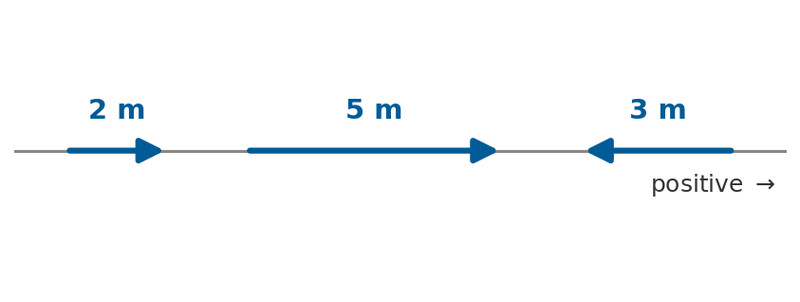
Example displacement vectors in one dimension
- Arrow length ∝ magnitude
- Arrowhead shows direction
In formal notation, we write vectors with arrows above them:
That arrow tells you direction is built in.
2. Vector Representation in One Dimension
In Topic 1.1, everything is along a single axis (usually the x-axis). That simplifies things a lot.
Arrow notation vs components
In full vector form:
In one dimension, we usually write components:
Here’s the key idea:
In 1D, the sign (+ or −) tells you the direction.
So this:
already includes direction. No arrow needed.
If , that just means 4 m/s in the negative direction.
Choosing a coordinate system
You must define what “positive” means.
Common choices:
- Right = positive
- Up = positive
But you could choose left as positive. Physics doesn’t care. What matters is consistency.
Once chosen:
- Motion in the positive direction → positive value
- Motion opposite → negative value
On quizzes, forgetting to assign signs correctly is one of the easiest ways to lose points.
3. Distance vs Displacement
This distinction shows up constantly in conceptual questions.
Distance (scalar)
- Total path length traveled
- Always positive
- Adds up every segment
If you walk 4 m forward, then 1 m backward:
Distance = 5 m.
Displacement (vector)
- Change in position
- Straight-line result from start to finish
- Includes direction
Same example:
- +4 m then −1 m
Displacement = +3 m
If you return to your starting point:
- Distance > 0
- Displacement = 0
That “round trip” idea is a favorite multiple-choice trap.
Always remember:
Distance ≥ |displacement|
4. Velocity and Acceleration as Vectors
Velocity
Velocity is how position changes over time.
The sign of velocity tells you direction of motion.
- → moving in + direction
- → moving in − direction
Acceleration
Acceleration tells you how velocity changes.
- → velocity becoming more positive
- → velocity becoming more negative
Here’s how signs interact:
| Velocity | Acceleration | What Happens |
|---|---|---|
| + | + | Speeding up |
| − | − | Speeding up |
| + | − | Slowing down |
| − | + | Slowing down |
| 0 | ≠ 0 | Starting to move |
| ≠ 0 | 0 | Constant velocity |
If velocity and acceleration have the same sign, the object speeds up.
If signs are opposite, it slows down.
Students often confuse “negative acceleration” with “slowing down.” It only means slowing down if velocity is positive.
5. Vector Addition in One Dimension
In 1D, vector addition becomes signed arithmetic.
Suppose right is positive.
Example:
- +7 m
- −2 m
Add them:
That +5 m tells you:
- Magnitude: 5 m
- Direction: positive direction
General process:
- Choose positive direction.
- Assign signs to each quantity.
- Add algebraically.
- Interpret the sign of the result.
This exact logic will later apply to forces and momentum. Same math, bigger ideas.
