Topic 7.4 Notes – Energy of Simple Harmonic Oscillators
1. Mechanical Energy in Simple Harmonic Motion
Any system undergoing SHM has mechanical energy made of two parts:
- = kinetic energy (due to motion)
- = potential energy (stored energy)
- In ideal SHM, is constant
That constant total is what makes SHM so predictable. The restoring force is proportional to displacement (like for springs), so energy smoothly shifts back and forth between forms.
What counts as potential energy?
- Spring-mass system:
(elastic potential energy) - Pendulum (small angles only):
Gravitational potential energy relative to the lowest point.
If friction or air resistance acts, total mechanical energy decreases and the oscillation shrinks. That’s damping, and it’s outside ideal SHM.
2. Where the Energy Is During the Motion
The key to this entire topic is connecting position with energy distribution. There are three important locations.
Here’s the big picture for a spring-mass system. The graph shows potential energy , kinetic energy , and the constant total energy as functions of position.
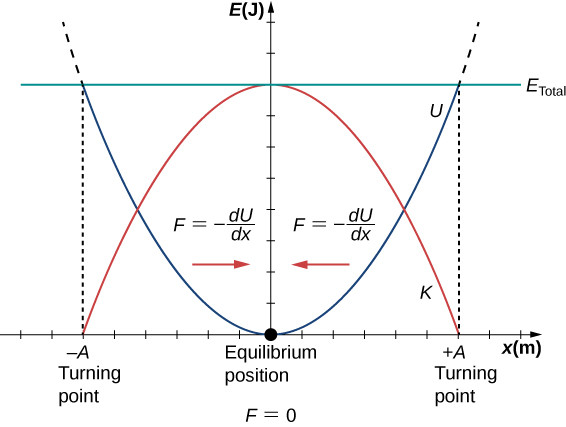
Notice how the total energy is a horizontal line, potential energy is lowest at the center, and kinetic energy is zero at the turning points.
At equilibrium
- Velocity is maximum
- Acceleration is 0
- Potential energy is minimum
- Kinetic energy is maximum
At this instant:
All the energy is kinetic. This is when the object moves fastest.
At maximum displacement
- Velocity = 0
- Kinetic energy = 0
- Potential energy = maximum
- Acceleration is largest (toward equilibrium)
For a spring system:
This equation shows up constantly. It connects amplitude directly to total energy.
Important fact the AP likes:
The minimum kinetic energy in SHM is zero, and it happens at the turning points.
At positions between 0 and A
Energy is shared:
If you need the speed at some position:
- Find total energy from amplitude.
- Calculate at that position.
- Subtract to get .
- Use to solve for .
This is often easier than using kinematics because acceleration is constantly changing.
3. How Amplitude Affects Total Energy
For a spring-mass system:
Energy is proportional to amplitude squared.
That squared relationship matters:
- Double → energy becomes 4× larger
- Triple → energy becomes 9× larger
So changing amplitude changes the maximum potential energy, which changes the total energy.
One subtle point students miss:
The period does not depend on amplitude (for ideal SHM), but energy does. The AP sometimes pairs those ideas in conceptual questions.
4. Core Energy Relationships to Recognize Fast
These patterns should feel automatic.
Conservation of energy
You can always move between position and speed using energy.
Energy extremes
| Location | Kinetic Energy | Potential Energy |
|---|---|---|
| Equilibrium | Maximum | Minimum |
| Turning points | 0 | Maximum |
When one is max, the other is min.
When one is zero, the other equals total energy.
Maximum speed connection
Since all energy is kinetic at equilibrium:
So:
Even if you forget the formula, you can derive it from energy in seconds.
