Topic 2.3 Notes – Newton’s Third Law
1. Newton’s Third Law
Newton’s Third Law says:
If object A pushes on object B, then B pushes back on A with equal magnitude and opposite direction.
Every third-law pair:
- Is the same type of force (gravity with gravity, normal with normal, etc.)
- Has equal magnitude
- Points in opposite directions
- Acts on different objects
- Happens at the same time
Because they act on different objects, they do not cancel each other.
Visualizing third-law pairs
Here’s a simple interaction: a box pushing on a wall. The diagram below shows the forces acting on the box.
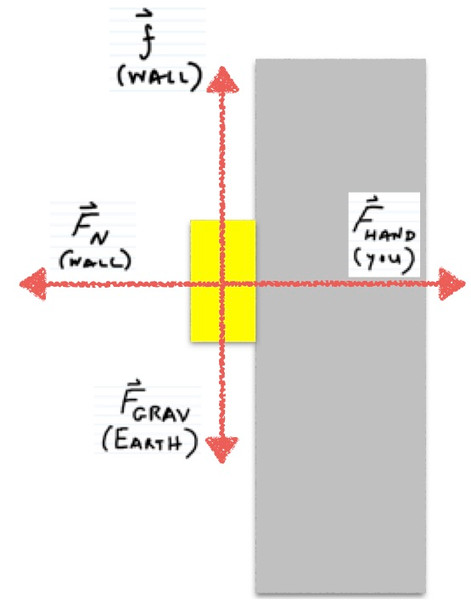
Free-body diagram of a box pressed against a wall
Each arrow in the picture acts on the box. The third-law partners to these forces act on other objects, like the wall or the Earth, so they would appear on different free-body diagrams. That’s the key.
A classic mistake is saying “normal force and weight are a third-law pair.” They are not. Both act on the same object. The third-law pair for weight is:
- Earth on object (gravity down)
- Object on Earth (gravity up)
On tests, always ask yourself: Which object is this force acting on? That question fixes most confusion.
Common interactions you should recognize quickly:
- Gravitational force (only long-range force in AP Physics 1)
- Normal force
- Tension
- Friction
- Applied forces
- Spring forces
2. Internal Forces and the Center of Mass
Now let’s zoom out and think about systems.
Internal vs. external forces
- Internal forces are forces objects inside the system exert on each other.
- External forces come from outside the system.
All internal forces come in third-law pairs.
Why internal forces don’t affect center of mass motion
Because internal forces are equal and opposite, they cancel when you look at the system as a whole.
That means internal forces:
- Can change how objects move relative to each other
- Cannot change the motion of the system’s center of mass
Only external forces can change:
- The velocity of the center of mass
- The total momentum of the system
Example: Two students on frictionless skateboards push off each other. They roll in opposite directions, but if you marked the system’s center of mass, it keeps moving exactly as it was before the push (unless an external force acts).
This idea shows up in conceptual questions where nothing external acts, and you’re expected to argue that the center of mass motion stays constant.
3. Tension in Strings, Cables, and Chains
Tension is a pulling force transmitted through a rope, cable, string, or chain.
It acts:
- Along the length of the object
- Away from the object it’s attached to
- As the result of many microscopic forces between neighboring segments
You can think of tension as a chain of third-law interactions passed along the string.
Ideal strings
An ideal string:
- Has negligible mass
- Does not stretch
- Has the same tension everywhere
Why uniform tension? If one part had more tension than another, that tiny massless segment would experience a net force and infinite acceleration. So tensions must match.
When solving problems:
- Use the same T everywhere in the same ideal string
- Even if it goes over an ideal pulley
Non-ideal (massive) strings
Real strings have mass.
In a hanging chain:
- The top supports the weight of everything below it
- The bottom supports almost nothing
So tension is larger at the top.
For AP Physics 1, you only need to describe this qualitatively. No calculus.
4. Ideal Pulleys
An ideal pulley:
- Has negligible mass
- Has negligible friction
- Rotates freely about its center
What it does:
- Changes the direction of tension
- Does not change its magnitude
Focus on the bottom diagram. The rope passes over a fixed pulley, and the tensions on both sides are labeled and .
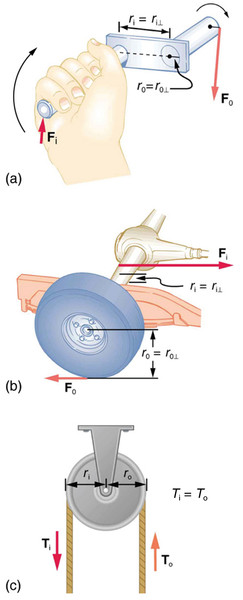
Ideal fixed pulley with equal tension on both sides
If the string is ideal, the tension is the same on both sides, so . The pulley changes the direction of the force but not its size.
When analyzing multi-object systems:
- Draw a separate FBD for each object.
- Use the same for all segments of the same ideal string.
- Apply Newton’s Second Law to each object individually.
5. Common Third-Law Traps
- Third-law pairs always act on different objects.
- The forces in a pair are the same type.
- Only gravitational forces act at a distance in AP Physics 1.
- Internal forces cannot change center of mass motion.
- In ideal strings and pulleys, tension stays uniform.
If something feels like it should “cancel,” check whether the forces are on the same object. That’s usually where students slip up.
