Topic 7.3 Notes – Representing and Analyzing SHM
1. What Simple Harmonic Motion Is
In simple harmonic motion, the net force always points toward equilibrium and grows in magnitude as you move farther away.
For a spring,
The negative sign means the force is opposite the displacement. Since , this gives
That proportional relationship is what makes the motion sinusoidal and periodic.
Core ideas and quantities
- Equilibrium position
Net force = 0. Displacement . - Displacement (x)
Position measured from equilibrium. Can be positive or negative. - Amplitude (A)
Maximum value of . The “edge” of the motion. - Period (T)
Time for one full cycle. - Frequency (f)
Cycles per second. - Angular frequency (ω)
Energy constantly shifts between kinetic and potential, but total energy stays constant in ideal SHM.
2. Displacement, Velocity, and Acceleration in SHM
All three are sinusoidal and locked together in a very specific way.
a. Displacement
- Use cosine if it starts at maximum displacement.
- Use sine if it starts at equilibrium.
- The choice depends only on initial conditions.
Key features:
- Maximums and minimums:
- Zeros: at equilibrium
- One cycle takes time
On a quiz, if they tell you “released from rest at maximum stretch,” that screams cosine.
b. Velocity
Velocity is the derivative of displacement.
If , then
Important facts:
- Velocity is zero at ±A
- Velocity is maximum at equilibrium
- Shifted by ¼ period from position
Physically, this makes sense. At the turning point, it stops before reversing direction.
c. Acceleration
From the restoring force:
So acceleration is directly proportional to negative displacement.
- Acceleration is zero at equilibrium
- Maximum magnitude at
- Always points toward equilibrium
- Shifted ½ period from displacement
Here’s the most testable snapshot idea:
| Location | x | v | a |
|---|---|---|---|
| Equilibrium | 0 | Maximum | 0 |
| Maximum displacement | ±A | 0 | Maximum toward center |
If you can fill in that table from memory, you understand SHM.
3. Amplitude and Period Relationships
One defining feature of SHM is that period does not depend on amplitude.
Bigger amplitude means:
- Larger maximum speed
- Larger maximum acceleration
- More total energy
But the period stays the same.
For common systems:
Mass-spring:
Simple pendulum (small angles only):
Notice what’s missing. No amplitude.
If an AP question says the amplitude doubles, your reflex should be: period unchanged.
4. Graphical Representations of SHM
A lot of exam questions give you graphs instead of equations. You should be able to read amplitude, period, velocity, and acceleration directly from them.
Position-time graph
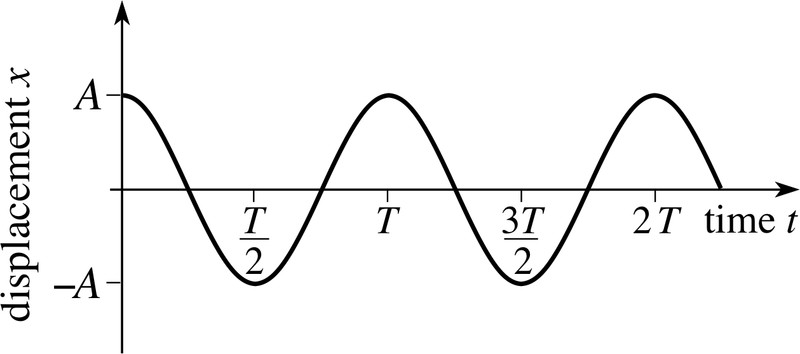
- Amplitude = peak height (±A on the graph)
- Period = time between peaks (for example, from one crest to the next at T and 2T)
- Slope at a point = velocity
Steepest slope happens at equilibrium, where the object is moving fastest.
Velocity-time graph
The middle curve in the figure below shows the velocity-time graph.
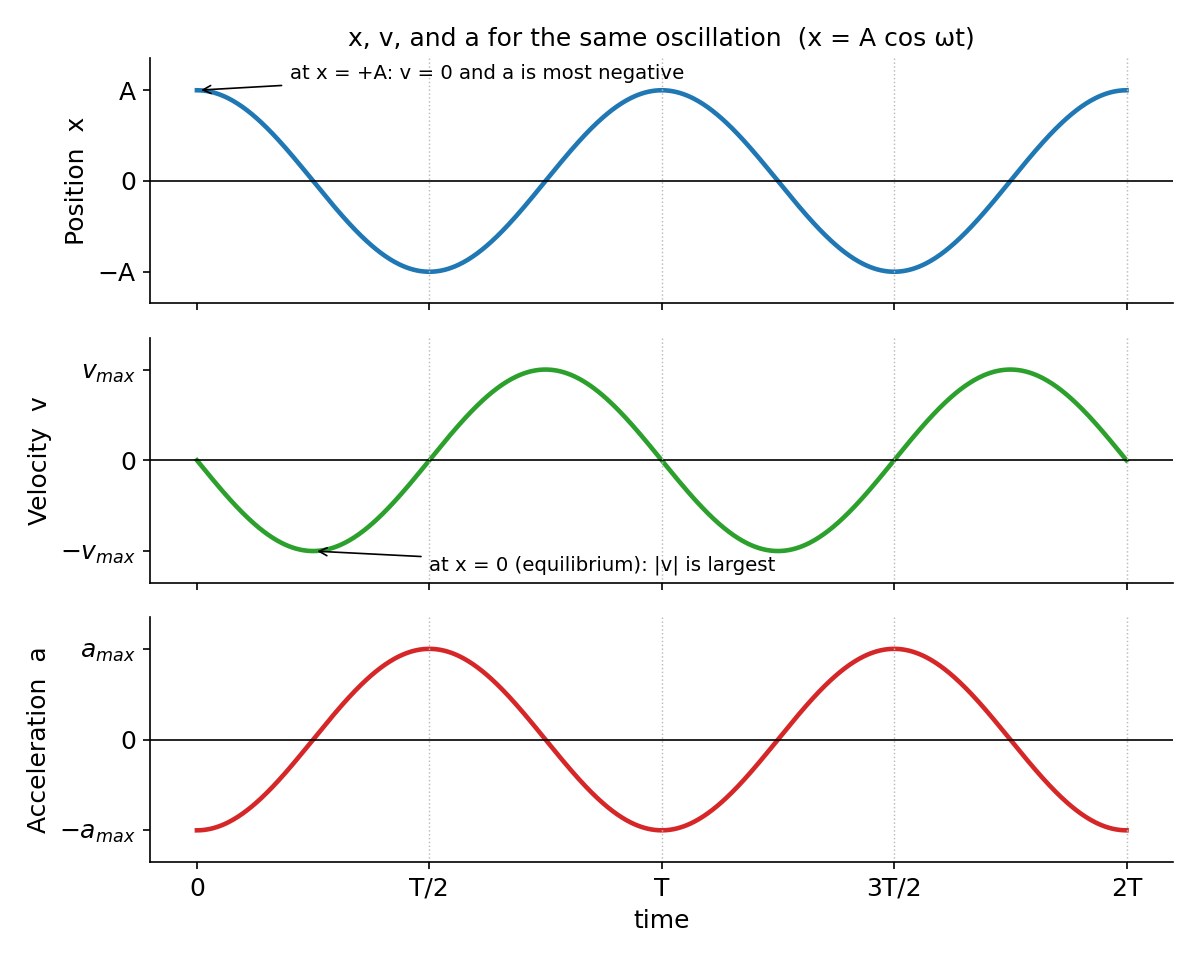
Position, velocity, and acceleration graphs for the same oscillation
- Zero when position is ±A
- Maximum at equilibrium
- Area under curve = displacement change
Acceleration-time graph
In the set below, focus on the acceleration graph.
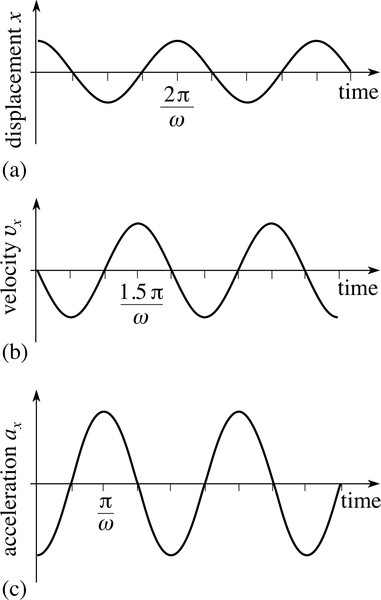
- Zero at equilibrium
- Maximum magnitude at ±A
- Opposite sign of displacement
Connecting them quickly
- Slope of x-t → velocity
- Slope of v-t → acceleration
- Zeros and peaks line up in predictable shifts
On FRQs, they often give one graph and ask you to sketch another. If you know where zeros and maximums must occur, you don’t need full equations to draw it correctly.
