Topic 2.6 Notes – Gravitational Force
1. Newton’s Law of Universal Gravitation
Gravity is a universal, attractive force between any two objects with mass.
The magnitude of that force is
- are the masses
- is the distance between their centers of mass
What this equation is saying
- Force is directly proportional to each mass
- Double one mass → doubles
- Double both → quadruples
- Force is inversely proportional to
- Double distance → force becomes as large
- Triple distance → force becomes
That inverse-square behavior is huge. Gravity drops off fast as distance increases.
Direction and where it acts
- Always attractive
- Always along the line connecting the centers of mass
- Can be treated as acting at each object’s center of mass
- Forces come in equal and opposite pairs (Newton’s 3rd law)
On FRQs, if they ask you to describe the gravitational interaction, mention both magnitude (inverse-square) and direction (along the line, attractive).
2. Gravitational Field and Weight
Instead of thinking about two objects pulling on each other, we often describe gravity using a field.
A field tells you what would happen to a small test object placed at some point in space.
Gravitational Field
By definition,
Units: N/kg, which is the same as m/s².
For a spherical mass :
Notice what’s missing. The test mass canceled out. That’s why all objects fall at the same rate in the same place.
If gravity is the only force acting,
That connection between N/kg and m/s² is something AP loves to test conceptually.
Weight
Weight is the gravitational force on an object.
- Mass (kg) is intrinsic.
- Weight (N) depends on the local gravitational field.
Near Earth’s surface, and is often treated as constant.
When can we treat gravity as constant?
When the change in distance from Earth’s center is tiny compared to Earth’s radius.
That’s true for:
- Projectiles
- Ramps
- Elevators
- Buildings
Not true for:
- Satellites
- Large altitude changes
If the force doesn’t change significantly over the motion, you’re allowed to treat it as constant.
3. Apparent Weight and Acceleration
Your apparent weight is not . It’s the normal force.
On a Flat Surface
At rest:
Scale reads true weight.
On an Incline
On a ramp, gravity still points straight down, but the normal force is perpendicular to the surface. Only the component of gravity perpendicular to the incline is balanced by the normal force.
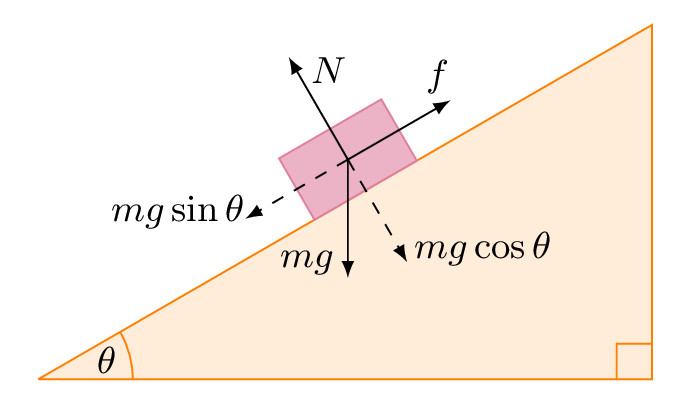
Free-body diagram of a block on an incline
In the diagram, is perpendicular to the surface and is parallel to it.
Since , you “weigh less” on a ramp.
In an Accelerating Elevator
Apply Newton’s 2nd law vertically.
- Accelerating upward:
You feel heavier.
- Accelerating downward:
You feel lighter.
If downward:
That’s weightlessness.
Students often forget to define a direction and write before plugging in. Always start with the free-body diagram.
Weightlessness
Weightless does not mean no gravity.
It means:
- No normal force, or
- Gravity is the only force acting (free fall)
Astronauts in orbit are constantly falling toward Earth, but moving sideways fast enough to miss it. No normal force → no apparent weight.
Equivalence Principle
If you’re in a closed box:
- You cannot tell whether you feel heavy because
- You’re in gravity, or
- The box is accelerating upward.
Acceleration and gravity are locally indistinguishable.
That idea connects directly to why is independent of mass.
4. Inertial Mass vs Gravitational Mass
These are conceptually different but experimentally equal.
Inertial Mass
Comes from Newton’s 2nd law:
Measures resistance to acceleration.
More inertial mass → harder to accelerate.
Gravitational Mass
Appears in:
Determines:
- How strongly an object creates gravity
- How strongly it responds to gravity
Why They Matter
Experiments show:
Because they’re equal, all objects fall with the same acceleration in a uniform field.
If those masses were different, heavier objects would fall differently than lighter ones.
That equality is the deep reason does not depend on mass.
