Topic 8.4 Notes – Fluids and Conservation Laws
1. Conservation of Mass in Fluid Flow
Fluids move because of a pressure difference. Higher pressure pushes fluid toward lower pressure. Once it’s flowing steadily in a completely filled pipe, mass cannot pile up anywhere.
That idea becomes conservation of mass.
Mass Flow Rate
The mass flow rate tells you how much mass passes a point each second:
- = density
- = cross-sectional area
- = speed
- Units → kg/s
For an incompressible fluid, is constant.
If the flow is steady, the mass entering a section each second equals the mass leaving.
Since cancels:
This is the continuity equation.
What It Physically Means
If area shrinks, speed must increase. If area increases, speed must decrease.
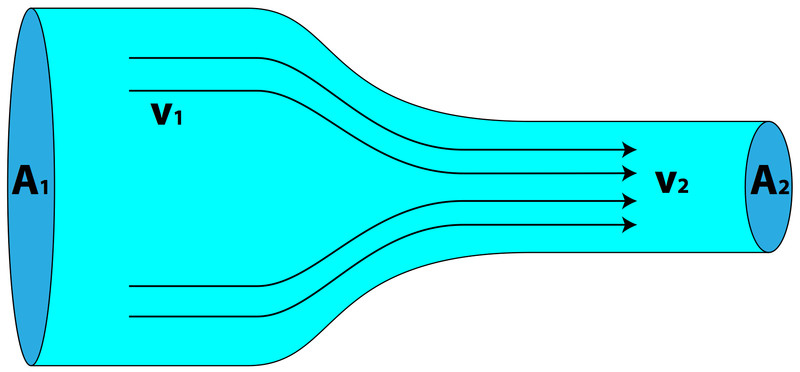
Continuity equation in a narrowing pipe
In the diagram, the wide section on the left has area and speed . The narrower section on the right has area and speed . Because the same amount of fluid must pass each section every second, the smaller area corresponds to a larger speed.
Quick reasoning example:
- Suppose a pipe’s diameter is cut in half.
- Area depends on radius squared.
- Area becomes one fourth as large.
- To keep constant, velocity becomes four times larger.
This shows up constantly in multiple choice. If they show a narrowing pipe, you should immediately think “speed increases.”
2. Mechanical Energy in a Flowing Fluid
Now shift from mass to energy.
Each small volume of fluid has three types of mechanical energy per unit volume:
- Pressure energy →
- Gravitational potential energy →
- Kinetic energy →
Think of it as energy stored in:
- compression (pressure),
- height,
- motion.
If one increases, another must decrease, assuming ideal flow.
For example:
- If fluid drops to a lower height, gravitational potential decreases.
- That energy must show up as higher speed and/or higher pressure.
3. Bernoulli’s Equation
Bernoulli’s equation is just conservation of mechanical energy applied to fluid flow:
You can use it when:
- Flow is steady
- Fluid is incompressible
- No viscosity (ideal)
- Points lie along the same streamline
What to Notice Immediately
Horizontal pipe?
If , the height terms cancel.
Then:
Now combine with continuity.
If the pipe narrows, like in the constricted section shown below:
- increases
- So increases
- Therefore pressure must decrease
This is the famous relationship:
Faster fluid → lower pressure
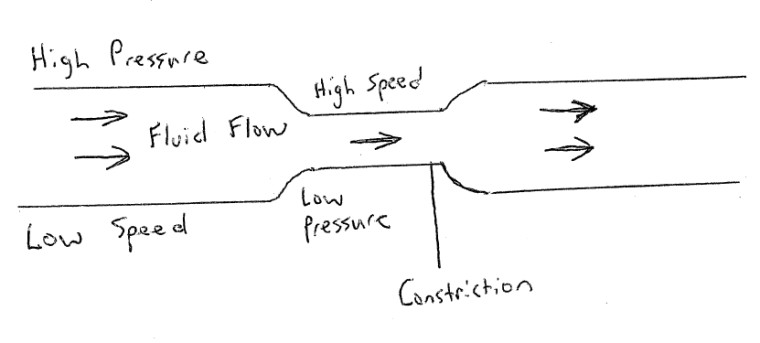
Venturi effect in a horizontal pipe
That’s how lift works on airplane wings and how Venturi tubes measure speed.
Problem Flow Strategy
When you see area change and pressure change:
- Use continuity to relate speeds.
- Plug speeds into Bernoulli.
- Solve for the unknown pressure or velocity.
Students often skip continuity and try to guess the new velocity. Don’t.
4. Torricelli’s Theorem
Now apply Bernoulli to a tank with a hole.
If a tank is open to the atmosphere and very wide, the surface speed is nearly zero. Using energy conservation between the top surface and the hole gives:
Where is the vertical distance from surface to hole.
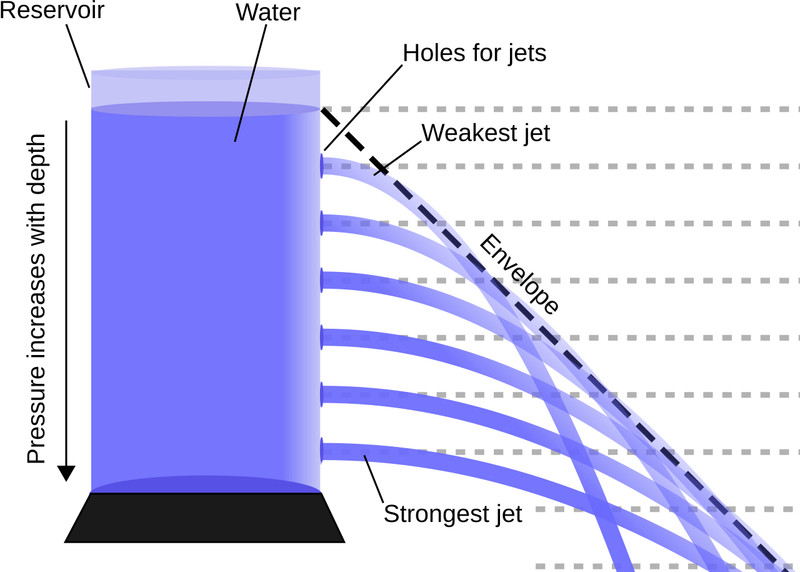
Water jets from holes at different depths
This is identical to the speed an object would have if dropped from height :
Mass cancels.
Important assumptions:
- Large tank so surface speed ≈ 0
- Hole open to atmosphere
- Ideal fluid
Deeper hole → larger → faster exit speed. That’s why the lower streams in the diagram travel farther horizontally.
On free response, they often ask you to explain why two holes at different depths produce different ranges. Your reasoning should mention gravitational potential energy converting into kinetic energy and use .
