Topic 2.2 Notes – Forces and Free-Body Diagrams
1. What a Force Is
A force is an interaction between two objects or systems. If you can’t name two objects, you don’t have a force.
- A force is a push or pull caused by another object.
- An object cannot exert a net force on itself.
- Every force involves a pair of objects.
Example: Earth pulls on a book (gravity). The table pushes on the book (normal force).
Some forces require contact, like friction or the normal force. These are contact forces, and they come from electric interactions between atoms at the surface. Others, like gravity, act at a distance.
Forces Are Vectors
Forces have:
- Magnitude (measured in newtons, N)
- Direction
We represent them with arrows. The net force is the vector sum of all forces acting on the object.
Forces Determine Acceleration
Newton’s Second Law connects force and motion:
- The direction of acceleration is the direction of the net force.
- Forces do not cause motion. They cause changes in motion.
If an object moves at constant velocity, its acceleration is zero, so .
2. Types of Forces You Must Recognize
You should be able to look at a situation and immediately identify which of these are present.
Gravitational Force (Weight)
- Symbol: or
- Direction: toward Earth’s center (down near the surface)
- Near Earth:
This acts even if the object is not moving.
Normal Force
- Support force from a surface
- Always perpendicular to the surface
- Does not automatically equal
On an incline or when extra forces push down, the normal force adjusts. Students often assume . That’s only true in specific cases.
Tension
- From a rope, string, or cable
- Pulls away from the object
- Acts along the rope
- In AP Physics 1, ropes are usually massless and pulleys frictionless → same tension throughout the rope.
Friction
- Contact force between surfaces
- Parallel to the surface
- Opposes motion or attempted motion
Conceptually:
- Static friction prevents slipping (can vary up to a maximum).
- Kinetic friction acts during sliding.
You won’t need detailed friction equations beyond basics, but you must recognize the direction correctly.
Applied Force
A push or pull by a person or object. Direction depends on the scenario.
Spring Force
A restoring force from a stretched or compressed spring.
Hooke’s Law (magnitude):
- = spring constant
- = displacement from equilibrium
- Direction is opposite displacement.
3. Newton’s Third Law and Force Pairs
Every interaction produces two forces:
- Equal magnitude
- Opposite direction
- Act on different objects
If a car pushes on a wall, the wall pushes back on the car.
They do not cancel because they act on different objects. Only forces on the same object can cancel in a free-body diagram.
Common trap:
The normal force and weight on a book are not a third-law pair. Both act on the book. The third-law partner of the book’s weight is the book pulling on Earth.
4. How to Draw a Free-Body Diagram
A free-body diagram (FBD) shows all external forces acting on one object.
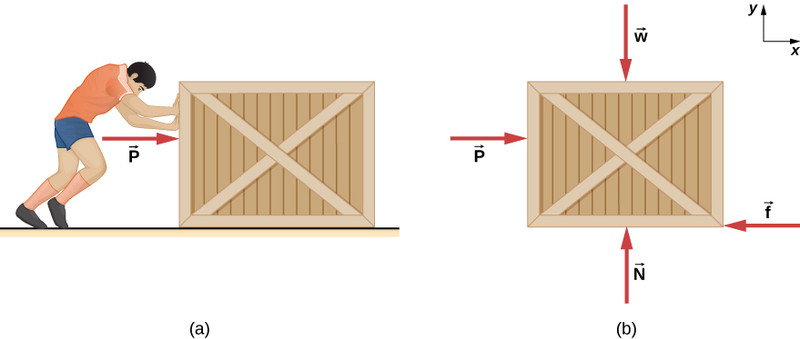
From real situation to free-body diagram (crate on a horizontal surface)
Focus on the right panel. The crate is isolated, and only the forces acting on the crate are shown.
What to Include
- Represent the object as a dot (center of mass).
- Draw each force as a straight arrow starting at the dot.
- Label every force clearly.
- Forces in the same direction must be drawn side by side, not overlapping.
- Include only forces acting on the object.
Do not draw components on the diagram. Break forces into components later in your equations.
Building an FBD Step-by-Step
- Choose the object.
- List all interacting objects (Earth, surface, rope, person).
- Draw one arrow per interaction.
- Label them.
- Choose axes.
Choosing a Coordinate System
Pick axes that simplify your math.
On an incline, isolate the block and choose axes that line up with the slope:
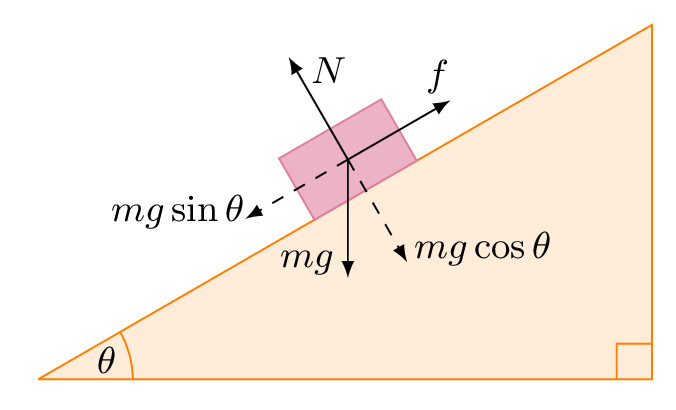
Free-body diagram for a block on an inclined plane
Align:
- -axis parallel to the incline
- -axis perpendicular
If acceleration is along the slope, this choice makes one equation much cleaner.
5. From Free-Body Diagram to Equations
Once the diagram is correct, the physics becomes algebra.
Break forces into components in your equations:
Treat directions separately.
Recognize patterns:
- At rest or constant velocity → .
- Acceleration only horizontally → vertical forces balance.
If your acceleration direction doesn’t match your net force direction, something is wrong in your FBD.
Everything in Unit 2 builds from this chain:
Interactions → Forces → Net force → Acceleration.
The free-body diagram is the bridge.
