Topic 2.8 Notes – Spring Forces
1. What an Ideal Spring Is
An ideal spring is a simplified model. Real springs aren’t perfect, but this model works extremely well for AP problems.
Negligible mass
We assume the spring’s mass is so small that:
- Its weight doesn’t affect the motion.
- We don’t include it in free-body diagrams.
- All the “action” is between the spring and the attached object.
If a block is attached to a spring, you only worry about forces on the block.
Linear force-displacement relationship
The defining feature is proportionality:
- Double the stretch → double the force.
- Triple the compression → triple the force.
That only works within the elastic limit. If you stretch a spring too far in real life, it won’t snap back properly. On the AP exam, assume it stays in the linear range unless told otherwise.
Relaxed length and displacement
Every spring has a relaxed (natural) length, where it exerts no force.
We define displacement as
Important habit: choose a positive direction first. Then determine whether is positive (stretched in the positive direction) or negative (compressed or stretched the opposite way).
2. Hooke’s Law
Hooke’s Law gives the force an ideal spring exerts on an object:
Where:
- = spring force (N)
- = spring constant (N/m)
- = displacement from relaxed length (m)
The spring constant
- Large → stiff spring → big force for small stretch.
- Small → soft spring.
- Units are N/m, which literally means “how many newtons per meter of stretch.”
Quick example:
If and ,
The magnitude is 30 N. The negative sign tells you direction.
The negative sign
That minus sign is everything.
It means the spring force is always opposite the displacement. The spring tries to bring the system back to equilibrium. That’s why we call it a restoring force.
In the figure below, focus on the cases where the block is displaced from .
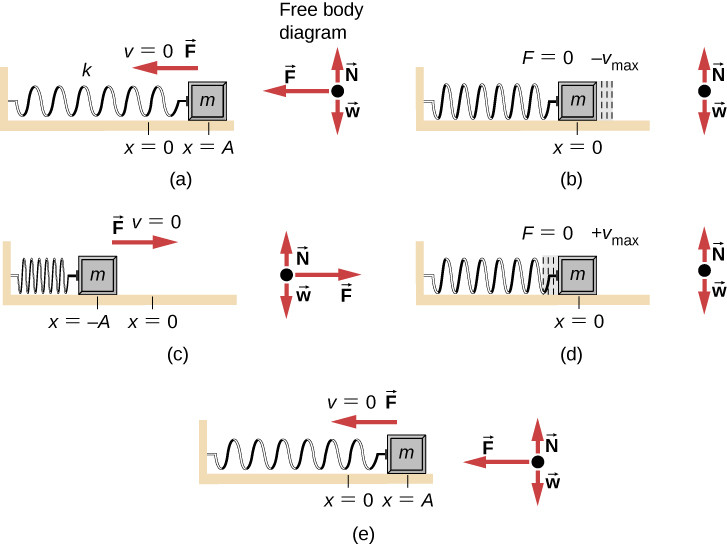
Mass-spring system showing restoring force direction
- Stretched to the right of equilibrium → spring force points left.
- Compressed to the left of equilibrium → spring force points right.
The force always points toward equilibrium.
3. Direction of the Spring Force
Think in terms of signs.
If the spring is stretched
- Suppose right is positive.
- .
- → force is negative.
- So the force points left, back toward equilibrium.
If the spring is compressed
- .
- The negative sign makes positive.
- Force points right, again toward equilibrium.
Let the equation handle direction. Don’t guess the sign after calculating.
A common mistake on quizzes is writing and then trying to manually assign direction. That usually leads to sign errors in Newton’s Second Law.
4. Spring Forces in Free-Body Diagrams
A spring force is treated like any other force in .
Horizontal surface
For a block attached to a wall:
- Spring force
- Normal force
- Weight
- Possibly friction
Only include the spring force along the axis of the spring.
Vertical spring (hanging mass)
If a mass hangs at rest:
- Upward force: spring force
- Downward force: weight
At equilibrium:
That tells you how much the spring stretches due to gravity.
Here’s how equilibrium compares to motion:
| Situation | Net Force | Motion |
|---|---|---|
| At equilibrium | 0 | Rest or constant velocity |
| Displaced from equilibrium | Nonzero (toward equilibrium) | Accelerates toward equilibrium |
Even if the object is moving through equilibrium, the net force there is zero at that instant.
5. Why Spring Forces Matter
Because the force depends on position, not velocity:
- Same displacement → same force.
- Speed doesn’t matter for the spring force.
This position-based restoring force is what leads to oscillations. Displace an object, release it, and the spring keeps pulling it back, causing back-and-forth motion. That becomes Simple Harmonic Motion later.
AP loves proportional reasoning here:
- If doubles → doubles.
- If doubles → doubles.
- If both double → force becomes four times as large.
Expect comparison questions where no numbers are given.
