Topic 6.4 Notes – Conservation of Angular Momentum
1. What Angular Momentum Is
Angular momentum measures how hard it is to stop or change rotational motion. It depends on both:
- How mass is distributed (moment of inertia )
- How fast it’s rotating (angular velocity )
For a rigid object rotating about a fixed axis:
- in kg·m²
- in rad/s
- Units of : kg·m²/s
For a particle moving in a circle (or passing by a pivot):
(when is perpendicular to the radius)
Angular momentum is a vector. Its direction follows the right-hand rule, same direction as .
Total Angular Momentum of a System
If you have more than one object:
Two rules matter a lot on tests:
- Every contribution must be calculated about the same axis.
- Both rotating objects and moving particles can contribute.
On FRQs, students often forget to include the angular momentum of an incoming particle before a collision. If it has mass, speed, and a distance from the axis, it contributes.
2. The Conservation of Angular Momentum
Here is the core statement:
If no net external torque acts on the system, total angular momentum stays constant.
This does not mean angular velocity stays constant.
Changing Shape with No External Torque
If the system changes shape, its moment of inertia changes. To keep constant:
- Mass moves inward → decreases → increases
- Mass moves outward → increases → decreases
Here’s the classic example of a figure skater pulling in her arms:
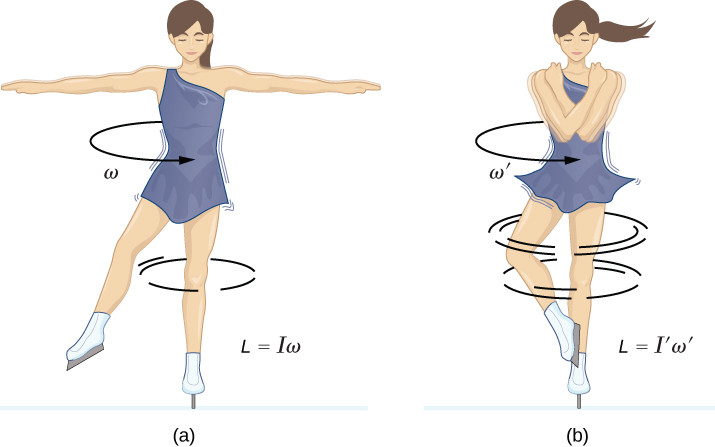
Figure skater demonstrating conservation of angular momentum
With arms extended, the skater has a larger moment of inertia and a smaller angular speed. When she pulls her arms inward, her moment of inertia decreases.
The skater spins faster not because of a torque, but because pulling arms inward decreases , so must increase to keep constant.
AP questions love asking for an explanation in words. A strong answer sounds like:
“As the mass moves closer to the axis, the moment of inertia decreases. Because no external torque acts, angular momentum is conserved, so the angular speed increases.”
3. Torque, Angular Impulse, and Changes in Angular Momentum
Angular momentum only changes if there is a net external torque.
The connection is:
Over a time interval:
That quantity is called angular impulse.
Two Situations
Zero external torque
- Angular momentum constant
Nonzero external torque
- Angular momentum changes
- The change equals the angular impulse
- Angular momentum is transferred between system and environment
This is rotational momentum’s version of .
4. System Selection Determines Whether L Is Conserved
Angular momentum is always conserved in the universe. The real question is whether it’s conserved for your chosen system.
Internal vs External Torques
If you include all interacting objects in your system:
- Internal torques come in equal and opposite pairs (Newton’s third law).
- Their angular impulses cancel.
- Total stays constant.
If you exclude one object:
- Its force becomes an external torque.
- Now your system’s angular momentum can change.
This idea shows up in paragraph questions. You might be asked why angular momentum is conserved in one case but not another. The difference is almost always system boundaries.
5. Angular Momentum in Collisions and Rotational Interactions
In collisions, angular momentum is conserved if there is no net external torque about the chosen axis.
A common setup is a small mass that strikes and sticks to a rod or pendulum that is free to rotate about a pivot, like the ballistic pendulum shown below.
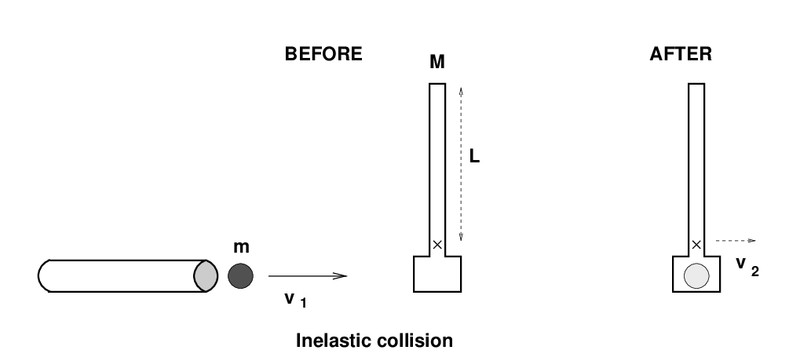
Inelastic collision with a pivoted rod
How to Solve These
- Choose an axis, often the pivot shown in the diagram.
- Compute initial angular momentum about that axis.
- For the incoming particle, , where is the perpendicular distance from the pivot to the particle’s line of motion.
- Compute the final moment of inertia of the combined system after the mass sticks.
- Apply .
- Solve for .
Energy is usually not conserved in these sticking collisions. Angular momentum still is, because the pivot force acts at the axis and produces zero torque about that point.
That last idea is a favorite conceptual multiple-choice trap.
