Topic 2.4 Notes – Newton’s First Law
1. What Newton’s First Law Says
Newton’s First Law (Law of Inertia):
If the net force on a system is zero, its velocity remains constant.
Constant velocity includes:
- Sitting still ()
- Moving in a straight line at constant speed
From Newton’s Second Law,
If , then .
No acceleration means no change in velocity.
Inertia
Inertia is the tendency of an object to resist changes in its motion.
- More mass → more inertia
- A heavy truck is harder to start or stop than a skateboard
- Inertia is not a force. It is a property of mass.
When a test question says an object “continues moving at constant speed,” your brain should immediately think: net force must be zero.
2. Net Force and Translational Equilibrium
Net force is a vector sum
The net force is the vector sum of all forces acting on a system.
Because forces are vectors:
- Same direction → add
- Opposite directions → subtract
- At angles → break into components
In this example, a box has three forces acting on it: 10 N to the right, 6 N to the left, and 4 N upward. First combine horizontal forces, then vertical forces.
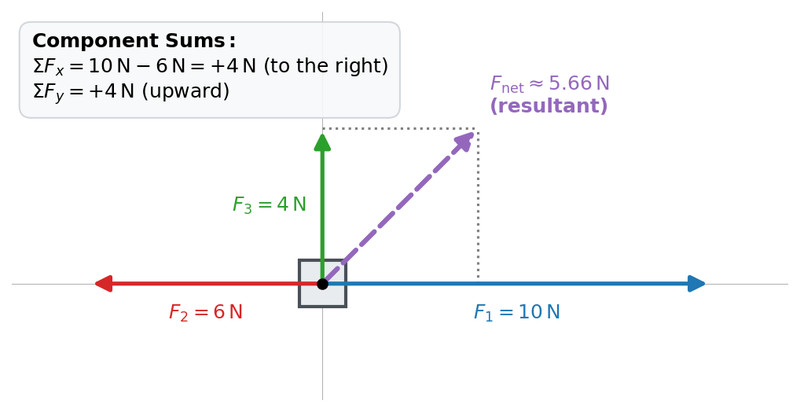
Vector addition using components
The diagram shows the horizontal forces combining to give a net of 4 N to the right, and the vertical forces giving 4 N upward. That produces a diagonal resultant force.
In AP Physics 1, you almost always analyze forces by components:
Treat each direction separately.
Translational equilibrium
A system is in translational equilibrium when:
That means:
- Velocity is constant
Two situations:
- Static equilibrium → object at rest
- Dynamic equilibrium → object moving at constant velocity
A puck sliding across nearly frictionless ice at steady speed is in dynamic equilibrium. Motion does not mean forces are unbalanced. Change in motion does.
On FRQs, you often earn points by explicitly stating:
“The net force is zero, so the acceleration is zero, therefore the velocity remains constant.”
3. Balanced vs Unbalanced Forces
Balanced forces
Balanced forces mean:
- No acceleration
- Velocity unchanged
Common example:
- Normal force up equals weight down
- Applied force forward equals friction backward (constant-speed motion)
Unbalanced forces
If:
- The object accelerates
- The acceleration points in the direction of the net force
If velocity changes, there must be a net force. That logic goes both ways.
Balanced in one direction, not another
Forces can cancel in one dimension but not the other.
Projectile motion is the classic example. In the diagram below, the projectile follows a parabolic path. The horizontal and vertical velocity components are shown at different points along the motion.
- → constant horizontal velocity
- → vertical acceleration downward
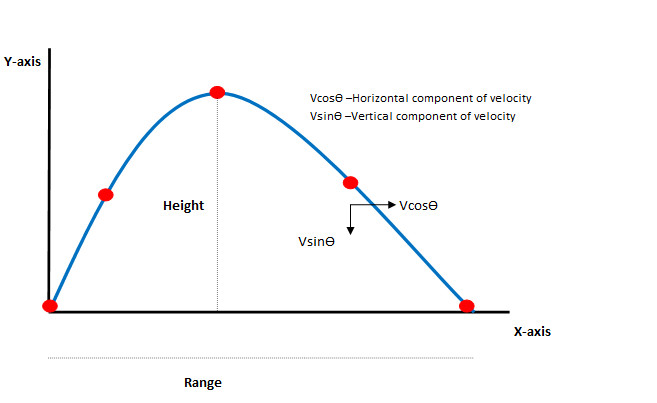
Projectile motion with horizontal and vertical velocity components
The key idea is that the horizontal component stays constant because there is no horizontal net force, and the vertical component changes because gravity acts downward.
This shows up constantly in multiple-choice questions. If horizontal velocity changes, you should immediately ask: what horizontal force is acting?
4. Inertial Reference Frames
An inertial reference frame is one where Newton’s First Law works as stated.
In these frames:
- If , velocity stays constant.
Examples:
- A lab table at rest
- A car moving at constant velocity
A non-inertial frame is accelerating. Inside a turning car, you feel “pushed” sideways. That effect appears because the frame is accelerating.
For AP Physics 1, treat Earth as approximately inertial unless the problem clearly involves acceleration of the frame (like an accelerating elevator).
5. Conditions for Constant Velocity
Velocity remains constant when:
- The net force is zero.
- Forces balance in every dimension.
- The motion is observed from an inertial reference frame.
If any component of net force is nonzero, velocity changes in that direction only.
