Topic 4.3 Notes – Conservation of Linear Momentum
1. Total Momentum of a System
Momentum of one object
Momentum measures how hard it is to stop something.
- Vector quantity → direction matters.
- In 1D: use + and − signs.
- In 2D: break into and components.
- Units:
A 2 kg cart moving right at 3 m/s has . If it moves left at 3 m/s, momentum is −6.
Total momentum
For a system of objects,
You are adding vectors, not just numbers.
- In 1D → add with signs.
- In 2D → add components separately.
- Think of multiple objects as one big system with one total momentum.
Even if objects collide and bounce, the system’s total momentum can stay constant.
Center-of-mass velocity
The whole system can be described as if all the mass were concentrated at one point moving with velocity:
Since , you can also write:
This is powerful. It says the system moves as if it were a single object.
If the net external force is zero, then:
- is constant
- is constant
That means even during an explosion, the center of mass keeps moving at the same velocity.
2. Conservation of Momentum
The core rule
If the net external force on a system is zero, then:
This works for all interactions when the system is chosen correctly.
Why this works
Newton’s 3rd law says forces between two objects are equal and opposite.
Equal forces over the same time → equal and opposite impulses.
So inside a system:
- One object gains momentum.
- Another loses the same amount.
- Total momentum does not change.
If total momentum does change, something external caused it.
Momentum and impulse
Impulse-momentum theorem:
- If external impulse = 0 → momentum constant.
- If momentum changes → there was a net external impulse.
Momentum is always conserved in the universe. Whether it’s conserved in your problem depends on how you define the system.
3. Choosing the System
This is where AP questions get interesting.
Zero net external force
Then momentum stays constant.
Common setups:
- Two skaters pushing off
- Collision on a frictionless surface
- Explosion in space
If friction is negligible during a short collision, you can treat external forces as zero during that time.
Nonzero net external force
Then momentum changes.
Examples:
- A ball bouncing off the ground (ground is external).
- A sliding block slowed by friction.
The external force transfers momentum between the system and surroundings.
If you include the Earth in your system, that “external” force can become internal. System choice matters.
When solving problems, always ask: What objects should I include so external forces are zero or negligible?
4. Collisions and Explosions
Momentum conservation applies immediately before and immediately after the interaction.
General 1D setup
- Define the system
- Write total initial momentum
- Write total final momentum
- Set them equal
- Solve
Keep track of signs.
Completely inelastic collisions
- Objects stick together.
- Share one final velocity.
- Momentum conserved.
- Kinetic energy is not conserved.
Elastic vs inelastic
| Type | Momentum | Kinetic Energy |
|---|---|---|
| Elastic | Conserved | Conserved |
| Inelastic | Conserved | Not conserved |
| Completely inelastic | Conserved | Not conserved (objects stick) |
In AP Physics 1, momentum is the priority. Only use kinetic energy conservation if explicitly told it’s elastic.
Explosions
Often start from rest, so initial momentum is zero.
After explosion:
- Total momentum must still be zero.
- Pieces move in opposite directions.
- Larger mass → smaller speed (because ).
Two-dimensional collisions
Momentum is conserved in each direction separately:
The diagram below shows a typical 2D collision. One object initially moves along the x-direction toward a stationary object. After the collision, both objects move off at angles, so you must conserve momentum in both x and y.
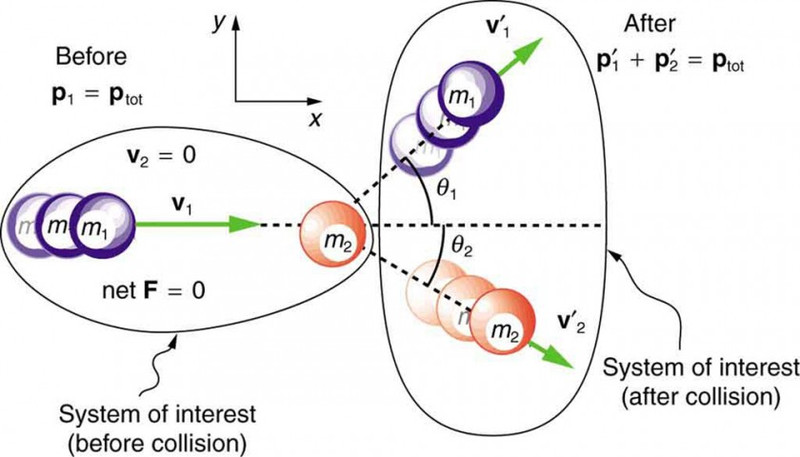
Two-dimensional collision with momentum conserved in x and y
You usually just need to set up the equations correctly and reason about how changing a mass or angle affects results, not grind through heavy algebra.
5. Center of Mass During Interactions
Internal interactions do not change total momentum.
So if net external force = 0:
- stays constant
- Even if objects move wildly relative to each other
This gives great shortcuts:
- Explosion from rest → center of mass stays at rest.
- Two objects push off from rest → equal and opposite total momentum.
- If your answer makes the center of mass suddenly change velocity with no external force, something is wrong.
