Topic 8.3 Notes – Fluids and Newton’s Laws
1. Fluids Obey Newton’s Laws
A fluid is any substance that flows, meaning its particles can move past one another. That includes liquids and gases.
Even though a fluid looks continuous, it’s made of particles. Each particle obeys:
- Newton’s 1st Law
If the net force on a fluid particle is zero, it moves at constant velocity (which could be zero). - Newton’s 2nd Law
A fluid particle accelerates only if there is a nonzero net force. - Newton’s 3rd Law
Fluid particles push on objects, and objects push back on the fluid with equal and opposite force.
Here’s the big picture idea:
A fluid’s velocity changes only when a net external force acts on it.
If a region of fluid is moving at constant speed in a straight line, the forces on that chunk must balance.
Microscopic → Macroscopic
The flowing patterns you see (currents, wind, water moving in a pipe) come from:
- Internal particle collisions
- Forces between particles
- External forces like gravity or pressure differences
The macroscopic behavior of a fluid is just millions of particles following Newton’s laws at the same time.
2. What Causes a Fluid’s Velocity to Change
Think about a small “chunk” of fluid and draw a free-body diagram for it. The same logic you use for blocks works here.
Pressure Differences
Pressure is force per area caused by particle collisions.
If pressure is higher on one side of a fluid element than the other, there is a net force.
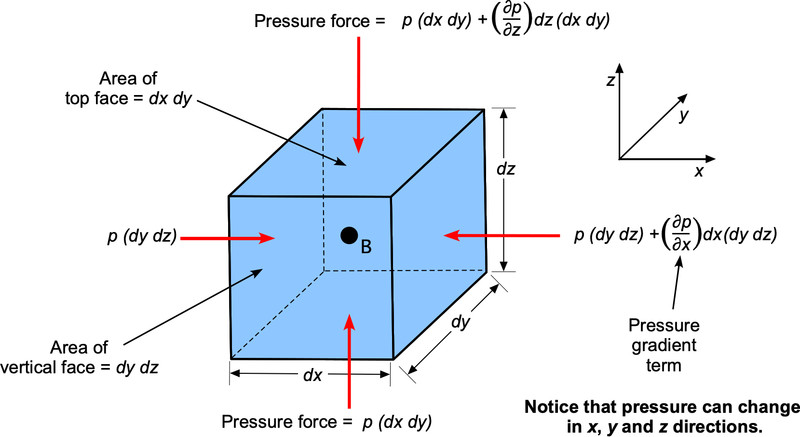
Pressure forces on a small fluid element
- Net force points from high pressure to low pressure.
- The fluid accelerates in that direction.
- No pressure difference → no acceleration.
This is why:
- Air moves from high- to low-pressure regions (wind).
- Fluid speeds up when pushed by a pressure gradient.
If velocity is changing, look for a pressure difference.
Gravity
Gravity pulls downward on fluid particles.
- It creates increasing pressure with depth.
- If not balanced, it can cause vertical acceleration.
In many situations (like water sitting in a container), gravity is balanced by pressure forces, so the fluid is at rest.
Drag and Resistive Forces
When an object moves through a fluid, or fluid moves past an object:
- The fluid exerts a drag force opposite motion.
- Drag increases with speed.
Eventually, drag can balance other forces. Then:
- Net force = 0
- Acceleration = 0
- Motion at terminal velocity
That’s just Newton’s 2nd Law applied carefully.
3. The Buoyant Force
What It Is
The buoyant force is a net upward force a fluid exerts on an immersed object.
It happens because pressure increases with depth.
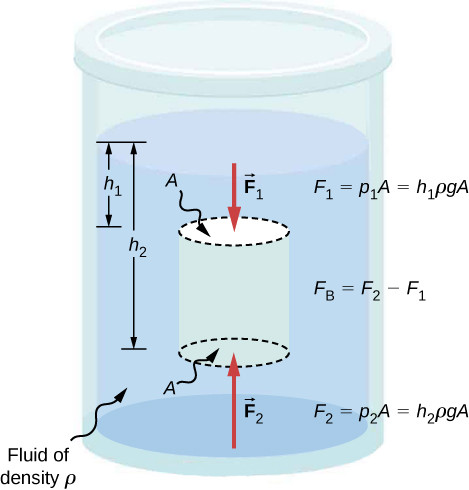
Pressure forces on a submerged object
- Top surface → lower pressure, smaller downward force
- Bottom surface → higher pressure, larger upward force
- Result → net upward force
Microscopic View
Fluid particles collide with every surface of the object.
- Each collision produces a tiny force.
- Add them all up over the surface.
- The sum is the buoyant force.
This explains why buoyancy works for any shape.
Archimedes’ Principle
The magnitude of the buoyant force is:
- = density of fluid
- = volume of displaced fluid
- = gravitational acceleration
Important: The buoyant force equals the weight of the displaced fluid, not the weight of the object.
On FRQs, students often forget to clearly say “weight of displaced fluid.” That phrase matters.
4. Floating, Sinking, and Equilibrium
Now apply Newton’s 2nd Law to the object.
Floating at Rest
If floating:
Since ,
So:
- → floats
- → neutrally buoyant
- → sinks
Notice density determines behavior.
Accelerating Up or Down
Use:
If:
- → accelerates up
- → accelerates down
Same structure as any forces problem.
Terminal Velocity in a Fluid
For a falling object in a fluid:
- Weight (down)
- Buoyant force (up)
- Drag (opposes motion)
At terminal speed:
Net force is zero, so speed is constant.
If you see “constant speed” in a problem, your brain should immediately think net force = 0.
