Topic 4.4 Notes – Elastic and Inelastic Collisions
1. What Makes a Collision Elastic or Inelastic
A collision is a short interaction where objects exert large forces on each other for a small amount of time. We analyze it by defining a system that includes all colliding objects.
Two key quantities:
- Momentum
- Vector quantity
- Conserved in an isolated system (no net external impulse)
- Kinetic Energy
- Scalar quantity
- May or may not be conserved
The Classification Rule
Elastic collision
- Total kinetic energy of the system is the same before and after.
- Momentum is also conserved.
- Individual objects’ kinetic energies can change.
Inelastic collision
- Total kinetic energy decreases.
- Momentum is still conserved.
- Some kinetic energy is transformed into other forms.
The whole decision comes down to this:
Momentum is always conserved (isolated system). Kinetic energy tells you the type.
2. Types of Collisions
a. Elastic Collisions
In an elastic collision, the system’s total kinetic energy is unchanged.
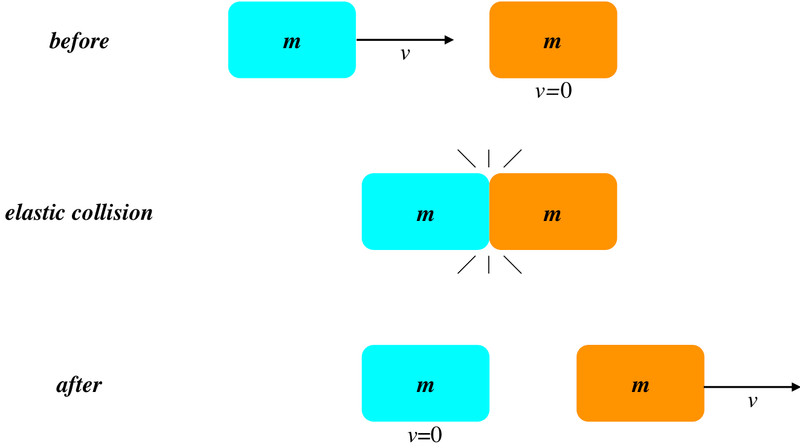
Elastic collision between equal masses
In the example above, two identical masses collide head-on. The incoming block stops and the other block leaves with the same speed. That velocity swap is a classic elastic result for equal masses.
A pattern you should recognize:
- Identical masses, head-on
- They exchange velocities.
- Light object hits heavy object
- Light object rebounds with large speed.
- Heavy object hits light object
- Heavy object barely changes velocity.
Important idea that shows up in explanations:
Even though total KE stays the same, each object’s KE can change. Energy transfers between them.
On FRQs, you may be asked to explain this in words. A good sentence sounds like:
“The system’s total kinetic energy is conserved, but kinetic energy is redistributed between the objects due to the interaction forces.”
b. Inelastic Collisions
In an inelastic collision, total kinetic energy decreases.
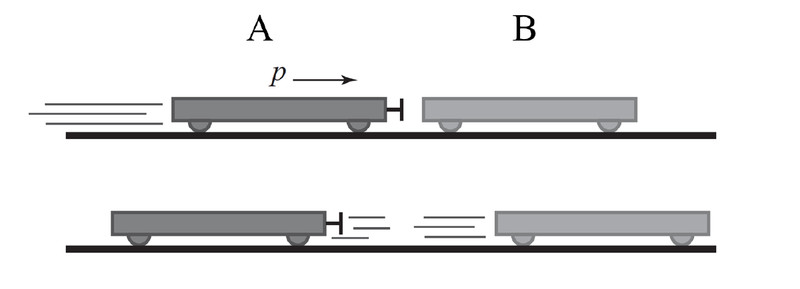
Cart collision on a horizontal track
The carts interact and then move away after the collision. In an inelastic case, their total momentum is still conserved, but the total kinetic energy after the collision is smaller than before.
Momentum is still conserved, but some kinetic energy transforms into:
- Thermal energy (internal friction)
- Sound
- Deformation (bending, denting)
- Vibrations inside materials
Energy is never destroyed. It simply leaves the system as mechanical kinetic energy and becomes other forms due to nonconservative forces during impact.
Most real-world collisions are at least somewhat inelastic.
c. Perfectly Inelastic Collisions
This is a special case of inelastic collisions.
Definition: The objects stick together and move with the same final velocity.
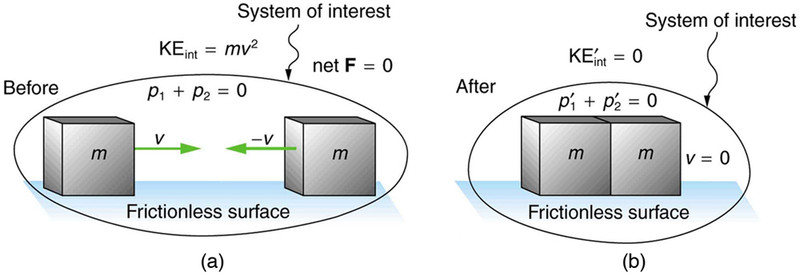
Perfectly inelastic collision on a frictionless surface
The diagram shows two equal masses moving toward each other and sticking together. After the collision they move as a single object, here with zero velocity because their initial momenta cancel.
Key features:
- Maximum possible kinetic energy loss (for given initial conditions).
- Momentum conservation alone determines final velocity:
Since they share one velocity after impact, you only solve for one unknown.
Common examples:
- A lump of clay hitting a cart and sticking
- Two train cars coupling
- A meteor embedding in the ground
On tests, if the problem says “stick together,” you immediately know it’s perfectly inelastic.
3. How to Analyze Collision Problems
Here’s the logical flow you should follow.
- Define the system
Include all colliding objects. Assume external forces are negligible during the short collision time. - Conserve momentum
In 1D, assign signs carefully. In 2D, conserve x and y separately. - Decide the type
- Elastic → also conserve kinetic energy.
- Perfectly inelastic → shared final velocity.
- Inelastic (general) → do not set KE equal.
Students lose points when they automatically conserve KE without checking the collision type. Only do that if the problem states or clearly implies “elastic.”
4. What Happens to the “Lost” Kinetic Energy
When kinetic energy decreases, nonconservative forces act during impact.
Energy can become:
- Microscopic random motion (thermal)
- Internal potential energy in bent materials
- Sound waves
- Permanent structural changes
Total energy of the universe is conserved.
Only the system’s mechanical kinetic energy decreases.
On conceptual questions, explain it this way:
“The decrease in kinetic energy corresponds to an increase in internal and thermal energy due to deformation and friction during the collision.”
5. High-Yield Comparison
| Feature | Elastic | Inelastic | Perfectly Inelastic |
|---|---|---|---|
| Momentum conserved? | Yes | Yes | Yes |
| Total KE conserved? | Yes | No | No |
| Objects stick? | No | No | Yes |
| KE transformed? | No | Yes | Maximum amount |
