Topic 4.1 Notes – Linear Momentum
1. What Linear Momentum Is
Definition
Linear momentum is defined as
- = momentum (vector)
- = mass (scalar)
- = velocity (vector)
- Units: kg·m/s
Momentum depends directly on both mass and velocity. If either one doubles, momentum doubles.
A 0.1 kg baseball at 30 m/s and a 3 kg bowling ball at 1 m/s can have comparable momentum. Different mass, different speed, same idea: how hard it is to stop.
What It Physically Represents
Momentum is often described as the “quantity of motion.” In practical terms:
- Larger mass → harder to stop
- Larger velocity → harder to stop
- Zero velocity → zero momentum
On free-response questions, when asked to describe momentum, say that it depends on both mass and velocity and has direction.
Momentum Is a Vector
Momentum points in the same direction as velocity.
In 1D:
- You choose positive (usually right or up).
- Left or down becomes negative.
In 2D:
You must track components separately. A sign mistake here ruins the whole problem.
2. Momentum of a System
Total Momentum
For multiple objects, total momentum is the vector sum:
In 2D, add x-components together and y-components together.
Here’s what that looks like conceptually. One object moves horizontally and another vertically, and their momentum components combine to form a single diagonal total momentum vector:
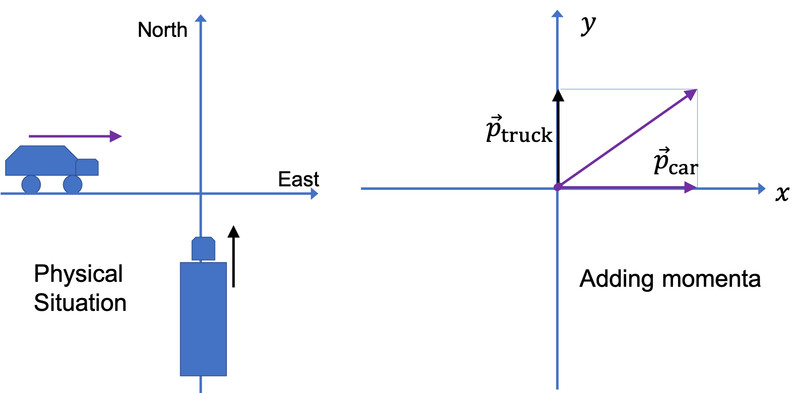
Vector addition of momentum components in two dimensions
The total momentum vector comes from combining those components.
Object Model for Interactions
During collisions or explosions:
- We only care about initial state and final state.
- We treat objects as particles.
- We do not calculate the complicated forces during impact.
That’s powerful. You skip all the messy force details.
When Momentum Analysis Works Best
Momentum conservation works when:
- Interaction time is short.
- Internal forces are much larger than external forces.
- The system is effectively isolated (net external force ≈ 0 during interaction).
This is why collisions are modeled this way.
3. Collisions
What a Collision Is
A collision is an interaction where:
- Objects exert large forces on each other.
- The interaction happens quickly.
- External forces are negligible compared to interaction forces.
Even a brief bump counts.
Conservation of Momentum
If the system is isolated:
Momentum is conserved in all types of collisions (as long as the system is isolated). Kinetic energy is a separate question.
Types of Collisions
| Type | Momentum | Kinetic Energy | What Happens |
|---|---|---|---|
| Elastic | Conserved | Conserved | Objects bounce, no lasting deformation |
| Inelastic | Conserved | Not conserved | Some KE → heat, sound, deformation |
| Completely Inelastic | Conserved | Not conserved (max loss) | Objects stick together |
For completely inelastic collisions:
If they stick, they share a final velocity.
How to Solve Collision Problems
- Define the system.
- Choose positive direction.
- Write total initial momentum.
- Write total final momentum.
- Set them equal.
- Solve algebraically.
- Check signs and units.
If your final velocity comes out negative, that just means opposite your chosen direction.
4. Explosions
What an Explosion Is
An explosion is the reverse of a collision:
- One object separates into pieces.
- Internal forces push parts apart.
- External forces are negligible.
Internal Forces and Momentum
Internal forces cannot change total system momentum.
If the object starts at rest:
So after the explosion:
That means momenta balance in opposite directions. In the example below, the bomb starts at rest and the fragments fly off in different directions, but their momentum vectors add tip to tail to form a closed shape. The vector sum is zero.
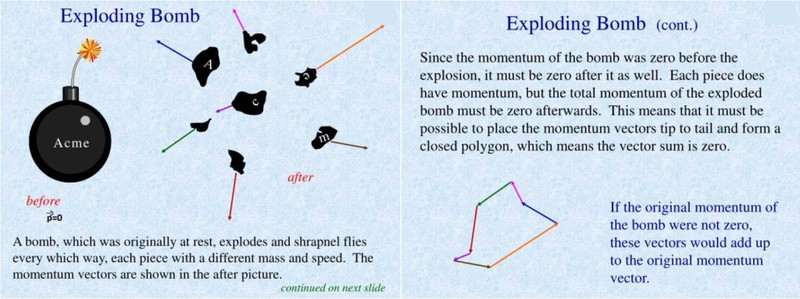
Momentum vectors after an explosion from rest
Heavier fragment → smaller velocity. Lighter fragment → larger velocity. Momentum must balance.
Solving Explosion Problems
- Write initial total momentum (often zero).
- Assign directions and signs.
- Write momentum of each piece.
- Set total final momentum equal to initial.
- Solve for unknown velocity.
Kinetic energy can increase in explosions. Momentum still stays constant.
