Topic 3.4 Notes – Conservation of Energy
1. What Energy Is and Why It’s Conserved
Energy is the ability of a system to do work or cause change.
The big rule is conservation of energy. Energy cannot be created or destroyed. It can only:
- Change form (kinetic → potential, mechanical → thermal, etc.)
- Transfer between system and surroundings
Globally, the total energy of the universe is constant.
In this course, you mainly track:
- Kinetic energy (KE)
- Potential energy (PE)
- Their sum, called mechanical energy (ME)
Whether energy is “conserved” in a problem depends on:
- What system you choose
- Whether forces are conservative or nonconservative
- Whether energy crosses the system boundary
That system choice idea becomes huge later.
2. Types of Energy in a System
Kinetic Energy
Kinetic energy is energy of motion.
Key things to remember:
- Scalar and always ≥ 0
- Depends linearly on mass
- Depends on the square of velocity
- Double → 4× KE
- Double → 2× KE
Important rule:
If your system contains only one object, it can only have kinetic energy. No interactions, no potential energy.
Gravitational Potential Energy (near Earth)
- Comes from vertical position in a gravitational field
- You choose where
- Exists only if your system includes object + Earth
Change the reference height and the number changes, but the physics does not. Only changes in PE matter.
Elastic Potential Energy (spring)
- is displacement from equilibrium
- Stored in a stretched or compressed spring
- Exists only if the system includes object + spring
Mechanical Energy
A system can have both KE and PE if:
- Objects interact via conservative forces (gravity, springs), or
- It can reversibly change shape (ideal spring).
3. Conservative vs Nonconservative Forces
Conservative Forces
Examples:
- Gravity
- Spring force
Properties:
- Work depends only on initial and final position
- Work around a closed loop equals zero
- Associated with potential energy
- Allow KE ↔ PE conversion with no loss
If only conservative forces act within the system, mechanical energy stays constant.
A classic example is a roller coaster moving along a frictionless track:
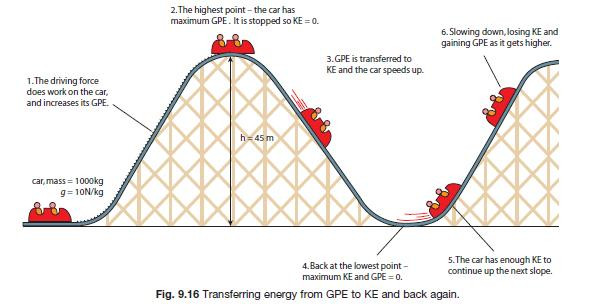
Conversion between gravitational potential energy and kinetic energy
At the top, gravitational potential energy is largest and kinetic energy is smallest. As the car descends, PE decreases and KE increases. At the lowest point, KE is maximum. On the way back up, KE converts back into PE.
Energy shifts between KE and PE, but the total mechanical energy stays the same.
Nonconservative Forces
Examples:
- Friction
- Air resistance
These convert mechanical energy into:
- Thermal energy
- Sound
- Deformation
Mechanical energy decreases, but total energy is still conserved. The “missing” energy changed form.
The AP expects you to explicitly say that friction can dissipate mechanical energy as thermal energy or sound.
4. Conservation of Mechanical Energy
When Mechanical Energy Is Constant
If:
- No external work is done on the system, and
- No nonconservative forces act within it
Then:
Common cases:
- Free fall (no air resistance)
- Frictionless ramp
- Ideal pendulum
- Ideal mass-spring system
Energy bookkeeping idea:
- Decrease in PE = increase in KE
- Increase in KE must come from somewhere
On tests, you’ll often solve for speed without forces at all. That’s your signal to use energy.
When Mechanical Energy Changes
If mechanical energy changes, then:
- Energy crossed the system boundary, or
- Nonconservative forces acted inside the system
Energy rule:
- Positive work on system → energy increases
- Negative work → energy decreases
If total energy of a system changes, that change equals the energy transferred in or out.
5. How System Choice Affects Energy Conservation
This is where students lose points.
Energy Is Always Conserved
Even if mechanical energy decreases, total energy is conserved. Nothing vanishes.
System Selection Changes the Story
Consider a falling ball.
System = ball + Earth
- Gravity is internal
- Mechanical energy is constant
System = ball only
- Gravity does external work
- Ball’s energy changes
Same physics. Different bookkeeping.
If work done on the chosen system is zero and there are no nonconservative forces inside it, mechanical energy is constant.
If work on the system is nonzero, energy transfers between system and surroundings.
On written responses, you must say:
- What your system is
- Whether forces are internal or external
- Where energy is transferred
That explanation is often worth more than the equation.
